Q.Which of the following is the most stable complex species? (A) (B) (C) (D)
You're viewing a preview — the full solution, concept, methods & PYQ mapping are locked.
Start your 14-day free trial to unlock the full solution →The stability of a complex is primarily determined by the nature of the ligand (denticity and field strength) and the oxidation state of the central metal. Metal carbonyls, like , exhibit exceptional stability due to synergistic bonding and often obey the 18-electron rule. The most stable complex species is (C) .
The stability of a complex species refers to its tendency to remain intact in solution or under various conditions. Several factors influence this stability, primarily the nature of the ligand and the central metal ion. We will analyze each option based on these factors.
Concept and Intuition: Factors Affecting Complex Stability
The stability of a coordination complex is governed by the strength of the metal-ligand bonds. This strength is influenced by:
-
Nature of the Ligand:
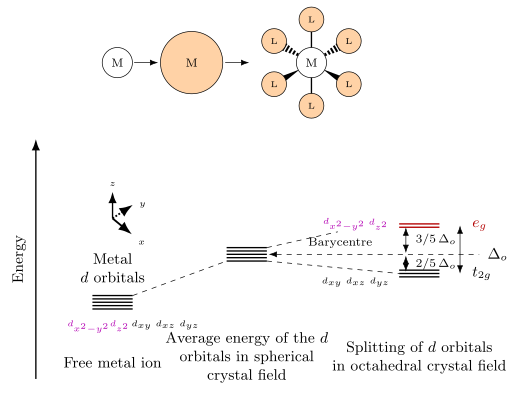
- Ligand Field Strength: Strong field ligands (e.g., , ) cause a larger crystal field splitting and generally form more stable complexes than weak field ligands (e.g., ). This is because stronger interactions lead to more energy required to break the bonds.
- Chelate Effect: Polydentate (chelating) ligands, which bind to the metal ion through multiple donor atoms, form significantly more stable complexes than monodentate ligands. This enhanced stability, known as the chelate effect, is primarily an entropic effect. When a chelating ligand replaces several monodentate ligands, the number of species in solution often increases, leading to a favorable increase in entropy. For example, replacing two monodentate ligands with one bidentate ligand increases the number of free species.
-
Nature of the Central Metal Ion:
- Oxidation State: Generally, a higher positive oxidation state of the metal ion leads to greater stability. A higher positive charge on the metal ion results in stronger electrostatic attraction between the metal and the electron-donating ligands.
- Size: Smaller metal ions tend to form more stable complexes due to higher charge density, leading to stronger electrostatic interactions.
- Electronic Configuration: The -electron configuration can also play a role, especially in terms of crystal field stabilization energy (CFSE).
-
Synergistic Bonding (for Metal Carbonyls): In metal carbonyls, a unique type of bonding occurs where the ligand (CO) donates electrons to the metal (sigma bond) and the metal simultaneously donates electrons back to the ligand's empty antibonding orbitals (pi back-bond). This synergistic bonding greatly strengthens the metal-ligand bond, leading to exceptionally stable complexes. Many stable metal carbonyls also obey the 18-electron rule, which is a good indicator of kinetic stability.
Let's apply these concepts to the given options.
Step-by-Step Analysis
-
Identify the central metal ion and its oxidation state in each complex.
- (A) : The central metal is Iron (Fe). Oxalate () is a bidentate ligand with a charge. Let the oxidation state of Fe be . . So, the metal ion is .
- (B) : The central metal is Iron (Fe). Cyanide () is a monodentate ligand with a charge. Let the oxidation state of Fe be . . So, the metal ion is .
- (C) : The central metal is Iron (Fe). Carbonyl () is a neutral monodentate ligand. Let the oxidation state of Fe be . . So, the metal is in the zero oxidation state, .
- (D) : The central metal is Iron (Fe). Water () is a neutral monodentate ligand. Let the oxidation state of Fe be . . So, the metal ion is .
-
Compare the ligands based on their denticity and field strength.
- Denticity:
- (oxalate) is a bidentate ligand. It forms a chelate ring.
- (cyanide) is a monodentate ligand.
- (carbonyl) is a monodentate ligand.
- (aqua) is a monodentate ligand.
- Ligand Field Strength (from the spectrochemical series, weakest to strongest):
- is a weak field ligand.
- is a moderately strong field ligand.
- is a strong field ligand.
- is a very strong field ligand.
- Denticity:
-
Evaluate the stability of each complex. …
Unlock everything free for 14 days
- Full step-by-step solutions
- Concept-first explanations
- Methods, shortcuts & mistakes
- PYQ mapping + timed mock tests
Full access for 14 days. No credit card required.