Q.Two statements are given — one labelled as Assertion (A) and the other labelled as Reason (R). Select the correct answer from the codes (A), (B), (C) and (D) as given below. (A) Both Assertion (A) and Reason (R) are true and Reason (R) is the correct explanation of the Assertion (A). (B) Both Assertion (A) and Reason (R) are true, but Reason (R) is not the correct explanation of the Assertion (A). (C) Assertion (A) is true, but Reason (R) is false. (D) Assertion (A) is false, but Reason (R) is true. Assertion (A) : The boiling points of alkyl halides decrease in the order RI > RBr > RCl > RF. Reason (R) : The van der Waals forces of attraction decrease in the order RI > RBr > RCl > RF.
You're viewing a preview — the full solution, concept, methods & PYQ mapping are locked.
Start your 14-day free trial to unlock the full solution →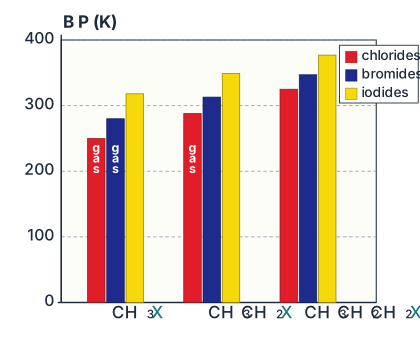
The boiling point trend RI > RBr > RCl > RF is driven by increasing molecular size and polarizability, which strengthen van der Waals forces. The Reason correctly identifies this cause, so both statements are true and the Reason is the correct explanation.
The question tests your understanding of how intermolecular forces — specifically van der Waals (London dispersion) forces — govern boiling points in a homologous series of alkyl halides. Let’s build the reasoning from the ground up.
Why boiling points depend on van der Waals forces
Boiling a liquid means overcoming the attractive forces between molecules so they can escape into the gas phase. For nonpolar or weakly polar molecules like alkyl halides, the dominant attractive force is the London dispersion force — a temporary, induced dipole interaction. The strength of these forces depends on two things: how easily the electron cloud can be distorted (polarizability) and how much surface area the molecule has for contact.
Larger atoms have more electrons and a more diffuse electron cloud, making them more polarizable. A more polarizable molecule develops stronger temporary dipoles, which in turn induce stronger dipoles in neighbours — leading to stronger van der Waals attractions and a higher boiling point.
Step-by-step reasoning
-
Identify the trend in the Assertion.
The given order is RI > RBr > RCl > RF. For a fixed alkyl group (say, methyl or ethyl), the boiling point increases as the halogen gets heavier: fluorine (the lightest) gives the lowest boiling point, iodine (the heaviest) gives the highest. This is a well-established experimental fact.
-
Connect the trend to molecular properties.
As you go down Group 17 (F → Cl → Br → I), the atomic size and number of electrons increase dramatically:
- Fluorine: 9 electrons, very small
- Chlorine: 17 electrons
- Bromine: 35 electrons
- Iodine: 53 electrons, very large
More electrons mean a larger, more polarizable electron cloud. The polarizability increases in the order F < Cl < Br < I.
-
Link polarizability to van der Waals forces.
Stronger polarizability → stronger temporary dipoles → stronger London dispersion forces between molecules. So the van der Waals attraction between alkyl halide molecules follows the same order: RF (weakest) < RCl < RBr < RI (strongest).
-
Check the Reason statement.
The Reason says: “The van der Waals forces of attraction decrease in the order RI > RBr > RCl > RF.” This is exactly the same order as the boiling points. Since stronger van der Waals forces require more energy to overcome, they lead to higher boiling points. So the Reason correctly explains why the boiling points follow that order. …
Unlock everything free for 14 days
- Full step-by-step solutions
- Concept-first explanations
- Methods, shortcuts & mistakes
- PYQ mapping + timed mock tests
Full access for 14 days. No credit card required.