Q.(a) What is meant by crystal field splitting energy ? For a d4 ion, write the configuration if
🔒You're viewing a preview — the full solution, concept, methods & PYQ mapping are locked.
🔒 Start your 14-day free trial to unlock the full solution →Concept understanding — Crystal Field Splitting
Crystal Field Splitting: From Intuition to Precision
Imagine you are a negatively charged electron sitting on a metal ion. All around you, the space is perfectly spherical — every direction feels the same. Your energy depends only on how far you are from the nucleus, not on which way you face.
Now imagine that six negative ions (or the negative ends of polar molecules) march in from the x, y, and z axes and stop close to you. Suddenly, the space around you is no longer uniform. If you try to move straight toward one of these approaching ions, you feel a strong repulsion — that path costs extra energy. If you move between the axes (say, along a diagonal), you feel less repulsion because you are farther from the incoming charges.
This is the core intuition: when ligands approach a metal ion, they break the spherical symmetry of the space around the metal. Different directions in space are no longer equivalent. Electrons in orbitals that point directly at the ligands get pushed up in energy; electrons in orbitals that point between the ligands stay lower.
The Precise Statement
Crystal Field Splitting is the splitting of degenerate d orbitals of a transition metal ion into two or more sets of different energies, caused by the electrostatic repulsion between the metal's d electrons and the negative charge (or dipole) of surrounding ligands.
For the most common geometry — octahedral — here is what happens:
- Six ligands sit at the corners of an octahedron, along the +x, −x, +y, −y, +z, −z axes.
- The dx2−y2 and dz2 orbitals point their lobes directly along these axes. These are the eg set. They feel maximum repulsion → higher energy.
- The dxy, dxz, and dyz orbitals point their lobes between the axes (into the octahedral faces). These are the t2g set. They feel less repulsion → lower energy.
The energy gap between these two sets is denoted by Δo (or 10Dq). The t2g set drops by 0.4Δo and the eg set rises by 0.6Δo, keeping the average energy unchanged (the "barycentre" rule).
The labels eg and t2g come from group theory — they describe how the orbitals transform under the symmetry operations of an octahedron. You do not need to memorise the derivation, but the notation is standard in every exam.
Why This Matters
Crystal field splitting explains three things you will see repeatedly:
- Colour — electrons can jump from t2g to eg by absorbing visible light. The gap Δo determines the colour you see.
- Magnetism — if Δo is large, electrons pair up in the lower t2g set (low spin). If Δo is small, electrons spread out (high spin). This changes the number of unpaired electrons. …
Why this formula?
Crystal Field Splitting: Why the Energy Splitting Occurs
Crystal Field Theory (CFT) explains how the d-orbitals of a transition metal ion split in energy when placed in an electrostatic field created by surrounding ligands (anions or polar molecules). The key result is that five degenerate d-orbitals split into two or more sets with different energies. Let's understand why this happens.
1. The Starting Point: Degenerate d-Orbitals
In a free transition metal ion (no ligands), all five d-orbitals have the same energy (degenerate). Their shapes are:
- dxy, dxz, dyz — lobes lie between the x, y, z axes (called t2g set in octahedral symmetry)
- dx2−y2, dz2 — lobes point directly along the x, y, z axes (called eg set)
Key idea: The spatial orientation of each orbital determines how it interacts with approaching ligands.
2. The Octahedral Case: Why eg Orbitals Are Higher in Energy
Imagine six ligands approaching along the +x, –x, +y, –y, +z, –z axes (octahedral geometry).
What happens to dx2−y2 and dz2?
- Their lobes point directly at the ligands.
- The negatively charged ligands repel the electron density in these orbitals.
- This repulsion raises the energy of these orbitals — they become less stable (higher energy).
What happens to dxy, dxz, dyz?
- Their lobes point between the axes (e.g., dxy lobes lie in the xy-plane but at 45° to x and y).
- They avoid the ligands — less repulsion.
- Their energy is lower than the eg set.
The Splitting Pattern
Δoct=E(eg)−E(t2g)
Where:
- E(eg) = energy of dx2−y2 and dz2 (higher)
- E(t2g) = energy of dxy, dxz, dyz (lower)
- Δoct is called the crystal field splitting energy (CFSE)
Why the name? The eg orbitals are "doubly degenerate" (2 orbitals), t2g are "triply degenerate" (3 orbitals). The letters come from group theory symmetry labels.
3. The Energy Conservation Rule
The total energy of all five d-orbitals must remain constant (no energy is created or destroyed). So:
- The center of gravity (average energy) of the split set equals the original degenerate energy.
- For octahedral splitting:
- 2 eg orbitals go up by +0.6Δoct each
- 3 t2g orbitals go down by −0.4Δoct each
Check:
2×(+0.6Δ)+3×(−0.4Δ)=1.2Δ−1.2Δ=0
This conservation of energy is a fundamental constraint — the splitting is not arbitrary.
4. The Tetrahedral Case: Why It's Opposite and Smaller
In a tetrahedral complex, four ligands approach from alternate corners of a cube. The axes are different:
- The dxy, dxz, dyz orbitals now point closer to the ligands (more repulsion).
- The dx2−y2 and dz2 orbitals point away from ligands (less repulsion).
Result:
- e set ( dx2−y2, dz2 ) — lower energy
- t2 set ( dxy, dxz, dyz ) — higher energy
The splitting is inverted compared to octahedral.
Magnitude:
Δtet≈94Δoct
Why smaller?
- Only 4 ligands (vs. 6) → less total repulsion.
- Ligands are not directly along axes → weaker interaction. …
(a) Crystal Field Splitting Energy
Concept: Crystal Field Splitting Energy (Δ) is the energy difference between the t2g and eg orbitals when a transition metal ion is placed in a crystal field of ligands. For an octahedral field, it is denoted Δo.
Reasoning for d4 configuration:
- The splitting depends on whether Δo is smaller or larger than the pairing energy P (energy required to pair two electrons in the same orbital).
- Case (i): Δo<P — weak field, high spin. Electrons occupy all five orbitals singly before pairing. Configuration: t2g3eg1. …
Crystal field splitting energy (Δ) is the energy gap between t2g and eg orbitals in a complex. For a d4 ion: (i) when Δo<P, configuration is t2g3eg1 (high spin);
(ii) when Δo>P, configuration is t2g4eg0 (low spin). Tetrahedral complexes rarely show low spin because Δt is too small to overcome pairing energy P.
Understanding Crystal Field Splitting
When a transition metal ion sits inside a crystal field created by surrounding ligands, its five d-orbitals are no longer degenerate. In an octahedral field, the dxy, dyz, and dzx orbitals (the t2g set) point between the ligands and are stabilised, while the dx2−y2 and dz2 orbitals (the eg set) point directly at the ligands and are destabilised. The energy gap between these two sets is called the crystal field splitting energy, denoted Δo (or 10Dq).
The key question for any dn configuration is: do electrons prefer to pair up in the lower t2g orbitals, or do they spread out into the higher eg orbitals? The answer depends on the competition between Δo and the pairing energy P — the energy cost of forcing two electrons into the same orbital.
Δo=Energy gap between t2g and eg orbitals in octahedral field
(a) Configuration for a d4 ion
For a d4 ion, we have four electrons to place in the d-orbitals. The first three electrons go into the three t2g orbitals, one each, with parallel spins (Hund's rule). The fourth electron faces a choice.
Case (i): Δo<P — The splitting is small, so it costs less energy to promote the electron to the eg level than to pair it up in the t2g set. The fourth electron goes into the higher energy eg orbital with parallel spin. This gives the high-spin configuration:
t2g3eg1
All four electrons are unpaired — the complex is paramagnetic with four unpaired electrons.
Case (ii): Δo>P — The splitting is large, so it costs less energy to pair the fourth electron in the t2g set than to promote it to eg. The fourth electron pairs up with one of the t2g electrons. This gives the low-spin configuration:
t2g4eg0
Now only two electrons are unpaired (since one t2g orbital contains a pair).
A common mistake is to write t2g4eg0 as having four unpaired electrons. Remember: four electrons in three orbitals means one orbital must contain a pair — so only two electrons are unpaired, not four.
(b) Why low spin is rare in tetrahedral complexes
In a tetrahedral crystal field, the splitting pattern is inverted compared to octahedral. The e set (dx2−y2 and dz2) is lower in energy, and the t2 set (dxy, dyz, dzx) is higher. The splitting energy Δt is related to Δo by:
Δt≈94Δo
This is a much smaller gap — typically only about 40–50% of the octahedral value. Meanwhile, the pairing energy P remains roughly the same (it depends on the metal ion, not the geometry). …
Showing the 12 most recent of 21 on this concept.
- CBSE 2026Set ANNUAL1 markQ.Write any one example of low spin complex.
›Reveal solutionSolution
A low-spin complex forms when a strong-field ligand causes the d electrons to pair up in the lower-energy t2g set rather than spreading into eg, reducing the number of unpaired electrons.
…
- CBSE 2026Set ANNUAL1 markMCQQ.Assertion [A]: [Ni(CN)4]2- is a square-planar and diamagnetic. Reason [R]: It has no unpaired electrons due to presence of strong field.(a) Both [A] and [R] are true and [R] is the correct explanation of [A].(b) Both [A] and [R] are true, but [R] is not the correct explanation of [A].(c) [A] is true, but [R] is false.(d) [A] is false, but [R] is true.
›Reveal solutionSolution
[Ni(CN)4]2− is indeed square planar and diamagnetic, and this is correctly explained by CN⁻ being a strong field ligand that forces electron pairing, leaving no unpaired electrons.
In [Ni(CN)4]2−, nickel is in the +2 oxidation state: Ni2+ has configuration 3d8 (8 electrons: t2g6eg2 in a free-ion sense, or 3d8=↑↓↑↓↑↓↑ ↑).
…
- CBSE 2026Set ANNUAL1 markQ.Which one is an inner-orbital complex? [Co(NH3)6]3+ or [CoF6]3−
›Reveal solutionSolution
Because NH3 is a strong-field ligand, Co3+'s d-electrons pair up and the complex uses the inner (n−1)d orbitals for hybridisation — making [Co(NH3)6]3+ the inner-orbital complex, unlike [CoF6]3−.
Analysis
Co3+ has the configuration 3d6 in both complexes; the difference lies in the field strength of the ligand.
- In [Co(NH3)6]3+: NH3 is a strong-field ligand. It forces all 6 d-electrons to pair up within three 3d orbitals (t2g6), freeing the other two 3d orbitals for hybridisation. Cobalt then hybridises as d2sp3, using inner (n−1)d, i.e. 3d, orbitals — this is an inner-orbital (low-spin) complex, diamagnetic. …
- CBSE 2026Set ANNUAL1 markQ.The oxidation number of all the alkali metals in their compounds is ________.
›Reveal solutionSolution
[!TLDR]
+1
Method
Alkali metals (Group 1) have one valence electron and invariably show a +1 oxida …
- CBSE 2025Set 56/5/11 markMCQQ.In which of the following groups are both ions coloured in aqueous solution ? I. Cu+ II. Ti4+ III. Co2+ IV. Fe2+ [Atomic number : Cu = 29, Ti = 22, Co = 27, Fe = 26] (A) I and II (B) II and III (C) III and IV (D) I and IV
›Reveal solutionSolution
The colour of a transition metal ion in aqueous solution depends on the presence of unpaired d-electrons, which allow d-d transitions. Both Co2+ and Fe2+ have unpaired d-electrons and are coloured, while Cu+ and Ti4+ have fully filled or empty d-subshells and are colourless. The correct pair is III and IV, i.e., option (C).
The question asks which two ions among the given four are coloured in aqueous solution. Colour in transition metal ions arises from the absorption of visible light due to electronic transitions between split d-orbitals — the famous d-d transition. But this only happens if the d-subshell is partially filled (i.e., has at least one unpaired electron and at least one vacant orbital). If the d-subshell is completely empty (d0) or completely filled (d10), no d-d transition is possible, and the ion is colourless (or white) in solution.
Let’s examine each ion one by one.
-
Cu+ (Copper(I))
Atomic number of Cu = 29. Neutral Cu has configuration [Ar]3d104s1.
Cu+ loses the 4s electron, so its configuration becomes [Ar]3d10.
The d-subshell is completely filled. No d-d transitions possible.
Result: Colourless in aqueous solution.
-
Ti4+ (Titanium(IV))
Atomic number of Ti = 22. Neutral Ti has [Ar]3d24s2.
Ti4+ loses all four valence electrons (two from 4s and two from 3d), so its configuration becomes [Ar]3d0.
The d-subshell is completely empty. No d-d transitions possible.
Result: Colourless in aqueous solution.
-
Co2+ (Cobalt(II))
Atomic number of Co = 27. Neutral Co has [Ar]3d74s2.
Co2+ loses the two 4s electrons, giving [Ar]3d7.
The d-subshell is partially filled (7 electrons in 5 orbitals — there are unpaired electrons). In aqueous solution, Co2+ forms the pink [Co(H2O)6]2+ complex.
Result: Coloured (pink) in aqueous solution. …
-
- CBSE 2025Set D1 markMCQQ.The structure of complex ion [Ni(CN)4]2- is(a) Linear(b) Tetrahedral(c) Square planar(d) Octahedral
›Reveal solutionSolution
Ni2+ (d8) with strong-field CN- gives dsp2 hybridisation -> square planar [Ni(CN)4]2-.
Step 1 - oxidation state: In [Ni(CN)4]2-, four CN- (each -1) give -4; overall charge -2, so Ni is +2.
Step 2 - configuration: Ni2+ is 3d8.
Step 3 - ligand strength: CN- is a strong-field ligand. It pairs up the d electrons, freeing one 3d orbital. …
- CBSE 2025Set ANNUAL1 markQ.CO is stronger ligand than Cl⁻¹. (True / False)
›Reveal solutionSolution
True — CO lies far above Cl⁻ in the spectrochemical series, so it is a much stronger field ligand.
The spectrochemical series arranges ligands in order of increasing crystal-field splitting (Δo) they cause:
I−<Br−<S2−<SCN−<Cl−<...<NH3<en<CN−<CO
…
- CBSE 2025Set ANNUAL1 markQ.Draw a figure to show the splitting of d-orbitals in an octahedral crystal field.
›Reveal solutionSolution
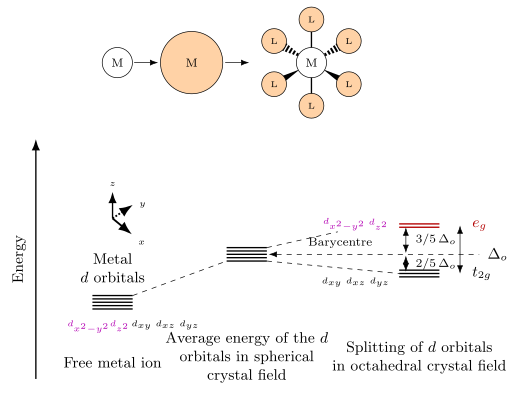
Figure — The stem 'Draw a figure to show the splitting of d-orbitals in an octahedral crystal field' needs the t2g/eg e Ligands approaching along the axes in an octahedral complex raise the energy of orbitals pointing along the axes more than those pointing between the axes, splitting the 5 degenerate d-orbitals into two sets separated by Δo.
Description of the splitting (energy-level diagram in words)
In a free (gaseous) metal ion, all five d-orbitals (dxy,dyz,dzx,dx2−y2,dz2) are degenerate (equal energy). When 6 ligands approach the metal ion symmetrically along the ±x,±y,±z axes to form an octahedral complex, the orbitals lying along the axes experience more electrostatic repulsion from the approaching ligand electron pairs than the orbitals lying between the axes. This splits the 5 orbitals into two sets:
- eg set (higher energy): dx2−y2 and dz2 — these point directly at the ligands along the axes, so they are raised in energy above the mean (barycentre) by +0.6Δo (i.e. +53Δo).
- t2g set (lower energy): dxy,dyz,dzx — these point between the axes (away from the ligand directions), so they are lowered below the barycentre by −0.4Δo (i.e. −52Δo).
Schematically (energy increasing upward):
____ ____ <- e_g (d(x2-y2), d(z2)) +0.6(Delta_o) … - CBSE 2024Set 56/3/11 markMCQQ.Which of the following is diamagnetic in nature ? (A) Co3+, octahedral complex with strong field ligand (B) Co3+, octahedral complex with weak field ligand (C) Co3+, in a square planar complex (D) Co3+, in a tetrahedral complex [ Atomic number : Co = 27 ]
›Reveal solutionSolution
The key is to determine the number of unpaired electrons in Co3+ (3d6) under each geometry and ligand field. Only the octahedral strong-field (low-spin) case gives zero unpaired electrons, making it diamagnetic. The correct option is (A).
Let’s start with the core idea. A substance is diamagnetic when all its electrons are paired — no unpaired electrons means no net magnetic moment. For transition metal complexes, this depends entirely on how the d-orbitals split in energy under the influence of the surrounding ligands (Crystal Field Splitting) and how electrons fill those orbitals.
Cobalt has atomic number 27. Its ground state electron configuration is [Ar]3d74s2. When it forms Co3+, it loses three electrons — typically the two 4s electrons and one 3d electron. So Co3+ has a 3d6 configuration.
Now, six d-electrons can arrange themselves in different ways depending on the geometry of the complex and the strength of the ligand field. The geometry determines the splitting pattern of the d-orbitals, and the ligand field strength decides whether electrons pair up in lower orbitals or spread out (Hund’s rule) into higher ones.
Let’s examine each option one by one.
-
Option (A): Octahedral complex with strong field ligand
In an octahedral field, the five d-orbitals split into two sets: the lower-energy t2g (three orbitals) and the higher-energy eg (two orbitals). The energy gap Δo is large when the ligand is strong (like CN⁻, CO).
For 3d6, a strong field forces electrons to pair up in the t2g set before any electron goes to eg. So the filling is: t2g6 — all six electrons paired in three orbitals. That gives zero unpaired electrons.
TipStrong field = low spin = maximum pairing. For d6, low-spin octahedral is always diamagnetic.
-
Option (B): Octahedral complex with weak field ligand
Here Δo is small. Electrons follow Hund’s rule: they occupy all five orbitals singly before pairing. For d6, the first five electrons go one each into t2g and eg (actually t2g3eg2), and the sixth electron must pair in a t2g orbital. So the configuration is t2g4eg2 — that’s four electrons in t2g (one pair, two unpaired) and two unpaired in eg. Total unpaired electrons = 4. Hence paramagnetic.
-
Option (C): Square planar complex …
-
- CBSE 2024Set ANNUAL1 markQ.What is crystal field splitting energy?
›Reveal solutionSolution
When ligands approach a metal ion, electrostatic repulsion splits the previously degenerate d-orbitals into two energy sets; the gap between them is the crystal field splitting energy, Δ.
In an isolated (gas-phase) transition-metal ion, all five d-orbitals are degenerate (equal energy). When ligands approach to form a complex, their electron pairs create an electric field that repels electrons in the d-orbitals unequally, depending on each orbital's spatial orientation relative to the ligand positions.
In an octahedral field, the d-orbitals split into two sets:
- t2g (dxy,dyz,dxz) — lower energy, point between the ligand axes
- eg (dx2−y2,dz2) — higher energy, point directly at the ligands …
- CBSE 2024Set ANNUAL1 markMCQQ.A coordination compound is colourless due to –(a) the absence of ligand(b) loss of water molecules(c) d-d transition of the electron(d) energy of crystal field splitting energy
›Reveal solutionSolution
A coordination compound is colourless when it cannot undergo d-d electronic transitions — either because it has no d electrons or a completely filled d-subshell.
Colour in most coordination compounds arises from d–d transitions, where an electron is excited from a lower-energy d-orbital (t2g) to a higher-energy one (eg) after crystal field splitting, absorbing a specific wavelength of visible light (and transmitting/reflecting the complementary colour).
…
- CBSE 2023Set 56/1/11 markMCQQ.Assertion (A) : Low spin tetrahedral complexes are rarely observed. Reason (R) : Crystal field splitting energy is less than pairing energy for tetrahedral complexes. (A) Both Assertion (A) and Reason (R) are true and Reason (R) is the correct explanation of the Assertion (A). (B) Both Assertion (A) and Reason (R) are true, but Reason (R) is not the correct explanation of the Assertion (A). (C) Assertion (A) is true, but Reason (R) is false. (D) Assertion (A) is false, but Reason (R) is true.
›Reveal solutionSolution
The assertion is true — low-spin tetrahedral complexes are rare — and the reason is also true: for tetrahedral complexes, the crystal field splitting energy Δt is much smaller than the pairing energy P, making low-spin configurations energetically unfavourable. The reason correctly explains the assertion, so option (A) is correct.
Why this question hinges on crystal field splitting
In coordination chemistry, the spin state of a complex (high-spin vs low-spin) depends on a tug-of-war between two energies: the crystal field splitting energy (Δ) and the pairing energy (P). If Δ>P, electrons prefer to pair up in the lower-energy orbitals (low-spin). If Δ<P, electrons spread out to avoid pairing (high-spin).
For tetrahedral complexes, the splitting pattern is the inverse of octahedral — the dxy,dyz,dzx orbitals (called t2) are higher in energy, and the dx2−y2,dz2 orbitals (called e) are lower. But the key number is the magnitude of Δt (tetrahedral splitting).
Δt≈94Δo
For the same metal ion and ligands, tetrahedral splitting is only about 44% of octahedral splitting.
Since Δo itself is often comparable to or smaller than P for many metal ions (especially first-row transition metals), Δt ends up being much smaller than P in almost all cases. That means the energy cost of pairing electrons is never recovered by the splitting — so electrons always occupy orbitals singly before pairing, giving high-spin configurations.
Watch outA common mistake is to think that low-spin tetrahedral complexes are impossible. They are not — they are just rare. With very strong-field ligands (like CN⁻) and heavy metals (where Δ is larger), a few examples exist. But for typical exam contexts (first-row transition metals, common ligands), the statement holds.
Step-by-step reasoning
- Understand the assertion: "Low spin tetrahedral complexes are rarely observed." This is a factual statement about coordination chemistry. For a tetrahedral complex to be low-spin, the splitting Δt must exceed the pairing energy P. But because Δt is inherently small (about 4/9 of Δo), this condition is seldom met. …
🎓Unlock everything free for 14 days
- ✓Full step-by-step solutions
- ✓Concept-first explanations
- ✓Methods, shortcuts & mistakes
- ✓PYQ mapping + timed mock tests
Full access for 14 days. No credit card required.