Q.A point on the hypotenuse of a triangle is at distance a and b from the sides of the triangle. Show that the minimum length of the hypotenuse is (a32+b32)23.
🔒You're viewing a preview — the full solution, concept, methods & PYQ mapping are locked.
🔒 Start your 14-day free trial to unlock the full solution →Concept understanding — Optimization Word Problem
Optimization Word Problems
Imagine planning a garden with 40 metres of fencing and wanting the largest rectangular area. A long, thin rectangle wastes space; a square feels roomier; somewhere in between lies the best shape. That is an optimisation problem — a fixed resource and a quantity to make as large (or as small) as possible.
Every optimisation word problem has the same skeleton: the best outcome — maximum area, minimum cost, largest volume, shortest time — under a constraint — limited material, a fixed budget, a given perimeter.
The Plan of Attack
The problem gives you a story, not a graph. Your job is to turn it into a single-variable function and find its peak or valley:
- Name the quantity to optimise — call it Q, and write it using variables.
- Find the constraint — a relation between those variables (e.g. "perimeter =40").
- Reduce to one variable — use the constraint to eliminate the rest.
- Differentiate — solve Q′(x)=0 to find the critical points.
- Confirm — use Q′′(x)<0 for a maximum or Q′′(x)>0 for a minimum.
- Answer the question asked — give the actual dimensions/cost, not just x.
In board exams these problems almost always reduce to a quadratic or cubic. Once Q(x) is written, the calculus is mechanical.
The Garden, Worked
40 m of fencing encloses a rectangle; maximise the area.
- Objective: A=lw.
- Constraint: 2l+2w=40, so l+w=20.
- Reduce: w=20−l, giving A(l)=l(20−l)=20l−l2.
- Differentiate: A′(l)=20−2l=0⟹l=10.
- Confirm: A′′(l)=−2<0, a maximum.
So l=w=10 m — a 10 m × 10 m square.
A common slip: solving A′(l)=0 and stopping. Always check max vs min, and answer in the units asked.
The Common Families
| Problem type | Typical objective | Typical constraint |
|--------------|-------------------|--------------------| …
Idea: Let the hypotenuse make angle θ with one leg; write its length as a single-variable function of θ and minimise it.
The fixed point on the hypotenuse is at perpendicular distances a and b from the two legs. Splitting the hypotenuse at the foot of these perpendiculars gives its length as
L(θ)=sinθa+cosθb,0<θ<2π.
Differentiate and set to zero:
L′(θ)=−sin2θacosθ+cos2θbsinθ=0 ⇒ bsin3θ=acos3θ ⇒ tan3θ=ba.
So tanθ=(a/b)1/3, giving
sinθ=a2/3+b2/3a1/3,cosθ=a2/3+b2/3b1/3.
Substitute back: …
Writing the hypotenuse length as L(θ)=acscθ+bsecθ and minimising gives tan3θ=a/b and Lmin=(a2/3+b2/3)3/2.
The set-up
A right triangle has a point P on its hypotenuse that is at perpendicular distance a from one leg and b from the other. As the triangle changes shape (keeping P at those fixed distances), the hypotenuse length changes; we want its smallest value.
Let θ be the angle the hypotenuse makes with the leg that is distance a from P. Drop perpendiculars from P to the two legs. These split the hypotenuse into two pieces:
- the piece near one end has length sinθa,
- the piece near the other end has length cosθb.
So the whole hypotenuse has length
L(θ)=sinθa+cosθb=acscθ+bsecθ,0<θ<2π.
This is already a single-variable function — exactly what we want to minimise.
Minimise with the derivative
Differentiate:
L′(θ)=−asin2θcosθ+bcos2θsinθ.
Set L′(θ)=0:
cos2θbsinθ=sin2θacosθ ⇒ bsin3θ=acos3θ ⇒ tan3θ=ba.
Hence
tanθ=(ba)1/3.(1)
Turn the angle into the length
From (1), build a right triangle with "opposite" =a1/3 and "adjacent" =b1/3, so the hypotenuse of that reference triangle is a2/3+b2/3. Then …
Method: Minimising a Length by Parametrising with an Angle
This method applies whenever a fixed point's distances from two perpendicular lines are given, and you need the minimum length of a segment (like a hypotenuse) through that point touching both lines — the natural variable is the angle the segment makes with one line, not a length.
Steps
Step 1: Identify the two fixed perpendicular distances and set up an angle θ
Let θ be the angle the segment makes with one of the two lines. Dropping perpendiculars from the fixed point to each line splits the segment into two pieces, each expressible using θ and one of the given distances via right-triangle trigonometry.
Step 2: Write the total length as a single-variable trig function of θ
L(θ)=sinθa+cosθb=acscθ+bsecθ,0<θ<2π
Step 3: Differentiate and set L′(θ)=0
Use dθdcscθ=−cscθcotθ and dθdsecθ=secθtanθ, then simplify the resulting equation into a single relation in tanθ.
Step 4: Solve for tanθ and convert to sinθ,cosθ …
Common Mistakes
Mistake 1: Treating the segment length as a function of a linear distance instead of the angle
Why it's wrong: trying to set up the problem with a linear variable (like the distance along one line) usually leads to an unnecessarily messy expression with square roots that resist clean differentiation; the angle parametrisation is what makes the trig derivatives collapse neatly. Correct approach: recognise "fixed point, two perpendicular distances, minimise the connecting segment" as the cue to parametrise by the angle the segment makes with one line.
Mistake 2: Losing track of which given distance pairs with sinθ versus cosθ
Why it's wrong: swapping a and b between the sine and cosine terms swaps the two given distances' roles, producing intermediate expressions with a and b interchanged (harmless for this problem's symmetric final formula, but a real error in the intermediate steps and in any similar problem where the two distances play asymmetric roles). Correct approach: re-derive the right-triangle relation carefully from the picture, and stay consistent about which leg θ is measured from. …
- CBSE 2026Set ANNUAL1 markQ.(Continuing the aluminium-box case study of Q.38) What will be the dimensions of the largest box?
›Reveal solutionSolution
Substitute the optimal square side x=32 m (found by maximising the volume function) into the length, breadth and height expressions.
From the case study, cutting a square of side x from each corner of the 3 m×8 m sheet and folding up the sides gives a box of:
- Length =(8−2x) m
- Breadth =(3−2x) m
- Height =x m
Maximising V(x)=x(3−2x)(8−2x)=4x3−22x2+24x using V′(x)=12x2−44x+24=0 (i.e. 3x2−11x+6=0) gives roots x=3 or x=32. Since 0<x<1.5 is required for the box to be valid, the admissible root is x=32, and V′′(32)=−28<0 confirms this is the maximum.
Substituting x=32:
Length=8−2(32)=8−34=320 m …
- CBSE 2026Set ANNUAL1 markQ.(Continuing the aluminium-box case study of Q.38) What will be the side of the square removed to form the largest box?
›Reveal solutionSolution
The optimal square side is the critical point of the volume function that lies in the valid domain and satisfies the second-derivative maximum test.
For a square of side x removed from each corner of the 3 m×8 m sheet, the box volume is:
V(x)=x(3−2x)(8−2x)=4x3−22x2+24x,0<x<1.5
Differentiating and setting V′(x)=0:
V′(x)=12x2−44x+24=0⟹3x2−11x+6=0
x=611±121−72=611±7⟹x=3 or x=32
Since the breadth (3−2x) must stay positive, only x<1.5 is valid, so x=3 is rejected and x=32 is the only admissible critical point.
Confirming it is a maximum: …
- CBSE 2025Set ANNUAL1 markQ.A gardener plans to plant flowers in a rectangular flower bed in such a way that a rectangle is inscribed in the semi-circular field (as shown in the figure). Radius of the semi-circular field is 30 m. Let the length of the rectangle be PQ = x m. Based on above information answer the following: What will be the breadth of the rectangular flower bed in terms of x?
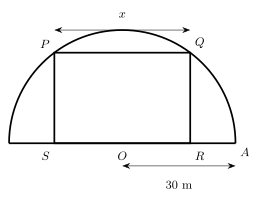
›Reveal solutionSolution
The rectangle's top corners lie on the semicircle of radius 30, so the Pythagorean relation between half the length and the breadth gives the breadth as a function of x.
Place the centre O of the semicircle at the origin, with the diameter along the x-axis. Since the rectangle PQRS is symmetric about O with top side PQ=x, the top corners P,Q are at horizontal distance x/2 from O. Let the breadth (height of the rectangle) be b. …
- CBSE 2025Set ANNUAL1 markQ.A gardener plans to plant flowers in a rectangular flower bed in such a way that a rectangle is inscribed in the semi-circular field (as shown in the figure). Radius of the semi-circular field is 30 m. Let the length of the rectangle be PQ = x m. Based on above information answer the following: What will be the area of rectangular region as a function of x?
›Reveal solutionSolution
Area = length × breadth, using the breadth found in terms of x.
The rectangle has length PQ=x and breadth b=900−x2/4 (from the semicircle constraint). So the area is …
- CBSE 2025Set ANNUAL1 markQ.A gardener plans to plant flowers in a rectangular flower bed in such a way that a rectangle is inscribed in the semi-circular field (as shown in the figure). Radius of the semi-circular field is 30 m. Let the length of the rectangle be PQ = x m. Based on above information answer the following: Gardener wants maximum area for the rectangular flower bed. For this to happen, what will be the value of x?
›Reveal solutionSolution
Maximize A(x)2 (equivalent and algebraically simpler) by setting its derivative to zero.
From A(x)=x900−x2/4, consider A2=x2(900−4x2)=900x2−4x4 (maximizing A2 maximizes A since A≥0).
dxd(A2)=1800x−x3=x(1800−x2)
Setting this to zero: x=0 (rejected, gives zero area) or x2=1800⇒x=1800=302.
…
- CBSE 2025Set ANNUAL1 markQ.A gardener plans to plant flowers in a rectangular flower bed in such a way that a rectangle is inscribed in the semi-circular field (as shown in the figure). Radius of the semi-circular field is 30 m. Let the length of the rectangle be PQ = x m. Based on above information answer the following: What will be the area of remaining field (in sq. m) after having the flower bed of maximum area?
›Reveal solutionSolution
Subtract the maximum rectangle area from the total semicircular field area.
Total area of the semicircular field: 21πr2=21π(30)2=450π sq. m.
At maximum, x=302, so breadth b=900−4(302)2=900−41800=900−450=450=152.
…
- CBSE 2024Set ANNUAL1 markQ.[Case study] Let a cone be inscribed in a sphere of radius R. The height and radius of the cone are h and r respectively; x denotes the distance from the sphere's centre O to the centre of the cone's base. Write the relation between r and R in terms of x.
›Reveal solutionSolution
r2=R2−x2.
From the figure, O is the sphere's centre, C is the centre of the cone's circular base, OC=x, CA=r (radius of the cone's base), and OA=R (a radius of the sphere, since A lies on the sphere).
…
- CBSE 2024Set ANNUAL1 markQ.[Case study, same setup as above — cone of height h, radius r inscribed in a sphere of radius R, with x the distance from the sphere's centre to the cone's base] Write the volume V of the cone in terms of R and x.
›Reveal solutionSolution
V=3π(R+x)2(R−x).
From the figure, the cone's height is h=R+x (from the base at C up to the apex D at the top of the sphere), and from the previous part, r2=R2−x2.
Volume of a cone: V=31πr2h. …
🎓Unlock everything free for 14 days
- ✓Full step-by-step solutions
- ✓Concept-first explanations
- ✓Methods, shortcuts & mistakes
- ✓PYQ mapping + timed mock tests
Full access for 14 days. No credit card required.