Business Economics · Ch 4 — Market Structures and Price Determination
Monopolistic Competition: Features and Price–Output Determination
Monopolistic Competition: Features and Price–Output Determination
Monopolistic competition is a market with a large number of sellers offering closely substitutable but differentiated products. It blends elements of both competition (many firms, free entry) and monopoly (each firm has a little control over price because its product is distinct). Markets for soap, toothpaste, biscuits and restaurants are common examples.
Main features
- Large number of sellers — each acts independently and ignores rivals' reactions.
- Product differentiation — goods differ in brand, quality, packing, colour or service, so they are close but not perfect substitutes. This is the defining feature.
- Free entry and exit in the long run.
- Selling costs — heavy advertisement and sales promotion are used to build brand preference.
- Downward-sloping but highly elastic demand curve — differentiation gives each firm slight price control, but the many close substitutes keep its demand very elastic.
Price–output equilibrium. Each firm faces its own downward-sloping AR curve (with MR below it) and maximises profit where
In the short run a firm may earn supernormal profit, normal profit or a loss, exactly as in monopoly, depending on whether AR is above, equal to or below AC at the equilibrium output.
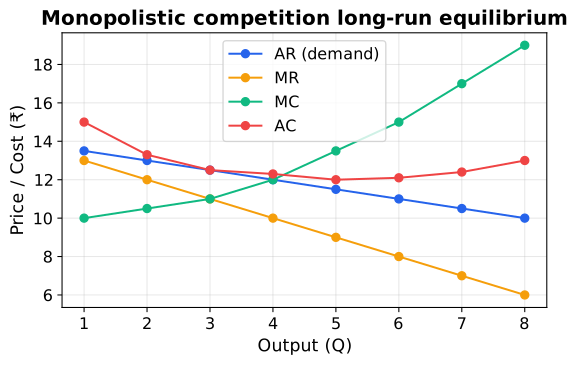
Long run. Free entry and exit again drive profits to normal. New firms attracted by profits reduce each firm's demand until the AR curve becomes tangent to the AC curve. At the point of tangency
…
Making a product appear distinct from rivals' — through brand, quality, packaging or service — so that it becomes a close but …
Expenditure such as advertising incurred to persuade buyers and shift a firm's demand curve, characteristic of mono …
The gap between a firm's actual long-run output and the output at which average cost is minimum; it arises because the AR curve is tangent to AC to …