Business Economics · Ch 4 — Market Structures and Price Determination
Monopoly: Features and Price–Output Determination
Monopoly: Features and Price–Output Determination
Monopoly (from mono = single, poly = seller) is a market in which there is a single seller of a commodity that has no close substitute, with strong barriers to the entry of new firms. The single firm is the industry.
Main features
- Single seller, many buyers — the firm controls the entire supply.
- No close substitute — buyers cannot easily switch to another product.
- Barriers to entry — legal (patents, licences), natural (control of a raw material), or technical (huge capital, economies of scale) barriers keep rivals out.
- Price maker — the monopolist can fix either the price or the quantity, but not both, because it must sell along a given market demand curve.
The revenue curves. Being the whole industry, the monopolist faces the downward-sloping market demand curve as its AR curve: to sell more it must lower the price. When AR falls as output rises, MR falls faster and lies below AR. For a straight-line demand curve, MR falls twice as steeply as AR. This relationship (AR above, MR below, both sloping down) is the key difference from perfect competition, where AR = MR.
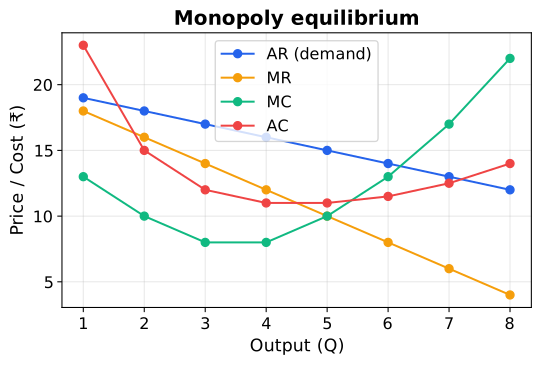
Price–output equilibrium. Like any firm the monopolist maximises profit where
This gives the profit-maximising output. The price is then read off the AR (demand) curve above that output — and because AR lies above MR, the monopoly price exceeds MR (and MC). The amount of profit depends on AC at that output:
- If , the monopolist earns supernormal profit;
- If , only normal profit; …
A market with a single seller of a product having no close substitute and strong bar …
Any legal, natural or technical obstacle that prevents new firms from entering an industry, allowing a m …
A firm that can influence the market price by adjusting its output; it faces a downward-slop …