Question of 90
Q.Draw a neat diagram of an Anatropous ovule in Angiosperms.
Goa GbshseGBSHSE Class 12 Board Exam 2024Subjective· 2mImportance★★★★★
0% · 0/90 Questions
You're viewing a preview — the full solution, concept, methods & PYQ mapping are locked.
Start your 14-day free trial to unlock the full solution →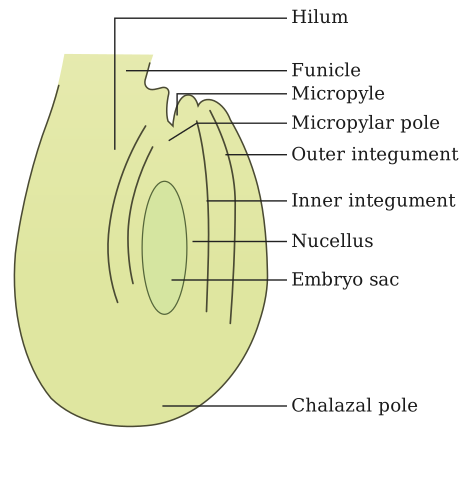
An anatropous ovule is turned through 180° so its micropyle and funicle end up close together, connected by a fused ridge called the raphe.
As this platform is text-based, here is a fully labelled description of the diagram of an anatropous ovule (the most common type of ovule found in flowering plants):
- The body of the ovule is completely inverted/curved through 180° during its development, so that it lies alongside, and parallel to, the funicle.
- Because of this bending, the funicle becomes fused along one side of the ovule body; this line of fusion is called the raphe.
- The micropyle (the small opening in the integuments through which the pollen tube enters) comes to lie close to the hilum (the point of attachment of funicle to the ovule), near the base.
- The chalaza (the basal part of the ovule where the integuments, nucellus and funicle meet) lies at the opposite end from the micropyle, but because of the inversion, both the micropyle and the chalaza end up oriented towards the same, funicle side of the ovule. …
Unlock everything free for 14 days
- Full step-by-step solutions
- Concept-first explanations
- Methods, shortcuts & mistakes
- PYQ mapping + timed mock tests
Full access for 14 days. No credit card required.