Q.Fill in the blank selecting the appropriate one: When pollen tube enters through micropyle into the ovule, it is called ____.
🔒You're viewing a preview — the full solution, concept, methods & PYQ mapping are locked.
🔒 Start your 14-day free trial to unlock the full solution →Concept understanding — Structure of the Ovule
Structure of the Ovule
The ovule (megasporangium) is the structure inside the ovary that develops into a seed after fertilisation. Learning to label a longitudinal section of a mature, inverted (anatropous) ovule is a standard part of the chapter on sexual reproduction in flowering plants.
The main parts are:
- Funicle — the stalk by which the ovule is attached to the placenta of the ovary.
- Hilum — the region where the body of the ovule fuses with the funicle.
- Integuments — one or two protective covering layers that enclose the ovule, leaving a small opening at one end.
- Micropyle — the narrow pore at the tip of the ovule, formed by the integuments; it is the point through which the pollen tube usually enters.
- Nucellus — the central mass of nutritive parenchymatous tissue enclosed by the integuments.
- Embryo sac (female gametophyte) — the large oval sac embedded in the nucellus, containing the egg apparatus, central cell and antipodal cells.
- Chalaza — the basal region, lying opposite the micropyle, where the integuments and funicle merge and the nucellus joins the stalk. …
The pollen tube can approach the ovule by different routes, and the route through the micropyle is the commonest one in angiosperms. …
Pollen-tube entry through the micropyle is porogamy; through the chalaza is chalazogamy; through the integuments/funicle is mesogamy.
After reaching the ovary, the pollen tube grows towards the ovule to deliver the male gametes. Depending on the point of entry into the ovule it is named:
- Porogamy - entry through the micropyle (the normal and most common route).
- Chalazogamy - entry through the chalaza (e.g. Casuarina). …
- CBSE 2025Set A1 markMCQQ.Which part of the ovule is attached to the funicle?(a) Micropyle(b) Hilum(c) Integuments(d) Chalaza
›Reveal solutionSolution
The hilum is the junction between the ovule and its funicle (stalk).
An ovule is attached to the placenta of the ovary by a stalk called the funicle. The point of attachment of the ovule body to the funicle is called the hilum, and it marks the boundary between the funicle and the ovule proper. Other parts named in the options are elsewhere on the ovule: the micropyle is a pore at the opposite end (near the tip) through which the pollen tube usually enters; the i …
- CBSE 2025Set ANNUAL1 markQ.Sketch a neat diagram of a typical anatropous ovule.
›Reveal solutionSolution
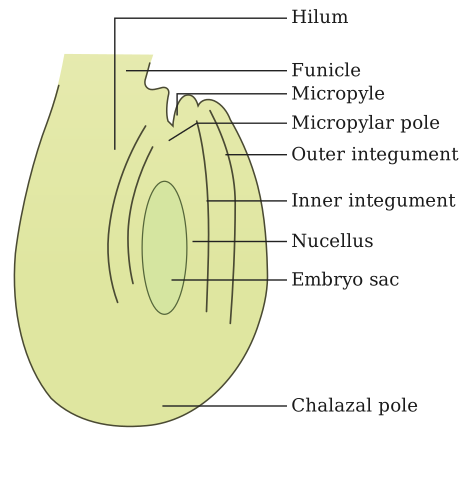
Figure — A hard draw-gate ('Sketch a neat diagram') for a typical anatropous ovule; catalog figure 1-7d is a labelled L An anatropous ovule is completely inverted along its funicle, bringing the micropyle and chalaza close to each other near the base, with the raphe marking the fused stalk.
Diagram (labelled description to draw):
Draw an oval outer body (the ovule, made of the nucellus surrounded by integuments) turned upside-down (180°) relative to its stalk. Label the following parts:
- Funiculus — the stalk attaching the ovule to the placenta.
- Hilum — the point where the funiculus joins the ovule body.
- Raphe — the ridge running along the ovule body, formed because the funiculus is fused lengthwise with the body of the inverted ovule.
- Chalaza — the basal region of the ovule where the integuments and nucellus merge (this ends up close to the hilum in an anatropous ovule).
- Micropyle — the small pore in the integuments through which the pollen tube enters; in an anatropous ovule it lies close to the funiculus, at the same end as the hilum/chalaza. …
- CBSE 2025Set BOTANY1 markMCQQ.Fill in the blank selecting the appropriate one: When pollen tube enters through micropyle into the ovule, it is called ____.(a) porogamy(b) chalazogamy(c) syngamy(d) mesogamy
›Reveal solutionSolution
Pollen-tube entry through the micropyle is porogamy; through the chalaza is chalazogamy; through the integuments/funicle is mesogamy.
After reaching the ovary, the pollen tube grows towards the ovule to deliver the male gametes. Depending on the point of entry into the ovule it is named:
- Porogamy - entry through the micropyle (the normal and most common route).
- Chalazogamy - entry through the chalaza (e.g. Casuarina). …
- CBSE 2023Set ANNUAL1 markMCQQ.The orthotropous ovule is found in which of the following?(a) Polygonum(b) Pisum sativum(c) Solanum nigrum(d) Helianthus annuus
›Reveal solutionSolution
The orthotropous ovule occurs in Polygonum.
In an orthotropous (atropous) ovule, the body of the ovule is erect and straight so that the micropyle, chalaza and the point of attachment (hilum/funicle) all lie in one straight line. This primitive type is found in plants such as Polygonum and Piper (Piperaceae, Polygo …
- CBSE 2020Set OC_BOTANY1 markMCQQ.A small opening at the apex of the integument is called(a) nucellus(b) funiculus(c) hilum(d) micropyle
›Reveal solutionSolution
The micropyle is the small apical pore left by the integuments of the ovule; it is the usual entry point for the pollen tube and later for water during germination.
Structure of the ovule
An ovule develops from the placenta and consists of a central mass of nucellus (megasporangium) enclosed by one or two protective layers called integuments. The integuments do not close completely at the apex — they leave a narrow canal-like opening called the micropyle.
Why the other options are wrong
- Nucellus is the nutritive tissue inside the integuments, not an opening.
- Funiculus is the stalk that attaches the ovule to the placenta.
- Hilum is simply the junction/region where the funiculus meets the body of the ovule. …
- CBSE 2019Set HE1 markMCQQ.Enclosed within the integuments is a mass of cells is called -(i) Chalaza(ii) Nucellus(iii) Embryosac(iv) Ovule
›Reveal solutionSolution
The mass of cells enclosed within the integuments of an ovule is the nucellus.
An ovule is the structure in flowering plants that, after fertilisation, develops into a seed. It consists of: the funicle (stalk attaching the ovule to the placenta), the integuments (protective outer layer(s) that later become the seed coat), the micropyle (a small pore in the integuments), the chalaza (the basal part where the integuments and nucellus are attached), and the nucellus — a mass of nutritive, undifferentiated cells enclosed within the integuments, occupying the main body of the ovule. It provides nutrition to the developing embryo sac, and the embryo sac (megagametophyte, containing the egg cell) is e …
🎓Unlock everything free for 14 days
- ✓Full step-by-step solutions
- ✓Concept-first explanations
- ✓Methods, shortcuts & mistakes
- ✓PYQ mapping + timed mock tests
Full access for 14 days. No credit card required.