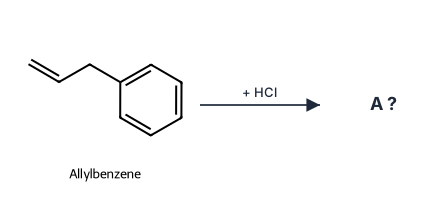
Q.What is ‘A’ in the following reaction?
You're viewing a preview — the full solution, concept, methods & PYQ mapping are locked.
Start your 14-day free trial to unlock the full solution →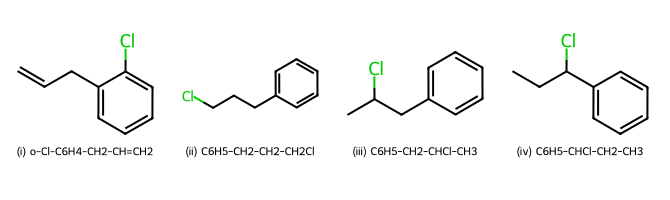
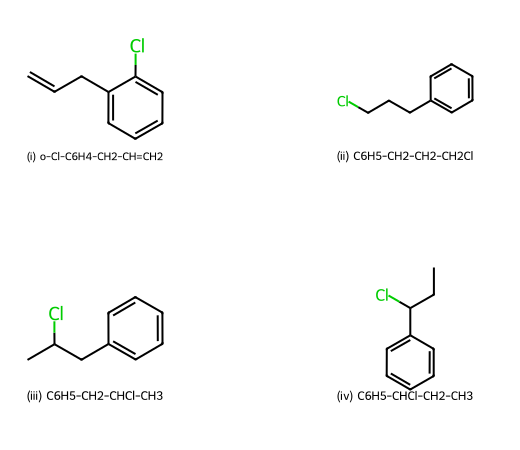
The reaction is an electrophilic addition of HCl to an alkene. The key is Markovnikov’s rule: the hydrogen adds to the less substituted carbon of the double bond, giving the more stable carbocation intermediate. For 3-phenylprop-1-ene, the product is 2-chloro-1-phenylpropane, which matches option (iii).
This is a classic electrophilic addition of HX to an unsymmetrical alkene. The molecule is 3-phenylprop-1-ene — a terminal alkene with a benzene ring three carbons away. The double bond is between C1 and C2 (counting from the phenyl end). HCl adds across the double bond, and the regiochemistry is governed by Markovnikov’s rule.
The rule says: the hydrogen atom of HX attaches to the carbon of the double bond that already has more hydrogens. That means H goes to the terminal carbon (C1, which has two hydrogens), and Cl goes to the internal carbon (C2). Why? Because the carbocation that forms on the more substituted carbon (secondary vs. primary) is more stable.
Let’s walk through it.
-
Identify the alkene structure.
The compound is . The double bond is between the last two carbons:
Carbon numbering: C1 (terminal, ), C2 (), C3 (benzylic, ), and then the ring.
-
Protonation step — which carbon gets H?
The electrons attack the electrophilic proton of HCl. Markovnikov’s rule says the proton adds to the less substituted carbon (the one with more hydrogens already). That’s C1 (terminal, ).
This gives a carbocation at C2:
This is a secondary carbocation — but not a benzylic one. The positive charge sits on C2, which is one carbon away from the ring (C3, the carbon actually attached to the ring, is the benzylic position). Still, a plain secondary carbocation is stable enough for Markovnikov addition to proceed cleanly here.
Watch outA common mistake is to think the carbocation is benzylic. It is not — the benzene ring is attached to C3, not C2. The positive charge is on C2, so it’s a simple secondary carbocation, not resonance-stabilised by the ring. That’s fine; it’s still more stable than a primary one.
-
Nucleophilic attack by chloride. …
Unlock everything free for 14 days
- Full step-by-step solutions
- Concept-first explanations
- Methods, shortcuts & mistakes
- PYQ mapping + timed mock tests
Full access for 14 days. No credit card required.