Q.Why can aryl halides not be prepared by reaction of phenol with HCl in the presence of ?
You're viewing a preview — the full solution, concept, methods & PYQ mapping are locked.
Start your 14-day free trial to unlock the full solution →Aryl halides cannot be prepared from phenols using HCl/ZnCl₂ because the C–O bond in phenol has partial double-bond character due to resonance, making it too strong to be broken by nucleophilic substitution; the reaction requires a different mechanism (e.g., diazotization followed by Sandmeyer reaction).
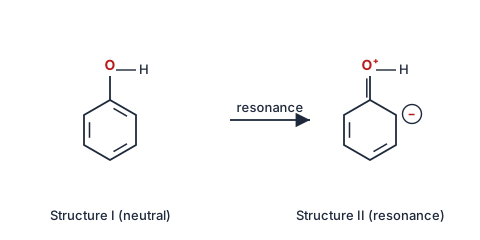
The question touches on a classic limitation in organic chemistry: why the Lucas test (HCl/ZnCl₂) works beautifully for alcohols but fails for phenols. The key lies in the electronic structure of the C–O bond.
Phenol is not just an alcohol with a benzene ring. The oxygen’s lone pairs are delocalised into the aromatic ring, giving the C–O bond significant double-bond character. This resonance stabilisation makes the bond far stronger than a typical C–O single bond in an aliphatic alcohol. For an alcohol like ethanol or 2-butanol, the Lucas reagent (HCl + ZnCl₂) works by first protonating the –OH group, then displacing water as a leaving group via an SN1 or SN2 mechanism. The ZnCl₂ acts as a Lewis acid to help generate a better leaving group.
But with phenol, even after protonation, the resulting phenoxonium ion (or its equivalent) is not a good leaving group because the positive charge on oxygen is stabilised by resonance with the ring. The C–O bond simply does not break under these conditions. Moreover, the aromatic ring is electron-rich, so a direct nucleophilic attack by chloride on the carbon bearing the –OH is also disfavoured — the carbon is sp² hybridised and the π-system resists disruption.
Let’s walk through the reasoning step by step.
-
Nature of the C–O bond in phenol
In phenol, one of the oxygen’s lone pairs is in conjugation with the π-system of the benzene ring. This gives the C–O bond a partial double-bond character (bond order > 1). The bond dissociation energy is higher than in aliphatic alcohols — roughly 460 kJ/mol vs. about 380 kJ/mol for a typical C–O single bond. This means more energy is needed to break it.
-
Mechanism of the Lucas test
The Lucas reagent (conc. HCl + anhydrous ZnCl₂) converts alcohols to alkyl chlorides. For a primary alcohol, it’s an SN2 process; for tertiary, SN1. In both cases, the –OH is protonated to –OH₂⁺, which then leaves as water. ZnCl₂ helps by coordinating to the oxygen, making it a better leaving group.
-
Why phenol fails
If we try the same with phenol:
- Protonation gives .
- But the positive charge on oxygen is delocalised into the ring (resonance structures place positive charge at ortho and para positions). This stabilises the intermediate, making it less eager to lose water.
- Even if water did leave, the resulting phenyl cation () would be highly unstable — an sp²-hybridised carbocation with no resonance stabilisation (the positive charge is on an sp² carbon, not in the ring). …
Unlock everything free for 14 days
- Full step-by-step solutions
- Concept-first explanations
- Methods, shortcuts & mistakes
- PYQ mapping + timed mock tests
Full access for 14 days. No credit card required.