Q.Aryl halides are extremely less reactive towards nucleophilic substitution. Predict and explain the order of reactivity of the following compounds towards nucleophilic substitution:
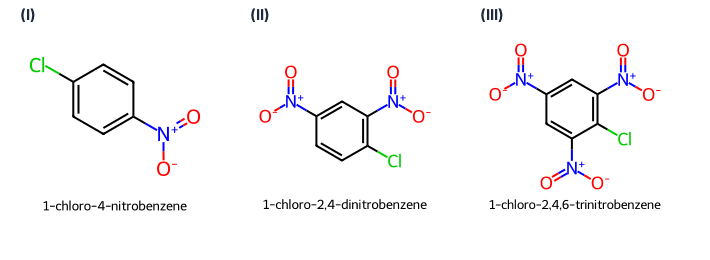
(II) 1-chloro-2,4-dinitrobenzene
(III) 1-chloro-2,4,6-trinitrobenzene
You're viewing a preview — the full solution, concept, methods & PYQ mapping are locked.
Start your 14-day free trial to unlock the full solution →
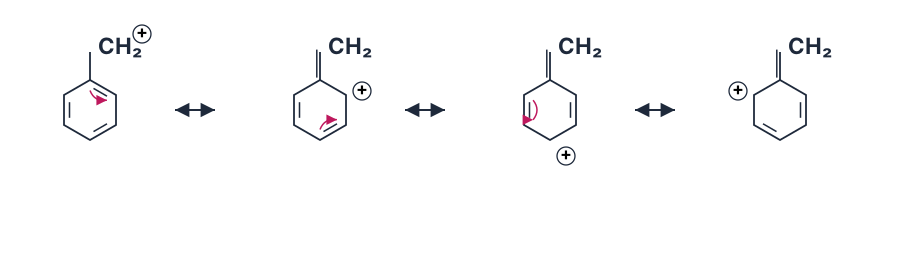
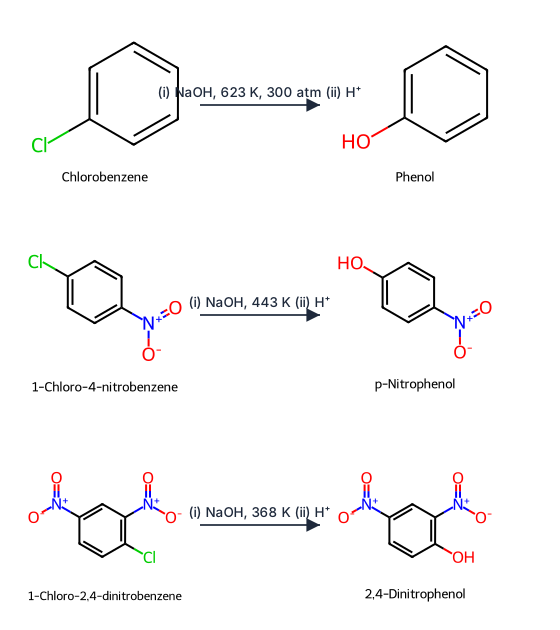
The reactivity order is (III) > (II) > (I). More nitro groups at ortho/para positions create stronger electron withdrawal via resonance and induction, which stabilises the Meisenheimer intermediate in the addition-elimination (SNAr) mechanism, making the aryl halide more reactive.
Why this is not an SN1/SN2 reaction
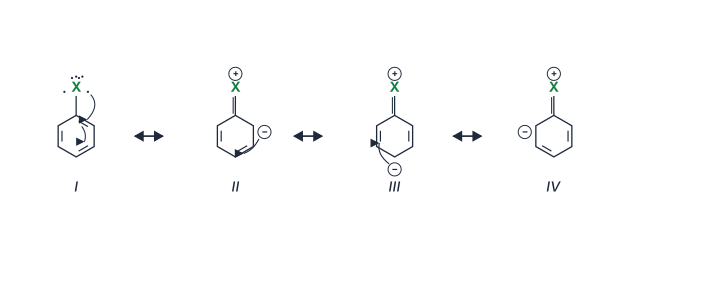
Aryl halides do not undergo typical SN1 or SN2 reactions. The carbon–halogen bond in chlorobenzene has partial double-bond character due to resonance, and the sp²-hybridised carbon is too hindered for a backside attack. Instead, these compounds react via nucleophilic aromatic substitution (SNAr) — specifically an addition-elimination mechanism.
The key step is the formation of a Meisenheimer complex (a negatively charged σ-adduct). The rate-determining step is the attack of the nucleophile on the ring, which creates this intermediate. Anything that stabilises the negative charge on the ring will speed up the reaction.
How nitro groups affect reactivity
A nitro group () is strongly electron-withdrawing by both induction (through σ-bonds) and resonance (through π-system). Crucially, when a nitro group is at the ortho or para position relative to the leaving group, it can delocalise the negative charge that builds up on the ring during nucleophilic attack.
Only nitro groups at ortho or para positions to the chlorine can stabilise the Meisenheimer intermediate via resonance. A meta nitro group cannot do this — it withdraws only inductively, which is much weaker.
Let’s examine each compound.
1. Compound (I): 1-chloro-4-nitrobenzene
One nitro group at the para position. During nucleophilic attack, the negative charge can be delocalised onto the oxygen atoms of the nitro group. This gives moderate stabilisation.
The resonance structures of the intermediate show the negative charge moving from the ring carbon to the nitro group’s oxygen. This lowers the energy of the transition state, but only modestly — one nitro group provides limited stabilisation.
2. Compound (II): 1-chloro-2,4-dinitrobenzene
Two nitro groups: one at ortho and one at para. Both are in positions that allow resonance delocalisation of the negative charge. The intermediate now has two sites where the charge can be spread out. This is significantly more stabilising than one nitro group.
The reactivity jumps noticeably — 2,4-dinitrochlorobenzene is famously reactive toward nucleophiles. (Its fluoro analogue, 1-fluoro-2,4-dinitrobenzene, is Sanger's reagent used in protein sequencing — the chloro compound itself is not.)
3. Compound (III): 1-chloro-2,4,6-trinitrobenzene
Three nitro groups: two ortho and one para. All three can participate in resonance stabilisation of the Meisenheimer intermediate. The negative charge is now delocalised over three nitro groups — an extremely stable intermediate.
This compound is so reactive that it undergoes nucleophilic substitution even with weak nucleophiles like water. It’s known as picryl chloride and is highly electrophilic. …
Unlock everything free for 14 days
- Full step-by-step solutions
- Concept-first explanations
- Methods, shortcuts & mistakes
- PYQ mapping + timed mock tests
Full access for 14 days. No credit card required.