Question of 42
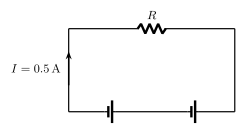
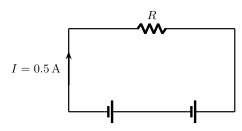
Q.Two batteries, one of emf 18 volts and internal resistance 2Ω and the other of emf 12 volts and internal resistance 1Ω, are connected as shown : What will be the potential difference across the points A and B ?
(a) 30 volt
(b) 18 volt
(c) 15 volt
(d) 14 volt
Goa GbshseGBSHSE Class 12 Board Exam 2025MCQ· 1mImportance★★★★★
0% · 0/42 Questions
You're viewing a preview — the full solution, concept, methods & PYQ mapping are locked.
Start your 14-day free trial to unlock the full solution →With no external load connected, the potential difference across A-B is simply the effective (Millman) EMF of the two parallel cells, which works out to 14 V.
The two branches (each an EMF in series with its internal resistance) are connected in parallel between the same two terminals A and B, with no external resistor drawing current from those terminals.
For two cells of EMF and internal resistances connected in parallel (same polarity), the equivalent EMF between the terminals is
Substituting : …
Unlock everything free for 14 days
- Full step-by-step solutions
- Concept-first explanations
- Methods, shortcuts & mistakes
- PYQ mapping + timed mock tests
Full access for 14 days. No credit card required.