Q.Arrive the expressions for equivalent emf and internal resistance of two cells connected in series.
You're viewing a preview — the full solution, concept, methods & PYQ mapping are locked.
Start your 14-day free trial to unlock the full solution →For two cells in series, the equivalent emf is the sum of the emfs and the equivalent internal resistance is the sum of the internal resistances: , .
Two cells in series
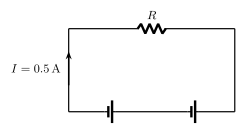
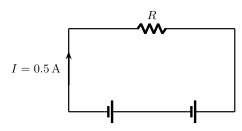
Let two cells of emfs and internal resistances be connected in series so that the negative terminal of the first is joined to the positive terminal of the second. Let the terminals A, B, C be as shown, and let be the current flowing through them.
Let be the potentials at points A, B, C.
Potential difference across the first cell (A to B):
Potential difference across the second cell (B to C):
The potential difference across the combination (A to C):
…
Unlock everything free for 14 days
- Full step-by-step solutions
- Concept-first explanations
- Methods, shortcuts & mistakes
- PYQ mapping + timed mock tests
Full access for 14 days. No credit card required.