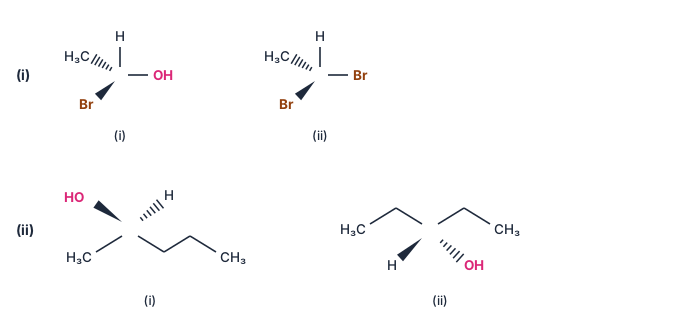
Q.Identify chiral and achiral molecules in each of the following pair of compounds. (Wedge and Dash representations according to Class XI.)
You're viewing a preview — the full solution, concept, methods & PYQ mapping are locked.
Start your 14-day free trial to unlock the full solution →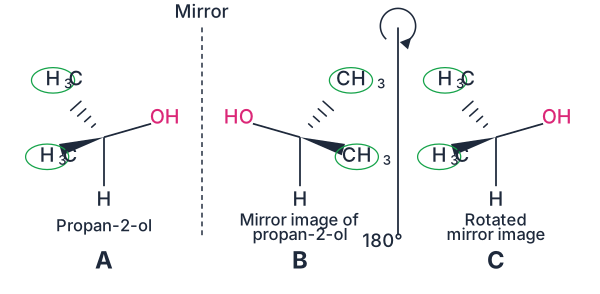
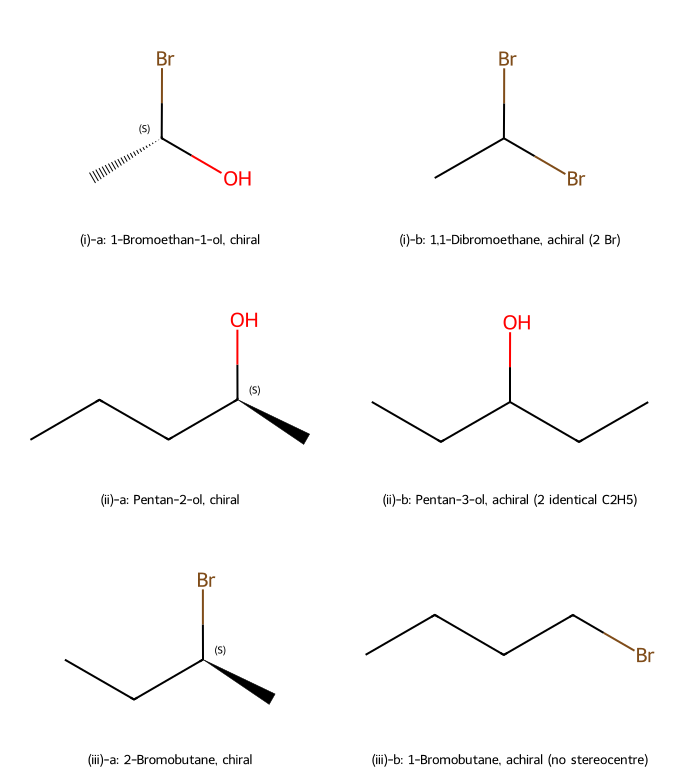
The key idea is that a molecule is chiral if it has a carbon atom bonded to four different groups (a stereocenter) and is non-superimposable on its mirror image. For the given pairs: (i) 1-Bromoethan-1-ol is chiral; 1,1-dibromoethane is achiral.
(ii) Pentan-2-ol is chiral; pentan-3-ol is achiral.
(iii) 2-Bromobutane is chiral; 1-bromobutane is achiral.
Why This Approach Works
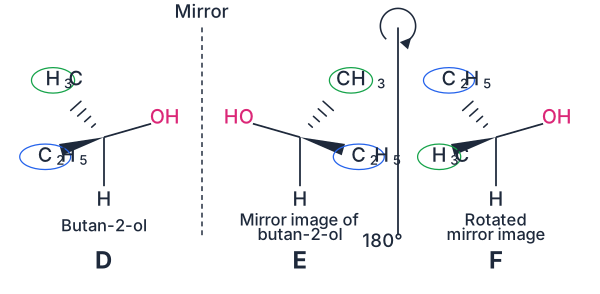
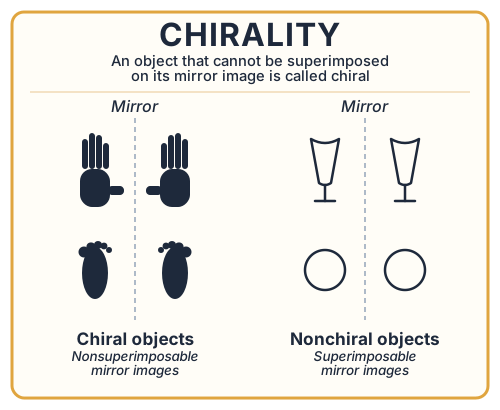
Chirality is a property of molecular handedness — a molecule is chiral if its mirror image cannot be superimposed on it, much like your left and right hands. The most common cause in organic chemistry is a stereocenter (or chiral center): a carbon atom bonded to four different substituents. If even two substituents are identical, the molecule becomes achiral because it will have a plane of symmetry.
The wedge-and-dash notation helps visualize the 3D arrangement: a solid wedge means a bond coming out of the plane toward you, a dashed wedge means a bond going behind the plane, and a plain line means a bond in the plane. But the real trick is to check each carbon for four different groups — no need to draw every 3D structure if you can spot the symmetry.
A common mistake is to think that any carbon with four bonds is a chiral center. It must have four different groups. Also, a molecule can be achiral even if it has no obvious plane of symmetry — but for these simple compounds, checking for a plane of symmetry is a reliable shortcut.
Let’s work through each pair step by step.
(i) 1-Bromoethan-1-ol () and 1,1-dibromoethane ()
1. Analyze 1-Bromoethan-1-ol ().
The structure is:
The central carbon (C2) is bonded to:
- a hydrogen atom (H)
- a bromine atom (Br)
- a hydroxyl group (OH)
- a methyl group ()
Are all four groups different? Yes — H, Br, OH, and are all distinct. So this carbon is a stereocenter. The molecule has no plane of symmetry (the OH and Br are different, and the and H are different), so it is chiral.
2. Analyze 1,1-dibromoethane ().
The structure is:
The central carbon (C2) is bonded to:
- a hydrogen atom (H)
- two bromine atoms (Br and Br) — these are identical
- a methyl group ()
Because two of the groups are the same (the two Br atoms), this carbon is not a stereocenter. The molecule has a plane of symmetry that passes through the H, the C, and the , cutting between the two Br atoms. So it is achiral.
For a carbon with two identical substituents, the molecule is always achiral — it will have a plane of symmetry through the carbon and the two different groups.
(ii) Pentan-2-ol () and Pentan-3-ol ()
1. Analyze Pentan-2-ol.
The structure is:
The carbon with the OH group (C2) is bonded to:
- a hydrogen atom (H)
- a hydroxyl group (OH)
- a methyl group () on one side
- a propyl group () on the other side
Are all four groups different? Yes — H, OH, , and are all distinct. So C2 is a stereocenter. The molecule has no plane of symmetry (the chain is asymmetric), so it is chiral.
2. Analyze Pentan-3-ol.
The structure is:
The carbon with the OH group (C3) is bonded to:
- a hydrogen atom (H)
- a hydroxyl group (OH)
- two ethyl groups ( and ) — these are identical …
Unlock everything free for 14 days
- Full step-by-step solutions
- Concept-first explanations
- Methods, shortcuts & mistakes
- PYQ mapping + timed mock tests
Full access for 14 days. No credit card required.