Q.Explain why diffraction of sound is more common in daily experience than that of light.
You're viewing a preview — the full solution, concept, methods & PYQ mapping are locked.
Start your 14-day free trial to unlock the full solution →Diffraction — the bending of waves around obstacles — is more noticeable for sound than for light because sound has a much longer wavelength (comparable to everyday objects), while light’s wavelength is tiny, so its diffraction effects are too small to observe without special setups.
The Core Concept: Wavelength and Obstacle Size
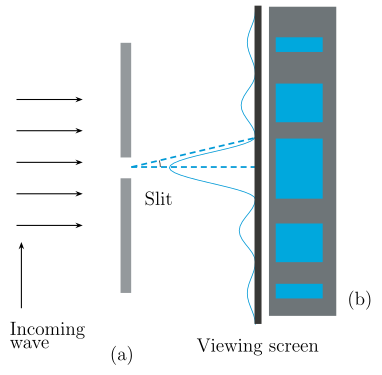
Diffraction isn’t a special property of sound or light — it’s a universal wave behaviour. Every wave bends around corners and spreads after passing through openings. The key question is: how much does it bend?
The amount of diffraction depends on the ratio of the wavelength () to the size of the obstacle or opening (). When is comparable to or larger than , diffraction is strong and obvious. When is much smaller than , diffraction is negligible — the wave travels almost in straight lines (like a ray).
This is why you can hear someone around a corner but cannot see them. Let’s break down why.
Step-by-Step Reasoning
-
Typical wavelengths in daily life
- Sound: Audible sound has frequencies from about 20 Hz to 20,000 Hz. In air, speed . Using :
- Low bass (100 Hz):
- Mid-range (1000 Hz): (34 cm)
- High treble (10,000 Hz): (3.4 cm)
- Light: Visible light has wavelengths from about to ( to ). That’s hundreds of nanometres — a million times smaller than sound wavelengths.
- Sound: Audible sound has frequencies from about 20 Hz to 20,000 Hz. In air, speed . Using :
-
Compare with everyday obstacles
A door opening is about wide. A building corner has a radius of curvature of perhaps to . A person’s head is about across.
- For sound: Many sound wavelengths (especially bass and mid-range) are comparable to or larger than these sizes. So sound diffracts strongly around doors, corners, and people.
- For light: The wavelength is 10,000 to 100,000 times smaller than a door or a corner. Light passes through such openings with almost no bending — it travels in straight lines, casting sharp shadows.
-
The diffraction condition
For significant diffraction, the opening or obstacle size should satisfy (rough rule).
- Sound: , → → strong diffraction.
- Light: , → → negligible diffraction.
A common mistake is to think that light cannot diffract. It can — but only when the opening or obstacle is comparable to its wavelength, i.e., a few hundred nanometres. That’s why you need a diffraction grating (with micron-scale slits) or a pinhole to see light diffraction. In daily life, no such tiny obstacles exist.
- Why we notice sound diffraction but not light diffraction …
Unlock everything free for 14 days
- Full step-by-step solutions
- Concept-first explanations
- Methods, shortcuts & mistakes
- PYQ mapping + timed mock tests
Full access for 14 days. No credit card required.