Question of 54
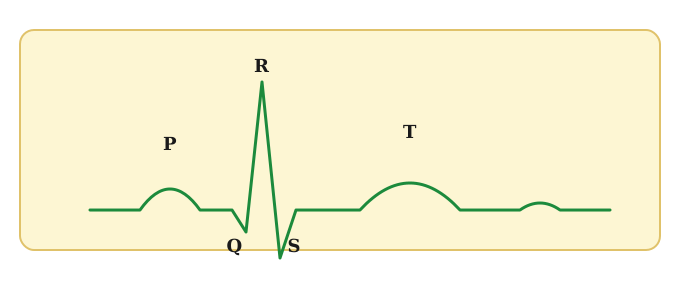
Q.Given below is diagrammatic presentation of standard ECG. Answer the following :
(i) [1 mark] Name the machine which is used to obtain ECG.
(ii) [1 mark] What P-wave represents and what it leads to ?
(iii) [2 marks] What is T-wave and what is the end of it marks ?
OR
(iii) alternative [2 marks] What QRS complex represents ? What is initiated by it ?
Haryana BsehBoard of School Education Haryana (Senior Secondary Part-I / Class 11) 2025Subjective· 4mImportance★★★★★
0% · 0/54 Questions
You're viewing a preview — the full solution, concept, methods & PYQ mapping are locked.
Start your 14-day free trial to unlock the full solution →The ECG is recorded by an Electrocardiograph; the P-wave marks atrial depolarisation (leading to atrial contraction) and the T-wave marks ventricular repolarisation (marking the end of ventricular systole).
An electrocardiogram (ECG), as shown in the figure, is a graphical record of the electrical activity of the heart during one cardiac cycle, with characteristic waves labelled P, Q, R, S, and T.
- [1 mark] Machine used to obtain ECG: The ECG is recorded using an instrument called the Electrocardiograph.
- [1 mark] What the P-wave represents and what it leads to: The P-wave represents the depolarisation of the atria — the electrical excitation that spreads from the SA node (sinoatrial node, the "pacemaker") through both atria. This electrical depolarisation is what triggers and leads to atrial systole, i.e., the contraction of the atria, which pushes blood from the atria into the ventricles.
- [2 marks] What the T-wave is and what its end marks: The T-wave represents the repolarisation of the ventricles — the return of the ventricular muscle to its resting electrical state after contraction. The end of the T-wave marks the end of ventricular systole, i.e., the completion of ventricular contraction/relaxation for that cardiac cycle, after which the heart is ready to begin the next cycle. …
Unlock everything free for 14 days
- Full step-by-step solutions
- Concept-first explanations
- Methods, shortcuts & mistakes
- PYQ mapping + timed mock tests
Full access for 14 days. No credit card required.