Question of 77
Q.(a) Give a schematic representation showing the events of spermatogenesis in humans.
(3)
(b) Describe structure of human sperm.
(2)
OR
Describe the structure of pollen grain in detail.
Haryana BsehBSEH Intermediate Board 2026Subjective· 5mImportance★★★★★
0% · 0/77 Questions
You're viewing a preview — the full solution, concept, methods & PYQ mapping are locked.
Start your 14-day free trial to unlock the full solution →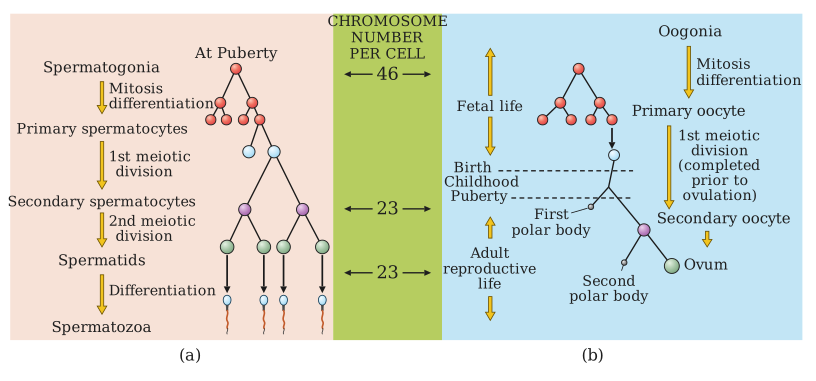
Spermatogenesis converts diploid spermatogonia into haploid, motile spermatozoa through mitosis, meiosis and morphological transformation (spermiogenesis); the resulting sperm is structurally organised into head, neck, middle piece and tail.
(a) Schematic representation of spermatogenesis:
- Diploid spermatogonia (2n), present on the inner wall of seminiferous tubules, multiply by mitosis and increase in number.
- Some spermatogonia periodically undergo differentiation, enlarging into primary spermatocytes (2n).
- Each primary spermatocyte completes meiosis I (reductional division) to form two equal, haploid secondary spermatocytes (n).
- The secondary spermatocytes undergo meiosis II (equational division) to produce four equal, haploid spermatids (n) per primary spermatocyte.
- Spermatids are then transformed into mature, motile spermatozoa through the process of spermiogenesis (growth of tail, condensation of nucleus, formation of acrosome).
- Following spermiogenesis, sperm heads become embedded in the Sertoli cells, and are finally released from the seminiferous tubule by a process called spermiation. The whole process is regulated by hormones — GnRH from the hypothalamus stimulates the pituitary to release LH and FSH, which act on Leydig cells (testosterone secretion) and Sertoli cells respectively.
(b) Structure of human sperm: …
Unlock everything free for 14 days
- Full step-by-step solutions
- Concept-first explanations
- Methods, shortcuts & mistakes
- PYQ mapping + timed mock tests
Full access for 14 days. No credit card required.