Q.The treatment of alkyl chlorides with aqueous KOH leads to the formation of alcohols but in the presence of alcoholic KOH, alkenes are major products. Explain.
You're viewing a preview — the full solution, concept, methods & PYQ mapping are locked.
Start your 14-day free trial to unlock the full solution →
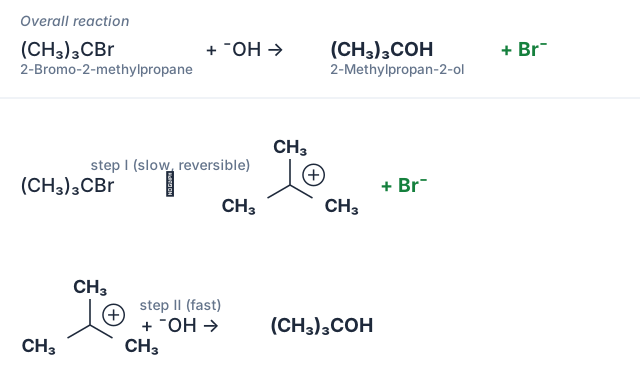
The key difference is the solvent: aqueous KOH favours substitution (SN2 for primary, SN1 for tertiary halides) to give alcohols, while alcoholic KOH favours elimination (E2) to give alkenes — the solvent controls which nucleophile/base is dominant and which mechanism is preferred.
This is a classic example of how a seemingly small change in reaction conditions — swapping water for ethanol — completely redirects the outcome. The reason lies in the dual role of KOH: it provides both a nucleophile (OH⁻) and a base (also OH⁻). The solvent decides which role wins.
The core idea: In aqueous solution, OH⁻ is heavily solvated by water, making it a less effective base but still a good nucleophile. In alcoholic solution, OH⁻ is less solvated, so it acts as a stronger base, favouring elimination over substitution. Additionally, the polarity of the solvent affects the stability of carbocation intermediates in SN1 reactions.
Let’s break it down step by step.
-
The reagent and its dual nature.
KOH in water dissociates to give K⁺ and OH⁻ ions. The hydroxide ion can act in two ways:
- As a nucleophile — it attacks the electrophilic carbon bearing the chlorine, displacing Cl⁻ (substitution).
- As a base — it abstracts a β-hydrogen (a hydrogen on the carbon next to the C–Cl), leading to formation of a double bond (elimination). The solvent determines which of these two pathways is kinetically favoured.
-
Aqueous KOH: substitution dominates.
Water is a highly polar, protic solvent. It strongly solvates the OH⁻ ion through hydrogen bonding, reducing its basicity and nucleophilicity. However, the effect on basicity is more pronounced — a solvated OH⁻ is a weaker base because the solvent stabilises the negative charge, making it less eager to abstract a proton.
For alkyl chlorides (especially tertiary or secondary ones), the reaction proceeds via an SN1 mechanism:
- Step 1: The C–Cl bond breaks slowly to form a carbocation (rate-determining step).
- Step 2: The carbocation is rapidly attacked by water (the solvent) to give a protonated alcohol, which then loses a proton to form the alcohol. The OH⁻ in solution acts mainly to neutralise the H⁺ released, not as the direct nucleophile. The result is an alcohol as the major product.
NoteFor primary alkyl chlorides, SN2 would dominate even in aqueous KOH, but the question focuses on the general trend — and for most alkyl chlorides (2°, 3°), SN1 is the pathway in aqueous conditions.
-
Alcoholic KOH: elimination dominates.
When the solvent is ethanol (or another alcohol), the environment is less polar and less protic than water. Ethanol still solvates ions, but much less effectively than water. The OH⁻ ion is now less solvated, making it a much stronger base.
- The strong base favours E2 elimination: a one-step, concerted process where the base abstracts a β-hydrogen while the C–Cl bond breaks, forming the alkene directly.
- The carbocation pathway (SN1) is suppressed because the solvent is less polar, destabilising the carbocation intermediate. …
Unlock everything free for 14 days
- Full step-by-step solutions
- Concept-first explanations
- Methods, shortcuts & mistakes
- PYQ mapping + timed mock tests
Full access for 14 days. No credit card required.