Q.Name the optoelectronic device used to detect optical signals.
🔒You're viewing a preview — the full solution, concept, methods & PYQ mapping are locked.
🔒 Start your 14-day free trial to unlock the full solution →Concept understanding — Photodiode
A photodiode is a p-n junction diode that converts an optical signal INTO an electrical signal, operated in REVERSE bias (the operational converse of the forward-biased LED). When a photon of sufficient energy hν strikes the depletion region, it lifts a valence electron into the conduction band, creating an electron-hole pair exactly as in ordinary thermal generation, except driven by light rather than heat; the reverse-bias field then sweeps these carriers across the junction before recombination, and completing an external circuit turns this into a measurable photocurrent proportional to the incident light in …
A photodiode is a p-n junction operated in reverse bias, and incident photons above its band-gap energy generate extra electron-hole pairs that increase the reverse current in proportion to the light intensity — making the reverse current i …
A photodiode is a p-n junction, operated in reverse bias, whose reverse current changes with the intensity of light falling on it — this makes it an optical signal detector.
A photodiode is fabricated with a transparent window so light can fall on or near the junction. It is operated under reverse bias. Normally the reverse saturation current is very small, but when photons of energy greater than the band gap strike the junction, they generate electron-hole pairs, which …
- CBSE 2021Set OC1 markQ.What is dark current?
›Reveal solutionSolution
Dark current is the residual reverse current of a photodiode that exists purely due to thermal generation of carriers, independent of illumination.
A photodiode is a p-n junction diode operated in reverse bias, in which incident light (photons) generates electron-hole pairs that add to the reverse saturation current, so the reverse current increases with light intensity.
…
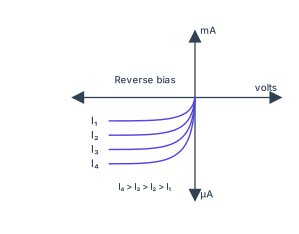
- CBSE 2019Set 55/2/11 markQ.Identify the semiconductor diode whose V-I characteristics are as shown.
›Reveal solutionSolution
The V-I curve shows current increasing with reverse bias (third quadrant operation), characteristic of a photodiode operating in photoconductive mode where light generates carriers that flow under reverse bias.
Figure — CBSE 2019 55/2/1 Q4 A standard p-n junction diode conducts heavily in forward bias (first quadrant) and blocks current in reverse bias except for a tiny leakage. The curve shown behaves differently: it operates primarily in the third quadrant (negative voltage, negative current), meaning current flows and increases as reverse bias increases. This is the signature of a light-detecting diode.
When light falls on a reverse-biased p-n junction, photons with energy greater than the band gap create electron-hole pairs in the depletion region. The built-in electric field sweeps these carriers across the junction, producing a photocurrent proportional to light intensity. The more reverse bias you apply, the wider the depletion region and the more efficiently carriers are collected—hence current magnitude grows with reverse voltage.
Why this identifies a photodiode
-
Third-quadrant operation: The curve sits in the region where both voltage and current are negative (reverse bias with current flow). A normal diode would show negligible current here; a photodiode is designed to operate here.
-
Current increases with reverse bias: As ∣VR∣ increases, ∣I∣ increases. This happens because:
- Wider depletion width → more photogenerated carriers collected
- Stronger electric field → faster carrier sweep-out
- The photocurrent Iph∝ (light intensity) × (collection efficiency)
-
No significant forward conduction shown: The first quadrant (forward bias) is either absent or minimal in the sketch, confirming the device is used in reverse mode—the standard operating regime for photodetection. …
-
- CBSE 2019Set ANNUAL1 markMCQQ.Photodiode functions in(a) Forward biased condition(b) Reverse biased condition(c) Both forward and reversed biased conditions(d) None of these
›Reveal solutionSolution
A photodiode is deliberately reverse biased because in this mode the diode's own dark current is tiny and stable, so the extra current generated by absorbed photons (electron-hole pairs) stands out clearly and varies almost linearly with light intensity.
A photodiode is a p-n junction diode designed to be sensitive to light, used to detect optical signals and convert them into an electrical current. It is operated in reverse bias:
- In reverse bias, the junction's depletion region widens and normally only a very small reverse saturation current flows (due to thermally generated minority carriers).
- When light (photons with energy greater than the bandgap) falls on the junction, it generates additional electron-hole pairs. These carriers are swept across the junction by the reverse-bias electric field, adding to the reverse current. …
- CBSE 2019Set ANNUAL1 markQ.Name the optoelectronic device used to detect optical signals.
›Reveal solutionSolution
A photodiode is a p-n junction, operated in reverse bias, whose reverse current changes with the intensity of light falling on it — this makes it an optical signal detector.
A photodiode is fabricated with a transparent window so light can fall on or near the junction. It is operated under reverse bias. Normally the reverse saturation current is very small, but when photons of energy greater than the band gap strike the junction, they generate electron-hole pairs, which …
- CBSE 2016Set ANNUAL1 markMCQQ.For determining the light intensity we use(a) a photodiode in reverse bias(b) a photodiode in forward bias(c) LED in reverse bias(d) LED in forward bias
›Reveal solutionSolution
A reverse-biased photodiode's current responds linearly and quickly to incident light intensity, making it ideal for measuring light intensity.
A photodiode is a p-n junction diode designed to be operated in reverse bias and exposed to light through a transparent window. Photons incident on (and near) the junction generate electron-hole pairs; these are swept across the junction by the reverse-bias electric field, adding to the (otherwise very small) reverse saturation current. The magnitude of this reverse photocurrent increases almost linearly with the intensity of incident light, and the device responds quickly (fast rise/fall time), making a reverse-biased photodiode well suited as a sensitive, fast light-intensity (illumination) sensor/detector.
Why the other options are wrong: …
🎓Unlock everything free for 14 days
- ✓Full step-by-step solutions
- ✓Concept-first explanations
- ✓Methods, shortcuts & mistakes
- ✓PYQ mapping + timed mock tests
Full access for 14 days. No credit card required.