Q.Distinguish between Forward and Reverse biasing in a p-n junction diode with the help of circuit diagram. Explain construction and working of a photo-diode. The current in the forward bias is known to be more (mA) than the current in the reverse bias (μA). What is the reason then to operate the photodiodes in reverse bias?
You're viewing a preview — the full solution, concept, methods & PYQ mapping are locked.
Start your 14-day free trial to unlock the full solution →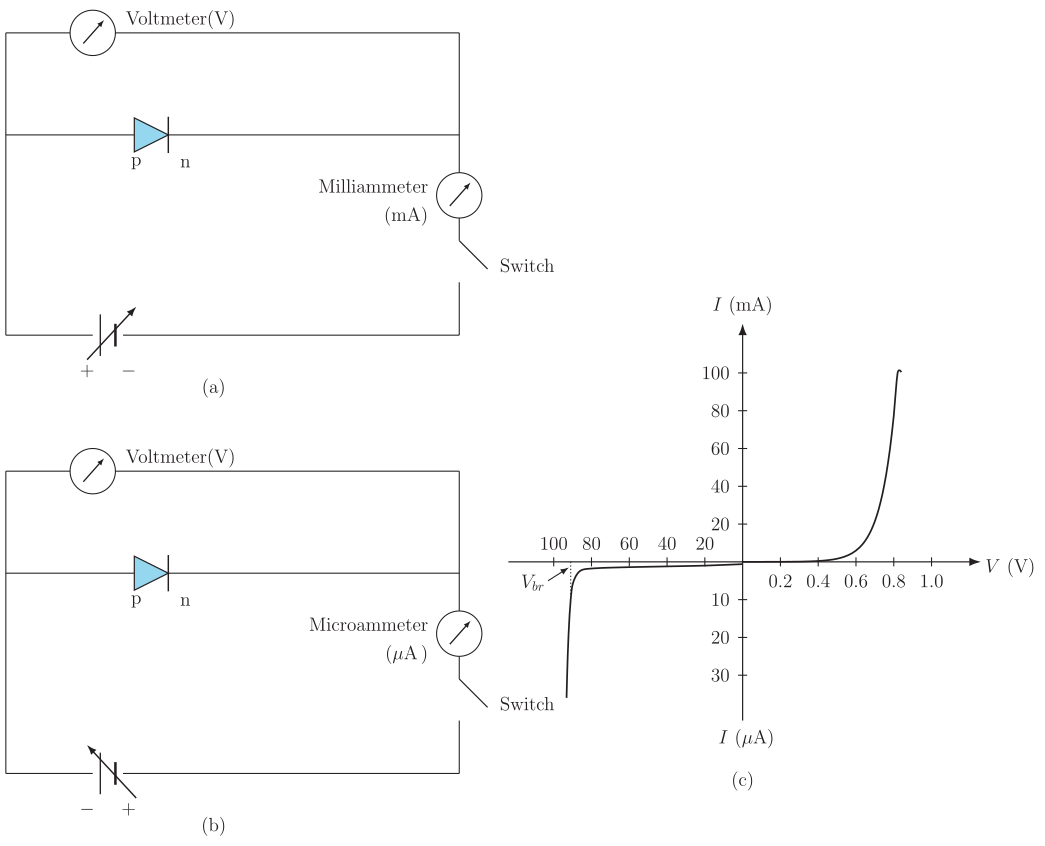
Forward bias = p to + terminal (low resistance, large current); reverse bias = p to − terminal (high resistance, tiny current). A photodiode is run in reverse bias because there the small reverse saturation current changes linearly and measurably with light intensity, giving a much more useful and sensitive light-current relationship than in forward bias.
Forward biasing: The p-side of the junction is connected to the positive terminal of the battery and the n-side to the negative terminal. This reduces the width of the depletion layer and lowers the junction's barrier potential, offering low resistance to current flow. A relatively large current (of the order of mA) flows, dominated by the diffusion of majority carriers across the junction.
Reverse biasing: The p-side is connected to the negative terminal and the n-side to the positive terminal. This increases the depletion layer width and the barrier potential, offering very high resistance. Only a small, nearly constant reverse saturation current (of the order of μA), due to minority carriers, flows across the junction.
(Circuit diagrams: forward bias — battery's + terminal wired to the p-region, − terminal to the n-region, in series with a milliammeter and a current-limiting resistor; reverse bias — battery's − terminal wired to the p-region, + terminal to the n-region, in series with a microammeter.)
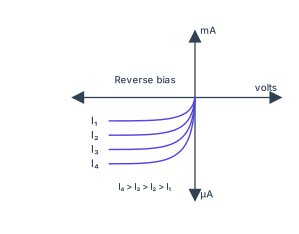
Photodiode — construction and working: A photodiode is a p-n junction diode made with a transparent window/lens so that light can fall directly on the junction. It is operated under reverse bias. In the dark, only the small reverse saturation current flows. When light (photons with energy greater than the semiconductor's band gap) falls on the junction, it generates electron-hole pairs near the depletion region. The junction's electric field quickly sweeps these light-generated carriers across the junction, adding to the reverse current. The magnitude of this photocurrent increases linearly with the intensity of the incident light, so the photodiode can be used to measure light intensity electronically.
…
Unlock everything free for 14 days
- Full step-by-step solutions
- Concept-first explanations
- Methods, shortcuts & mistakes
- PYQ mapping + timed mock tests
Full access for 14 days. No credit card required.