Question of 37
Q.Discuss the working of a photodiode. Why is a photodiode operated in reverse bias mode?
Meghalaya MboseMBOSE Meghalaya Intermediate Board 2018Subjective· 4mImportance★★★★★
0% · 0/37 Questions
You're viewing a preview — the full solution, concept, methods & PYQ mapping are locked.
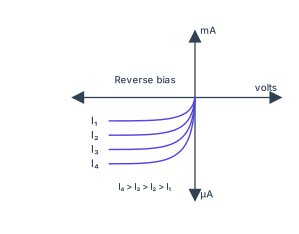
Start your 14-day free trial to unlock the full solution →Light falling on a reverse-biased p-n junction generates extra electron-hole pairs in/near the depletion region, and these are swept across by the junction field, adding a light-dependent contribution to the (otherwise tiny) reverse saturation current — reverse bias is chosen because it makes this small photocurrent easy to detect and keeps the response fast.
Working of a photodiode
A photodiode is essentially a p-n junction diode with a transparent window that lets light fall on (or near) the depletion region, and it is operated under reverse bias.
- Without light, only a small reverse saturation current flows (due to thermally generated minority carriers).
- When photons of energy the material's band gap fall on the junction, they generate additional electron-hole pairs.
- The (still-present) electric field of the depletion region, strengthened by the reverse bias, sweeps these photo-generated carriers across the junction quickly, adding a photocurrent to the reverse current.
- This photocurrent increases (nearly linearly) with the intensity of incident light, so the diode's reverse current becomes a measure of light intensity.
Why reverse bias, not forward bias?
- In forward bias, a large forward current already flows due to injected majority carriers; a small light-generated current would be swamped and undetectable against this large background. …
Unlock everything free for 14 days
- Full step-by-step solutions
- Concept-first explanations
- Methods, shortcuts & mistakes
- PYQ mapping + timed mock tests
Full access for 14 days. No credit card required.