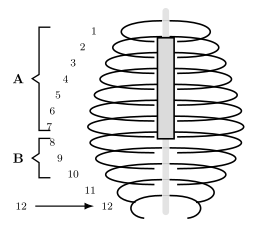
Q.(i) Study the following diagram about Ribs and Answer the questions below :
You're viewing a preview — the full solution, concept, methods & PYQ mapping are locked.
Start your 14-day free trial to unlock the full solution →(i) The diagram shows the human rib cage: group A (ribs 1-7) are the true/vertebrosternal ribs, group B (ribs 8-10) are the vertebrochondral/false ribs, and ribs are ventrally attached to the sternum. (ii) Acetylcholine is a common neurotransmitter. (iii) Grey matter (unmyelinated cell bodies) and white matter (myelinated axons) differ in composition, location and colour.
(i) The human thoracic (rib) cage consists of 12 pairs of ribs, classified by how they attach to the sternum:
- Part A (ribs 1-7, bracketed together in the diagram) are the True ribs, also called Vertebrosternal ribs, because each one is connected directly to the sternum by its own costal cartilage. Part B (ribs 8-10, the next bracketed group) are the Vertebrochondral ribs — these do not attach directly to the sternum; instead, their costal cartilages join the cartilage of the rib immediately above them, so they are attached to the sternum only indirectly.
- Since ribs 8-10 (Vertebrochondral ribs) do not connect directly to the sternum, they are grouped together with ribs 11 and 12 (which do not connect to the sternum at all) under the common name False ribs — so the Vertebrochondral ribs are also known as False Ribs.
- All ribs are dorsally (posteriorly) attached to the thoracic vertebrae of the vertebral column. Ventrally (anteriorly), the true ribs (1-7) and the vertebrochondral/false ribs (8-10) are connected — directly or indirectly via costal cartilage — to the sternum (breastbone); ribs 11 and 12 (floating ribs, shown unbracketed with the arrow in the diagram) have no ventral connection at all and end freely in the body wall musculature.
(ii) Common neurotransmitter: Acetylcholine is one of the most common and widely studied neurotransmitters, released at the synaptic knob of a neuron to transmit the nerve impulse across a synapse to the next neuron or to a muscle (at the neuromuscular junction). (Noradrenaline is another common neurotransmitter, especially in the sympathetic nervous system.)
…
Unlock everything free for 14 days
- Full step-by-step solutions
- Concept-first explanations
- Methods, shortcuts & mistakes
- PYQ mapping + timed mock tests
Full access for 14 days. No credit card required.