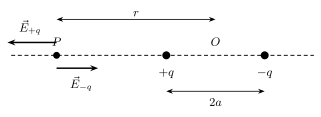
Q.Let the point P be at distance r from the centre of the dipole on the side of the charge q, as shown in Figure, then.
🔒You're viewing a preview — the full solution, concept, methods & PYQ mapping are locked.
🔒 Start your 14-day free trial to unlock the full solution →Concept understanding — Electric Field Due to a Dipole
A short dipole's field falls off as 1/r3 (faster than a single charge's 1/r2, since the two opposite charges' fields nearly cancel at large distances) and depends on direction: on the axial line (through the charges, extended), Eaxial=2kp/r3, directed along p; on the equatorial line (perpendicular bisector), Eeq=kp/r3, directed opposite to p -- exactly half the axial value at the same distance. At a general point making angle θ with the axis, $E=(kp …
Point P lies on the axial line closer to the +q charge (at distance r − a) than to −q (at distance r + a), so Coulomb's law for the field due to +q alone uses this shorter distance. …
The point P is closer to the +q charge (distance r−a) than to −q (distance r+a), so the field due to +q at P follows the inverse-square law with (r−a) in the denominator, pointing away from +q along the dipole axis.
Figure recap: The dipole has +q at one end and −q at the other, separated by 2a, with centre O. Point P lies on the axial line at distance r from O, on the side of the +q charge, so P is only (r−a) away from +q but (r+a) away from −q.
Field due to +q at P: Using Coulomb's law for a point charge,
E(+q)=4πε0(r−a)2q
directed AWAY from +q, i.e. along p^ (the unit vector along the dipole axis, pointing from −q towards +q and beyond, towards P).
…
- CBSE 2026Set ANNUAL1 markMCQQ.Let the point P be at distance r from the centre of the dipole on the side of the charge q, as shown in Figure, then.(a) E(+q) = q / [4πε₀ (r + a)²] , directed along P̂(b) E(+q) = q / [4πε₀ (r - a)²] , directed along P̂(c) E(+q) = -q / [4πε₀ (r + a)³] , directed along P̂(d) None of these
›Reveal solutionSolution
The point P is closer to the +q charge (distance r−a) than to −q (distance r+a), so the field due to +q at P follows the inverse-square law with (r−a) in the denominator, pointing away from +q along the dipole axis.
Figure recap: The dipole has +q at one end and −q at the other, separated by 2a, with centre O. Point P lies on the axial line at distance r from O, on the side of the +q charge, so P is only (r−a) away from +q but (r+a) away from −q.
Field due to +q at P: Using Coulomb's law for a point charge,
E(+q)=4πε0(r−a)2q
directed AWAY from +q, i.e. along p^ (the unit vector along the dipole axis, pointing from −q towards +q and beyond, towards P).
…
- CBSE 2026Set SEM31 markMCQQ.The electric field intensity due to an electric dipole at a distance r from its centre in axial position is E. If the dipole is rotated through an angle of 90° about its perpendicular axis, the magnitude of the electric field intensity at the same point will be(a) E(b) E/4(c) E/2(d) 2E
›Reveal solutionSolution
At the same distance r, the axial field is twice the equatorial field. Rotating the dipole 90° about its perpendicular axis makes the observation point equatorial, so the field drops to E/2. Option (c).
Step 1 — recall the two standard dipole fields at distance r (r ≫ dipole size), from NCERT/CBSE Class 12 Physics:
- Axial (end-on): E_axial = (1/4πε₀)(2p/r³)
- Equatorial (broadside): E_equatorial = (1/4πε₀)(p/r³) …
- CBSE 2025Set ANNUAL1 markQ.The electric field intensity at axis due to an electric dipole is inversely proportional to the ____________ of distance.
›Reveal solutionSolution
The axial field of a dipole falls off much faster than that of a single point charge — as the inverse cube, not the inverse square, of distance.
For a short electric dipole of moment p=q(2a), the electric field at a point on the axial line at distance r from the centre (for r≫a) is:
Eaxial=4πε01r32p
…
- CBSE 2023Set 55/1/11 markMCQQ.A point charge, situated at a distance r from a short electric dipole on its axis, experiences a force F. If the distance of the charge is doubled, the force acting on the charge will be :(a) 16F(b) 8F(c) 4F(d) 2F
›Reveal solutionSolution
The force on a point charge due to a short electric dipole on its axis follows an inverse-cube law. Doubling the distance reduces the force by a factor of 8, so the new force is F/8.
The key here is understanding how the electric field of a dipole behaves with distance. A short electric dipole (two equal and opposite charges separated by a small distance) does not produce a field that falls off like a point charge (1/r2). Instead, along its axis, the field falls off as 1/r3. This is because the fields from the two opposite charges nearly cancel at large distances, leaving a weaker, faster-decaying net field.
Since force on a test charge is F=qE, and the test charge itself doesn’t change, the force is directly proportional to the dipole’s electric field at that point. So if the field changes by a factor, the force changes by the same factor.
Let’s work through it step by step.
- Recall the formula for the axial field of a short dipole. For a dipole of dipole moment p, at a point on its axis at distance r from its centre (where r is much larger than the separation between the two charges), the electric field magnitude is:
E=4πε01⋅r32p
This is a standard result — the 1/r3 dependence is the hallmark of a dipole field.
- Relate force to field. The force on a point charge q placed in this field is simply:
F=qE=q⋅4πε01⋅r32p
So F∝r31.
- Now double the distance. Let the initial distance be r, giving force F. …
- CBSE 2023Set ANNUAL1 markQ.Write the value of electric field due to an electric dipole at a point on its axis.
›Reveal solutionSolution
The electric field on the axial line of a short dipole falls off as 1/r^3 and is twice the equatorial field at the same distance.
For an electric dipole of dipole moment p=q(2a), the exact field at an axial point at distance r from the centre is
Eaxial=4πε01(r2−a2)22pr
For a short dipole, i.e. when r≫a (the usual approximation used), this simplifies to …
- CBSE 2023Set ANNUAL1 markMCQQ.The electric field and the potential of an electric dipole vary with distance r as(1) 1/r and 1/r^2(2) 1/r^2 and 1/r(3) 1/r^2 and 1/r^3(4) 1/r^3 and 1/r^2
›Reveal solutionSolution
For a dipole, the potential falls one power of r faster than a single charge (1/r² instead of 1/r), and the field falls one power faster than the potential (1/r³).
…
- CBSE 2020Set ANNUAL1 markMCQQ.The ratio of the electric field intensity due to an electric dipole at an axial point to that at an equatorial point at same distance from the centre is(i) 1 : 1(ii) 2 : 1(iii) 1 : 2(iv) 1 : 4
›Reveal solutionSolution
For a short dipole, Eaxial=2Eequatorial at the same distance, so the ratio is 2:1.
For an electric dipole of moment p, at a distance r from the centre (with r much greater than the dipole separation):
Field at an axial (end-on) point:
Eaxial=4πε01r32p
Field at an equatorial (broadside-on) point:
Eequatorial=4πε01r3p
…
- CBSE 2018Set ANNUAL1 markQ.Match the Column-A item 'Intensity of electric field on axial position' with the correct entry from Column-B. Column-B options (as printed, unordered): watt; μ₀/4π · 2md/(d² − l²)²; 1/(4πε₀) · 2pr/(r² − l²)²; Transverse wave; A coil.
›Reveal solutionSolution
The axial field of a short electric dipole is E = (1/4πε₀)·2pr/(r²−l²)², matching the Column-B formula involving p (dipole moment) and r (distance).
For an electric dipole of dipole moment p (charges ±q separated by 2l), the electric field intensity at a point on its axial line, at distance r from the centre, is:
Eaxial=4πε01⋅(r2−l2)22pr …
- CBSE 2018Set ANNUAL1 markMCQQ.A given charge situated at a certain distance from an electric dipole of very small length along its axial line experiences a force F. If the distance of the charge is doubled, the force on the charge will become(a) 2F(b) F/2(c) F/4(d) F/8
›Reveal solutionSolution
The axial-line field of a short dipole varies as 1/r3, so doubling the distance cuts the force to 1/8 of its original value.
Step 1 — Field of a short dipole on its axial line
Eaxial=r32kp
where p is the dipole moment and r is the distance from the centre of the dipole (valid for r≫ dipole length).
Step 2 — Force on the charge
…
🎓Unlock everything free for 14 days
- ✓Full step-by-step solutions
- ✓Concept-first explanations
- ✓Methods, shortcuts & mistakes
- ✓PYQ mapping + timed mock tests
Full access for 14 days. No credit card required.