Q.Draw the molecular orbital diagram for O2 molecule. Write its molecular orbital electronic configuration and predict its magnetic behaviour.
You're viewing a preview — the full solution, concept, methods & PYQ mapping are locked.
Start your 14-day free trial to unlock the full solution →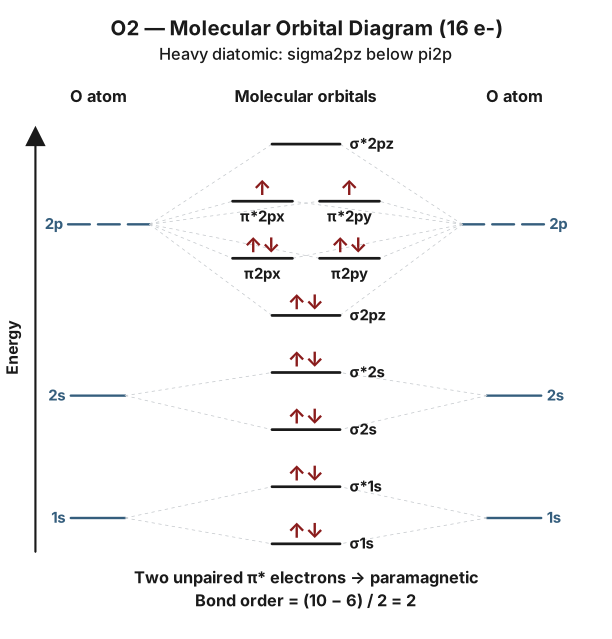
O2 has 16 electrons total; its MO filling places one electron each in the two degenerate pi*2p orbitals, giving bond order 2 and explaining why oxygen is paramagnetic.
Oxygen molecule, O2, has a total of 16 electrons (8 from each O atom). According to molecular orbital theory, these are filled into molecular orbitals in increasing order of energy:
sigma1s2, sigma1s2 (these two, from the 1s core electrons, are usually abbreviated 'KK' and not involved in bonding), then: sigma2s2, sigma2s2, sigma2pz2, pi2px2 = pi2py2, pi2px1 = pi2py1
Molecular orbital electronic configuration of O2:
KK, sigma2s2, sigma2s2, sigma2pz2, (pi2px2 = pi2py2), (pi2px1 = pi*2py1)
By Hund's rule, the two electrons remaining after filling the bonding pi2p orbitals go into the two degenerate antibonding pi2p orbitals (pi2px and pi*2py) singly, with parallel spins, rather than pairing up in just one of them.
Bond order = 1/2 x (electrons in bonding MOs - electrons in antibonding MOs)
Bonding electrons (excluding the K-shell sigma1s/sigma1s which cancel): sigma2s2 + sigma2pz2 + pi2px2 + pi2py2 = 2+2+2+2 = 8 Antibonding electrons: sigma2s2 + pi2px1 + pi2py1 = 2+1+1 = 4 …
Unlock everything free for 14 days
- Full step-by-step solutions
- Concept-first explanations
- Methods, shortcuts & mistakes
- PYQ mapping + timed mock tests
Full access for 14 days. No credit card required.