Q.State and explain Kepler's three laws of planetary motion.
You're viewing a preview — the full solution, concept, methods & PYQ mapping are locked.
Start your 14-day free trial to unlock the full solution →Kepler's three laws describe planetary orbits: they are ellipses (law of orbits), sweep equal areas in equal times (law of areas), and have T^2 proportional to a^3 (law of periods).
-
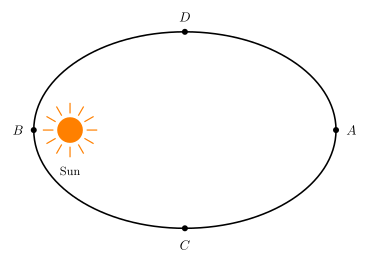
Law of Orbits: Every planet revolves around the Sun in an elliptical orbit, with the Sun located at one of the two foci of the ellipse (not at the centre). This replaced the earlier assumption of perfectly circular orbits.
-
Law of Areas: The radius vector (the line joining the planet to the Sun) sweeps out equal areas in equal intervals of time. This means the planet moves faster when it is closer to the Sun (perihelion) and slower when farther away (aphelion). Mathematically, dA/dt = constant. This law is a direct consequence of the conservation of angular momentum, since the gravitational force on the planet acts along the line joining it to the Sun (a central force), producing zero torque about the Sun.
-
Law of Periods: The square of the time period (T) of revolution of a planet around the Sun is directly proportional to the cube of the semi-major axis (a) of its elliptical orbit: …
Unlock everything free for 14 days
- Full step-by-step solutions
- Concept-first explanations
- Methods, shortcuts & mistakes
- PYQ mapping + timed mock tests
Full access for 14 days. No credit card required.