Q.State Kepler's laws of planetary motion (any two).
You're viewing a preview — the full solution, concept, methods & PYQ mapping are locked.
Start your 14-day free trial to unlock the full solution →Kepler's laws describe planetary motion: orbits are ellipses (Law of Orbits), the radius vector sweeps equal areas in equal times (Law of Areas), and T^2 is proportional to a^3 (Law of Periods). Any two are required here.
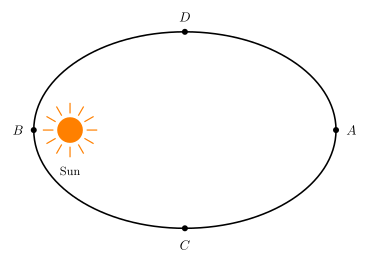
Law of Orbits (First Law): Every planet revolves around the Sun in an elliptical orbit, with the Sun situated at one of the two foci of the ellipse.
Law of Areas (Second Law): The line joining a planet to the Sun (the radius vector) sweeps out equal areas in equal intervals of time. This is a direct consequence of the conservation of angular momentum, and it implies the planet moves faster when nearer the Sun (perihelion) and slower when farther (aphelion).
…
Unlock everything free for 14 days
- Full step-by-step solutions
- Concept-first explanations
- Methods, shortcuts & mistakes
- PYQ mapping + timed mock tests
Full access for 14 days. No credit card required.