Q.What do you mean by semiconservative mode of replication ? Explain the mechanism of same with suitable diagrams. OR State the principle of independent assortment. Explain the same with dihybrid cross.
🔒You're viewing a preview — the full solution, concept, methods & PYQ mapping are locked.
🔒 Start your 14-day free trial to unlock the full solution →Concept understanding — DNA Replication and Okazaki Fragments
DNA Replication and Okazaki Fragments
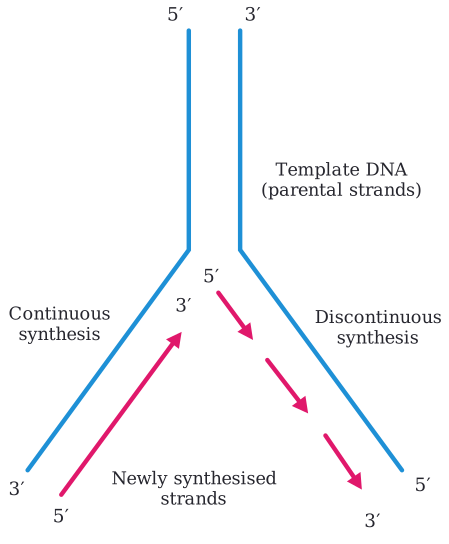
DNA replication is semi-conservative and requires the two strands of the parent DNA to be copied. Because the two strands are antiparallel and DNA polymerase can add nucleotides only in the 5′→3′ direction, the two template strands are copied differently.
- On the leading strand, synthesis is continuous, following the opening of the replication fork.
- On the lagging strand, synthesis is discontinuous: DNA is made as many short pieces called Okazaki fragments, each synthesised in the 5′→3′ direction away from the fork.
The enzyme DNA ligase then joins these Okazaki fragments together to make a continuous strand. If ligase is absent or non-functional, the fragments cannot be sealed, so newly synthesised radioactive DNA accumulates as short, low-molecular-weight pieces rather than long continuous strands — an observation that provides direct evidence for discontinuous synthesis. …
When DNA copies itself, the parental double helix unwinds and each separated strand acts as a template for building a new complementary strand. Distinguishing this pattern from the rival conservative and dispersive models required tracking old versus new strands by their density. …
DNA replication is semiconservative — each daughter molecule retains one parental strand and gains one newly synthesized strand; the Meselson–Stahl experiment (1958) proved this using ¹⁵N-labelled E. coli.
Meaning of semiconservative replication
During replication the two strands of the parental DNA double helix separate, and each strand acts as a template for synthesis of a new complementary strand. So each of the two daughter DNA molecules has one strand from the parent (conserved) and one newly made strand — hence “semi”conservative.
Meselson–Stahl experiment
E. coli was grown for many generations in a medium containing ¹⁵NH₄Cl (heavy nitrogen) so all its DNA became heavy (¹⁵N/¹⁵N). Cells were then shifted to normal ¹⁴N medium; DNA extracted after each generation was separated by CsCl density-gradient centrifugation.
- Generation 0: a single heavy (¹⁵N/¹⁵N) band.
- Generation 1: a single hybrid (¹⁵N/¹⁴N) band — this rules out the conservative model (which would give two separate bands, heavy + light).
- Generation 2: equal amounts of hybrid (¹⁵N/¹⁴N) and light (¹⁴N/¹⁴N) DNA — this rules out the dispersive model and confirms semiconservative replication.
Mechanism, with diagram description
- Origin: replication starts at a specific origin of replication.
- Unwinding: helicase unwinds the double helix at the replication fork; single-strand binding proteins keep the strands apart; topoisomerase relieves supercoiling ahead of the fork.
- Priming: primase lays down a short RNA primer, giving DNA polymerase a free 3'-OH to extend.
- Elongation: DNA polymerase III adds nucleotides only in the 5'→ 3' direction, base-pairing each new nucleotide with its template (A–T, G≡C).
- On the leading strand, synthesis is continuous, in the same direction as fork movement.
- On the lagging strand, synthesis is discontinuous, made as short Okazaki fragments running away from the fork.
- Finishing: DNA polymerase I removes the RNA primers and fills the gaps with DNA; DNA ligase seals the nicks between Okazaki fragments into one continuous strand. …
Showing the 12 most recent of 18 on this concept.
- CBSE 2026Set 57/2/11 markMCQQ.A bacterium having radioactive thymidine in its DNA is allowed to multiply in a medium having non-radioactive thymidine for two generations. What percentage of bacteria will have radioactive thymidine in its DNA ? (A) 100 (B) 50 (C) 75 (D) 25
›Reveal solutionSolution
After two generations of growth in a non-radioactive medium, only 50% of the bacteria retain radioactive thymidine in their DNA — one strand per original double helix remains labelled.
This question is a classic application of Chargaff’s rule and, more importantly, of semiconservative replication — the mechanism by which DNA copies itself. The key idea, first demonstrated by Meselson and Stahl, is that each new DNA molecule gets one old (parental) strand and one newly synthesised strand. Radioactive thymidine acts as a label on the parental strand; once the bacterium moves to a non-radioactive medium, any new strand built will use only non-radioactive thymidine.
Let’s trace what happens. You start with one bacterium whose DNA is fully labelled — both strands contain radioactive thymidine. This is your generation zero. When this bacterium divides once (first generation), each daughter cell receives one original radioactive strand and one newly made non-radioactive strand. So after one generation, every bacterium has radioactive DNA — but only one strand per cell is labelled. That gives 100% of bacteria still radioactive.
Now comes the second generation. Each of those two bacteria divides again. For each, the single radioactive strand acts as a template to build a new complementary strand (non-radioactive). The other, already non-radioactive strand also acts as a template, producing another non-radioactive strand. So from each first-generation cell, you get two daughter cells: one retains the original radioactive strand, the other gets only non-radioactive strands.
NoteThis is exactly the pattern Meselson and Stahl saw: after two generations in a light medium, half the DNA molecules were hybrid (one heavy, one light) and half were fully light. Here, “heavy” is replaced by “radioactive” and “light” by “non-radioactive.”
So after two generations, you have four bacteria in total. Two of them carry the original radioactive strand; the other two have no radioactivity at all. That means 50% of the bacteria are radioactive. …
- CBSE 2026Set ANNUAL1 markMCQQ.Which enzyme helps in the separation of both strands of DNA in DNA replication?(a) Helicase(b) DNA polymerase(c) Topoisomerase(d) DNA ligase
›Reveal solutionSolution
Helicase breaks the hydrogen bonds between complementary bases, unwinding and separating the two DNA strands so replication machinery can access them.
During DNA replication, several enzymes act in coordination:
- Helicase unwinds the double helix by breaking hydrogen bonds between base pairs, creating a replication fork with two separated single strands that serve as templates.
- DNA polymerase then synthesises the new complementary strand by adding nucleotides in the 5'→3' direction, reading the template. …
- CBSE 2026Set ANNUAL1 markMCQQ.What is the role of enzyme Helicase in DNA Replication?(a) Joining of discontinuously synthesised fragments of DNA.(b) Unwinding of the double helix of DNA.(c) Synthesises RNA primer.(d) Formation of H-bond between complementary base pairs.
›Reveal solutionSolution
Helicase opens up (unwinds) the double helix ahead of the replication fork so the two strands can act as templates.
During DNA replication, the double helix must first be separated into two single strands before DNA polymerase can copy them. Helicase is the enzyme that does this: it moves along the DNA at the origin of replication, breaking the hydrogen bonds between complementary base pairs, and unwinds the helix to create the replication fork.
…
- CBSE 2025Set 57/4/11 markMCQQ.The substrate used during DNA replication by the enzyme DNA-dependent DNA polymerase is : (A) Deoxyribonucleotide triphosphate (B) Deoxyribonucleoside triphosphate (C) Ribonucleotide triphosphate (D) Ribonucleoside triphosphate
›Reveal solutionSolution
DNA polymerase adds nucleotides to a growing DNA chain by using deoxyribonucleoside triphosphates (dNTPs) as substrates, which provide both the building block and the energy for phosphodiester bond formation. The answer is (B).
Why deoxyribonucleoside triphosphates?
DNA replication requires two things: the correct chemical building blocks that match the template strand, and energy to drive the formation of new bonds. DNA polymerase accomplishes both with a single substrate molecule.
The key is understanding what "nucleoside" versus "nucleotide" means, and why the triphosphate form matters.
A nucleoside = sugar + nitrogenous base
A nucleotide = sugar + nitrogenous base + phosphate group(s)
In biochemistry textbooks, you'll often see "nucleotide" used loosely to mean any of these forms, but the precise terminology matters here. When we say deoxyribonucleoside triphosphate, we mean:
- Deoxyribose sugar (the "deoxyribo-" part)
- A nitrogenous base (A, T, G, or C)
- Three phosphate groups attached to the 5′ carbon of the sugar
How DNA polymerase uses dNTPs
-
The substrate arrives as a triphosphate
DNA polymerase recognizes and binds deoxyribonucleoside triphosphates: dATP, dTTP, dGTP, and dCTP. The three phosphate groups are designated α, β, and γ (counting outward from the sugar).
-
Base-pairing determines which dNTP is selected
The enzyme checks which incoming dNTP correctly pairs with the template strand (A with T, G with C). Only the complementary dNTP is accepted.
-
The polymerization reaction
DNA polymerase catalyzes a nucleophilic attack by the 3′-OH group of the growing strand on the α-phosphate of the incoming dNTP. This forms a new phosphodiester bond and releases pyrophosphate (PPi, the β and γ phosphates together).
DNAn + dNTP → DNAn+1 + PPi (pyrophosphate)
-
Energy comes from breaking the high-energy bond
The release of pyrophosphate (which is then hydrolyzed to two inorganic phosphates) makes the reaction thermodynamically favorable. The triphosphate form is essential because it provides the energy currency. …
- CBSE 2025Set 57/4/11 markMCQQ.The correct depiction of the experiment performed by Matthew Meselson and Franklin Stahl to prove that DNA replicates semi-conservatively on separation of DNA by centrifugation after 40 minutes is : (A) [centrifuge tube diagram] (B) [centrifuge tube diagram] (C) [centrifuge tube diagram] (D) [centrifuge tube diagram]
›Reveal solutionSolution
E. coli replicates once about every 20 minutes, so 40 minutes = TWO generations. After two rounds of semi-conservative replication the tube shows two bands — a hybrid (intermediate-density) band and a light band — so the correct depiction is the diagram with two bands (option A), not a single band.
Meselson and Stahl grew E. coli for many generations in medium containing heavy nitrogen (¹⁵N) so that all the DNA was 'heavy', then transferred the cells to medium with light nitrogen (¹⁴N). Newly made strands from that point on incorporate only ¹⁴N. The DNA is then separated by density-gradient (CsCl) centrifugation, where heavier molecules settle lower and lighter molecules band higher.
Why 40 minutes means two generations
The crucial fact is the generation time: E. coli divides roughly every 20 minutes. So:
- After 20 minutes (one generation): every molecule is a hybrid (one ¹⁵N strand + one ¹⁴N strand) → a single band at intermediate density.
- After 40 minutes (two generations): replication of those hybrids produces equal numbers of hybrid molecules and fully light molecules → two bands, one at intermediate density and one at the light position.
Reading the tube after 40 minutes …
- CBSE 2025Set ANNUAL1 markMCQQ.Which of the following is a substrate for DNA replication?(a) ATP(b) DNA polymerase(c) Helicase(d) Deoxyribonucleoside triphosphate
›Reveal solutionSolution
DNA replication needs the four deoxyribonucleoside triphosphates as raw material - they supply both the nucleotide monomers and, through cleavage of their phosphate bonds, the energy for the polymerisation reaction.
DNA polymerase catalyses replication by joining deoxyribonucleotides in a chain using the parental strand as template, but the enzyme itself is a catalyst, not a substrate. Helicase unwinds the double helix at the replication fork; it too is an enzyme, not consumed as a building block. ATP is the general energy currency of the cell but is a ribonucleotide, not directly incorporated into DNA. The actual substrates polymerised into the new …
- CBSE 2025Set ANNUAL1 markMCQQ.In DNA replication, the Okazaki fragments on the lagging strand are joined by(a) primase(b) DNA polymerase(c) helicase(d) DNA ligase
›Reveal solutionSolution
DNA ligase acts as the 'molecular glue' that joins the short Okazaki fragments of the lagging strand into one continuous DNA strand.
On the lagging strand of a replication fork, DNA is synthesised discontinuously in short segments called Okazaki fragments, since DNA polymerase can only extend DNA in the 5'→3' direction. After each fragment's RNA primer is removed and replaced with DNA, the enzyme DNA ligase forms the phosphodiester bond that joins the adjacent fragments into a single, continuous strand. Primase (a) …
- CBSE 2024Set 57/3/11 markMCQQ.In an experiment, E. coli is grown in a medium containing 14NH4Cl. (14N is the light isotope of Nitrogen) followed by growing it for six generations in a medium having heavy isotope of nitrogen (15N). After six generations, their DNA was extracted and subjected to CsCl density gradient centrifugation. Identify the correct density (Light/Hybrid/Heavy) and ratio of the bands of DNA in CsCl density gradient centrifugation. (A) Hybrid : Heavy, 1 : 16 (B) Light : Heavy, 1 : 31 (C) Hybrid : Heavy, 1 : 31 (D) Light : Heavy, 1 : 05
›Reveal solutionSolution
After six generations of semi-conservative DNA replication in a heavy nitrogen medium, the original two light strands will always form hybrid DNA, while all other DNA will be heavy. This results in a Hybrid : Heavy DNA ratio of 1 : 31.
The core concept here is the semi-conservative nature of DNA replication, famously demonstrated by the Meselson-Stahl experiment. When DNA replicates, each new double helix consists of one original (parental) strand and one newly synthesized strand. This principle dictates how the nitrogen isotopes are distributed in the DNA molecules over successive generations, which in turn affects their density.
Nitrogen is a key component of DNA bases.
- 14N is the common, "light" isotope of nitrogen.
- 15N is a heavier isotope. DNA containing 15N will be denser than DNA containing 14N. DNA with one 14N strand and one 15N strand (a hybrid molecule) will have an intermediate density.
CsCl density gradient centrifugation separates molecules based on their density. When DNA is spun in a CsCl solution, it forms bands at positions where its density matches the density of the CsCl solution.
- Light DNA (14N/14N) will form a band at the highest position (least dense).
- Hybrid DNA (14N/15N) will form a band at an intermediate position.
- Heavy DNA (15N/15N) will form a band at the lowest position (most dense).
Let's trace the DNA composition over the generations:
-
Initial State (Generation 0):
The E. coli is initially grown in a medium containing 14NH4Cl. This means all the nitrogen incorporated into their DNA is the light isotope, 14N.
So, all DNA molecules are 14N/14N (Light).
Let's assume we start with 1 DNA molecule. It has two 14N strands.
-
First Generation (after 1 replication in 15N medium):
The E. coli is transferred to a medium containing 15NH4Cl and allowed to replicate once.
According to semi-conservative replication, the original 14N/14N DNA molecule unwinds. Each 14N strand serves as a template for a new strand synthesized using 15N.
This results in two DNA molecules, each consisting of one 14N strand and one 15N strand. These are Hybrid DNA molecules.
- Total DNA molecules: 2^1 = 2
- Hybrid DNA molecules: 2
- Heavy DNA molecules: 0
-
Second Generation (after 2 replications in 15N medium):
The two hybrid DNA molecules from the first generation replicate again in the 15N medium.
Each hybrid molecule (14N/15N) unwinds.
- The 14N strand acts as a template, pairing with a new 15N strand to form a new Hybrid molecule (14N/15N).
- The 15N strand acts as a template, pairing with a new 15N strand to form a new Heavy molecule (15N/15N). Since there were 2 hybrid molecules, they will produce 2 hybrid and 2 heavy molecules.
- Total DNA molecules: 2^2 = 4
- Hybrid DNA molecules: 2
- Heavy DNA molecules: 2
-
Generalizing for 'n' Generations:
Notice a pattern:
- The two original 14N strands (from the very first DNA molecule) will always serve as templates. Each time they replicate in the 15N medium, they will pair with a newly synthesized 15N strand. This means there will always be exactly 2 Hybrid DNA molecules, regardless of how many generations pass, as long as the replication continues in the 15N medium. …
- CBSE 2024Set E1 markMCQQ.Which of the following statements is incorrect about DNA replication?(a) DNA replication is semi-conservative(b) Main enzyme for DNA replication is DNA polymerase(c) Mutation appears due to error in replication(d) Replication on both strands of DNA is continuous
›Reveal solutionSolution
DNA replication is discontinuous on the lagging strand, so the statement that both strands replicate continuously is wrong.
DNA replication is semi-conservative (each new molecule has one old and one new strand), the key enzyme is DNA polymerase, and errors during replication can lead to mutations — so statements (a), (b) and (c) are correct. However, because DNA polymerase synthesises new DNA only in the 5'→3' direction, only the leading strand is made continuously; the lagging strand is synthesised discontin …
- CBSE 2023Set 57/3/11 markMCQQ.Given below is a list of steps Meselson and Stahl carried out in their experiment to prove that DNA replication is semi-conservative. Select the option that gives the correct sequence of steps followed by them.(i) Bacteria transferred to a N14 medium and sampled every 20 minutes.(ii) All bacteria contain hybrid DNA (N14 DNA and N15 DNA).(iii) Bacteria grown in N15 medium for many generations.(iv) All bacteria contain N15 DNA.(v) Bacteria contain either all N14 DNA or all hybrid DNA.(a)(ii) →(iv) →(iii) →(i) →(v)(b)(i) →(ii) →(v) →(iv) →(iii)(c)(iii) →(iv) →(i) →(ii) →(v)(d)(iv) →(iii) →(ii) →(v) → (i)
›Reveal solutionSolution
Meselson and Stahl's experiment proved DNA replication is semi-conservative by tracking heavy nitrogen (15N) labeled DNA through successive generations in a light nitrogen (14N) medium.
The discovery of DNA's double helix structure by Watson and Crick in 1953 immediately raised a crucial question: how does this molecule replicate itself to pass genetic information accurately from one generation to the next? The structure itself, with its complementary base pairing (adenine always pairing with thymine, and guanine with cytosine), offered a strong hint. If the two strands of the double helix could separate, each strand could then serve as a template for the synthesis of a new complementary strand. This idea formed the basis of what is known as semi-conservative replication.
However, before Meselson and Stahl's groundbreaking work, there were three main hypotheses for how DNA might replicate:
- Conservative Replication: In this model, the original double helix would remain intact after replication, and a completely new double helix would be synthesized from scratch. So, after one round, you'd have one old DNA molecule and one new DNA molecule.
- Semi-conservative Replication: Here, each new DNA molecule would consist of one original (parental) strand and one newly synthesized strand. This is the model suggested by Watson and Crick.
- Dispersive Replication: This model proposed that the parental DNA molecule would break into fragments, and new DNA would be synthesized in between these fragments. The resulting DNA molecules would be a mosaic of old and new DNA on both strands.
To definitively distinguish between these possibilities, Matthew Meselson and Franklin Stahl designed an elegant experiment in 1958 using Escherichia coli bacteria and isotopes of nitrogen. Their method relied on the fact that DNA contains nitrogen, and different isotopes of nitrogen have different atomic masses, which would affect the density of the DNA molecule.
NoteIsotopes are atoms of the same element that have different numbers of neutrons, and thus different atomic masses. 15N (heavy nitrogen) has one more neutron than 14N (light nitrogen), making DNA containing 15N denser than DNA containing 14N.
Here's how Meselson and Stahl carried out their experiment, following a precise sequence of steps:
-
Step 1: Labeling the parental DNA with heavy nitrogen.
- (iii) Bacteria grown in N15 medium for many generations. They first grew E. coli in a culture medium where the only nitrogen source was 15NH4Cl (ammonium chloride containing heavy nitrogen). They allowed the bacteria to divide for many generations (multiple cell cycles).
- (iv) All bacteria contain N15 DNA. After many generations in the 15N medium, virtually all the nitrogenous bases in the bacterial DNA incorporated 15N. This made the DNA molecules significantly denser than normal DNA. They confirmed this by centrifuging the DNA in a cesium chloride (CsCl) density gradient, where the heavy DNA settled at a lower position in the tube.
-
Step 2: Transferring to light nitrogen medium and observing the first generation.
- (i) Bacteria transferred to a N14 medium and sampled every 20 minutes. They then transferred these 15N-labeled bacteria to a fresh culture medium containing only 14NH4Cl (light nitrogen). E. coli divides approximately every 20 minutes, so they took samples at this interval.
- (ii) All bacteria contain hybrid DNA (N14 DNA and N15 DNA). After one generation (20 minutes), they extracted the DNA from the bacteria. When this DNA was centrifuged in a CsCl gradient, it formed a single band at an intermediate density, precisely between the positions of pure 15N DNA and pure 14N DNA. This "hybrid" band indicated that each DNA molecule contained both heavy (15N) and light (14N) nitrogen. This result immediately ruled out the conservative replication model, which would have predicted two distinct bands: one heavy and one light.
-
Step 3: Observing the second generation. …
- CBSE 2023Set ANNUAL1 markMCQQ.In which phase of the cell division does DNA replication take place?(a) G1 phase(b) S-phase(c) G2 phase(d) G0 phase
›Reveal solutionSolution
The cell cycle's interphase has three parts (G1, S, G2); DNA is duplicated only in the S (Synthesis) phase, which is why it is named that.
The cell cycle is divided into interphase and M-phase (division). Interphase itself has three sub-phases:
- G1 (Gap 1): cell grows, prepares enzymes/materials needed for DNA synthesis.
- S (Synthesis): the DNA content of the cell doubles — each chromosome, made of one DNA molecule (one chromatid), replicates to become two sister chromatids joined at the centromere. …
- CBSE 2023Set ANNUAL1 markQ.What are Okazaki fragments?
›Reveal solutionSolution
Because DNA polymerase can only synthesise DNA in the 5'→3' direction, the lagging strand is made in short, discontinuous stretches called Okazaki fragments, which are later joined together.
During DNA replication, the two parental strands are antiparallel, but DNA polymerase can add new nucleotides only in the 5'→3' direction. On one template strand (the leading strand), synthesis of the new strand can proceed continuously in the same direction as the replication fork moves. On the other template strand (the lagging strand), synthesis must occur discontinuously, in short stretches, each begun with its own RNA primer, moving away from the replication fork; these short DNA segments are called Okazaki fragments. They are subsequen …
🎓Unlock everything free for 14 days
- ✓Full step-by-step solutions
- ✓Concept-first explanations
- ✓Methods, shortcuts & mistakes
- ✓PYQ mapping + timed mock tests
Full access for 14 days. No credit card required.