Q.Calculate the current in an external circuit when a number of cells are connected in :
You're viewing a preview — the full solution, concept, methods & PYQ mapping are locked.
Start your 14-day free trial to unlock the full solution →For identical cells (emf , internal resistance ) driving an external resistance : in series the emfs add () and so do internal resistances (); in parallel the emf stays but the internal resistance drops to .
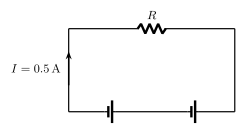
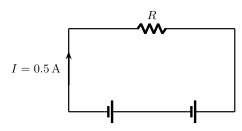
(a) Cells in series
Consider identical cells, each of emf and internal resistance , joined in series (positive terminal of one to negative of next) and connected to an external resistance .
Since the cells are in series, their emfs add up: total emf . Their internal resistances also add up (they carry the same current in series): total internal resistance .
By Ohm's law applied to the whole circuit:
Two limiting cases:
- If (external resistance dominates), — current increases almost proportionally with , so a series combination is useful when .
- If , — adding more cells in series does not help.
(b) Cells in parallel
Now let the identical cells be connected in parallel with each other (all positive terminals joined, all negative terminals joined), the combination connected to external resistance .
Since the cells are identical and in parallel, the combination behaves as a single cell of emf (the emf does not add) but the internal resistances combine as resistors in parallel:
Applying Ohm's law:
Limiting cases:
- If , — parallel grouping gives little advantage.
- If , — current increases with , so a parallel combination is useful when (low external resistance).
OR — Kirchhoff's Laws
1. Junction (Current) Law (KCL): At any junction in a circuit, the algebraic sum of currents meeting at that junction is zero — the sum of currents entering a junction equals the sum leaving it:
This follows from conservation of charge — charge cannot pile up at a junction in steady state, so whatever flows in per second must flow out per second.
…
Unlock everything free for 14 days
- Full step-by-step solutions
- Concept-first explanations
- Methods, shortcuts & mistakes
- PYQ mapping + timed mock tests
Full access for 14 days. No credit card required.