Question of 96
Q.Draw a well labelled diagram of DNA double helix.
Jharkhand JacJAC Intermediate Board 2020Subjective· 5mImportance★★★★★
0% · 0/96 Questions
You're viewing a preview — the full solution, concept, methods & PYQ mapping are locked.
Start your 14-day free trial to unlock the full solution →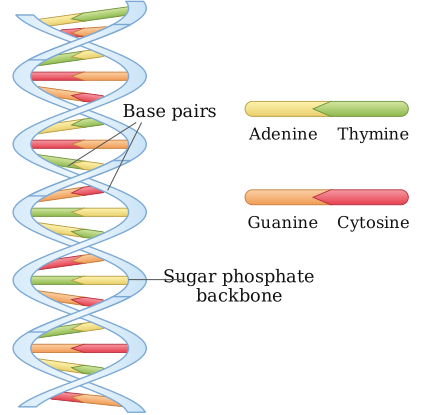
The DNA double helix is a right-handed, antiparallel double-stranded structure with sugar-phosphate backbones on the outside and complementary base pairs (A-T, G-C) stacked on the inside, as described by Watson and Crick (1953).
Since a literal hand-drawn diagram cannot be rendered here, the structure is described in full labelled detail as it would appear in the diagram:
- Two polynucleotide chains: DNA consists of two long polynucleotide strands, each made of a chain of nucleotides (deoxyribose sugar + phosphate group + one of four nitrogenous bases: Adenine (A), Thymine (T), Guanine (G), Cytosine (C)).
- Antiparallel orientation: the two strands run in opposite directions — one strand runs 5' to 3', while the complementary strand runs 3' to 5'.
- Sugar-phosphate backbone (outside): alternating sugar and phosphate groups, linked by phosphodiester bonds, form the two outer 'rails' of the ladder-like structure.
- Base pairing (inside, rungs of the ladder): the nitrogenous bases project inward from each backbone and pair specifically via hydrogen bonds — Adenine pairs with Thymine (A=T, joined by 2 hydrogen bonds), and Guanine pairs with Cytosine (G≡C, joined by 3 hydrogen bonds). This is called complementary base pairing.
- Right-handed helix: the two strands coil around a common axis to form a right-handed double helix. …
Unlock everything free for 14 days
- Full step-by-step solutions
- Concept-first explanations
- Methods, shortcuts & mistakes
- PYQ mapping + timed mock tests
Full access for 14 days. No credit card required.