Q.Describe the salient features of the double-helix structure of D.N.A. Draw diagram also.
You're viewing a preview — the full solution, concept, methods & PYQ mapping are locked.
Start your 14-day free trial to unlock the full solution →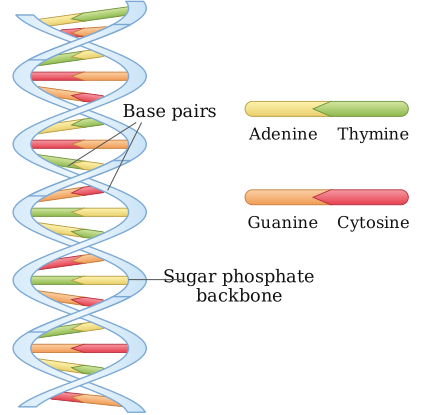
DNA is a right-handed, antiparallel double helix of two polynucleotide strands held together by base-pairing (A=T, G≡C) and stacked base pairs.
The salient/major features of the Watson–Crick double-helix model of DNA are: (1) DNA consists of two polynucleotide chains, coiled around a common axis in a right-handed helix. (2) The two chains (strands) are antiparallel — one runs in the 5'→3' direction while the other runs 3'→5'. (3) The backbone of each strand is formed by sugar (deoxyribose) and phosphate groups joined by phosphodiester bonds, while the nitrogenous bases (adenine, guanine, cytosine, thymine) project inward, at right angles to the axis. (4) The two strands are held together by hydrogen bonds between complementary base pairs: adenine pairs with thymine (A=T) via two hydrogen bonds, and guanine pairs with cytosine (G≡C) via three hydrogen bonds — complementary base pairing means one strand's sequence predicts the other's, and a purine always pairs with a pyrimidine, keeping the diameter of the helix uniform. (5) Because of this complementarity, the two chains are not identical but complementary to each other. (6) The double helix has a diameter of about 20 Å (2 nm), and one complete turn of the helix corresponds to a rise of about 34 Å (3.4 nm), containing about 10 base pairs per turn (a rise of about 3.4 Å per base pair). (7) The DNA helix can be visualised as a twisted ladder, with the sugar-phosphate backbones forming the two rails and the paired bases forming the rungs.
[Diagram: double helix showing antiparallel sugar-phosphate backbones with paired bases A=T and G≡C as rungs, and the helical dimensions (34 Å per turn, 3.4 Å per bp, 20 Å diameter).]
…
Unlock everything free for 14 days
- Full step-by-step solutions
- Concept-first explanations
- Methods, shortcuts & mistakes
- PYQ mapping + timed mock tests
Full access for 14 days. No credit card required.