Q.Draw a well-labelled diagram of double-helical structure of DNA.
You're viewing a preview — the full solution, concept, methods & PYQ mapping are locked.
Start your 14-day free trial to unlock the full solution →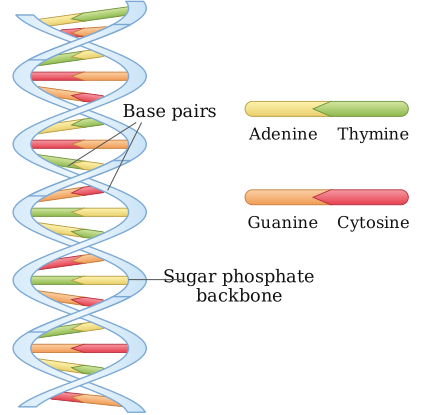
DNA's double-helical structure has two sugar-phosphate backbones twisted around each other, held together by complementary base pairing between the two strands.
The Watson-Crick double-helical model of DNA describes DNA as being made of two polynucleotide chains, coiled around a common central axis in a right-handed helix. The two strands run antiparallel to each other (one runs 5'→3' while the other runs 3'→5'). The backbone of each strand is formed by alternating sugar (deoxyribose) and phosphate groups, oriented on the outside of the helix, while the nitrogenous bases of the two strands project inward and pair up specifically: adenine (A) always pairs with thymine (T) via two hydrogen bonds, and guanine (G) always pairs with cytosine (C) via three hydrogen bonds. These base pairs are stacked one above another, like the rungs of a twisted rope ladder, giving the molecule its characteristic helical shape, and the specific base-pairing (complementarity) between the two strands is what makes each strand a perfect template for producing an identical copy during replication.
…
Unlock everything free for 14 days
- Full step-by-step solutions
- Concept-first explanations
- Methods, shortcuts & mistakes
- PYQ mapping + timed mock tests
Full access for 14 days. No credit card required.