Q.Which of the compounds will react faster in reaction with the ion?
or
You're viewing a preview — the full solution, concept, methods & PYQ mapping are locked.
Start your 14-day free trial to unlock the full solution →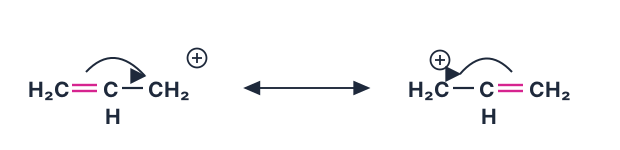
The key idea is that reactions depend on carbocation stability. Benzyl chloride () forms a resonance-stabilized benzyl carbocation, so it reacts much faster than ethyl chloride (), which gives a high-energy primary carbocation.
The mechanism is a two-step nucleophilic substitution where the rate-determining step is the formation of a carbocation intermediate. The nucleophile ( here) attacks only after the leaving group () has left. So the entire reaction rate depends on how easily the C–Cl bond breaks — and that depends entirely on the stability of the carbocation that forms.
Let’s compare the two candidates.
-
Ethyl chloride ()
If the chloride ion leaves, we get an ethyl carbocation: . This is a primary carbocation — the positive carbon is attached to only one alkyl group. Primary carbocations are highly unstable because there is very little electron-donating hyperconjugation or inductive stabilization. They are so high in energy that reactions with primary substrates are essentially impossible under normal conditions; the reaction would instead follow an pathway if a good nucleophile is present. Here, with (a strong nucleophile), ethyl chloride would react via , not .
-
Benzyl chloride ()
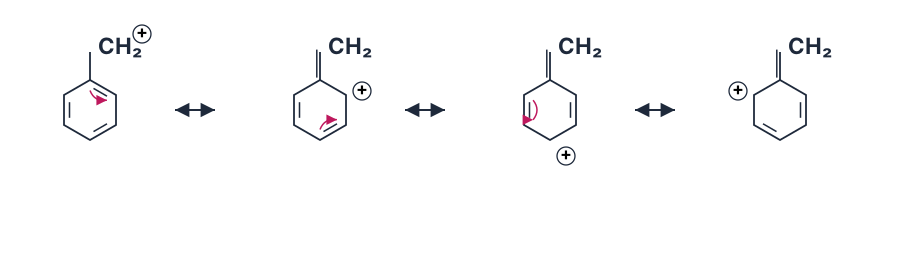
Loss of chloride gives a benzyl carbocation: . This is not a simple primary carbocation — the positive charge is delocalized into the aromatic ring. The benzene ring’s electrons can overlap with the empty p-orbital on the benzylic carbon, spreading the charge over several atoms. This resonance stabilization dramatically lowers the energy of the carbocation, making it far more stable than any simple alkyl primary carbocation. In fact, the benzyl carbocation is comparable in stability to a tertiary carbocation. …
Unlock everything free for 14 days
- Full step-by-step solutions
- Concept-first explanations
- Methods, shortcuts & mistakes
- PYQ mapping + timed mock tests
Full access for 14 days. No credit card required.