Q.Some alkylhalides undergo substitution whereas some undergo elimination reaction on treatment with bases. Discuss the structural features of alkyl halides with the help of examples which are responsible for this difference.
You're viewing a preview — the full solution, concept, methods & PYQ mapping are locked.
Start your 14-day free trial to unlock the full solution →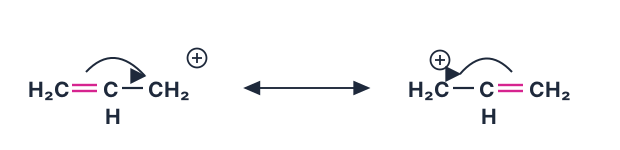
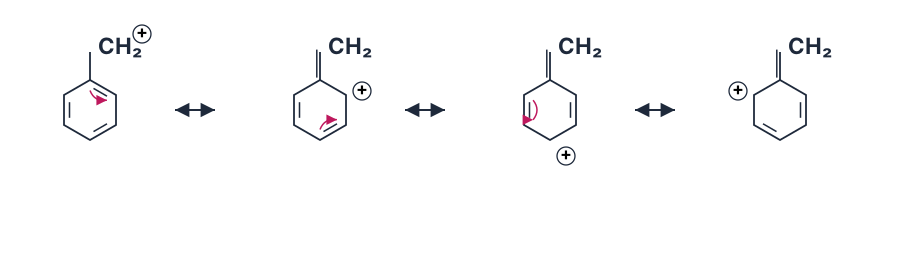
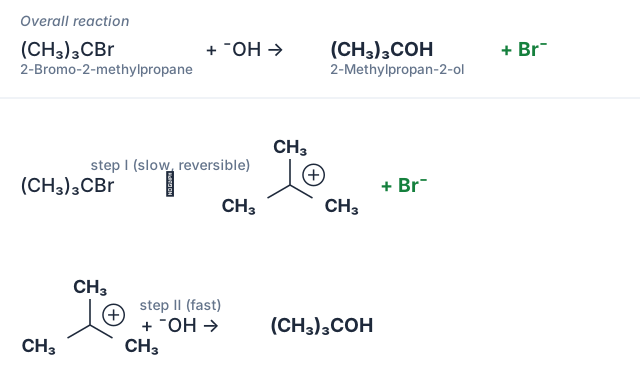
The outcome of a base/alkyl halide reaction (substitution vs. elimination) is governed by the structure of the alkyl halide — specifically the degree of substitution at the carbon bearing the halogen. Primary halides favour substitution (SN2), tertiary halides favour elimination (E2), and secondary halides give mixtures, with strong bulky bases pushing elimination.
The key idea is that the same base can trigger two completely different reaction pathways — substitution (replacing the halogen) or elimination (removing H and X to form a double bond). Which one wins depends on how accessible the carbon is and how stable the potential alkene would be.
Let’s break down the structural features that decide the fate.
1. The carbon’s substitution pattern — primary vs. secondary vs. tertiary
The most important structural feature is the number of alkyl groups attached to the carbon that holds the halogen (the -carbon).
-
Primary alkyl halide (e.g., ): The -carbon is bonded to only one other carbon. This carbon is sterically unhindered — a nucleophile/base can easily approach from the back side. The SN2 mechanism is fast here. Elimination (E2) is possible but requires a strong, bulky base to abstract a -hydrogen; with a small base like , substitution dominates.
-
Tertiary alkyl halide (e.g., ): The -carbon is crowded by three alkyl groups. Back-side attack is blocked, so SN2 is impossible. However, the -hydrogens are numerous and the alkene product (e.g., 2-methylpropene) is highly substituted and stable. The base easily abstracts a -hydrogen, and the bulky halide leaves — E2 elimination is strongly favoured.
-
Secondary alkyl halide (e.g., ): Intermediate case. Both SN2 and E2 are possible. The outcome depends on the base’s strength and size. A small, strong base like gives a mixture; a bulky strong base like forces elimination.
A common mistake is to think that “strong base always gives elimination”. A strong but small base (like ) can still give SN2 with primary halides because it can squeeze in for back-side attack. Bulky bases are the elimination specialists.
2. The nature of the -hydrogens
Elimination requires at least one hydrogen on a carbon adjacent to the -carbon (a -hydrogen). The number and accessibility of these -hydrogens matter.
- In a primary halide like , there are three -hydrogens on the group. They are available, but the SN2 pathway is so fast that elimination is minor unless a bulky base is used.
- In a tertiary halide like , there are nine -hydrogens — plenty of targets for the base. Moreover, the alkene formed (tetrasubstituted or trisubstituted) is highly stable due to hyperconjugation and alkyl group donation.
The Saytzeff rule applies here: the more substituted alkene (more alkyl groups on the double bond) is more stable. Tertiary halides give the most substituted alkene, which is a thermodynamic bonus for elimination.
3. The leaving group ability
While the halogen (Cl, Br, I) is a good leaving group in both reactions, the structure of the alkyl group affects how easily it leaves. In tertiary halides, the carbocation-like transition state for E2 is stabilised by the three alkyl groups (inductive effect and hyperconjugation), making the C–X bond more polarised and easier to break. In primary halides, no such stabilisation exists — the SN2 transition state is favoured because it avoids charge buildup.
4. Base strength and bulk — the external factor tied to structure
The structural features of the alkyl halide dictate which base will favour which pathway.
| Alkyl halide | Favoured with small strong base (e.g., ) | Favoured with bulky strong base (e.g., ) |
|--------------|----------------------------------------------------------|------------------------------------------------------------| …
Unlock everything free for 14 days
- Full step-by-step solutions
- Concept-first explanations
- Methods, shortcuts & mistakes
- PYQ mapping + timed mock tests
Full access for 14 days. No credit card required.