Q.Discuss the nature of C–X bond in the haloarenes.
You're viewing a preview — the full solution, concept, methods & PYQ mapping are locked.
Start your 14-day free trial to unlock the full solution →The C–X bond in haloarenes is shorter, stronger, and less polar than in haloalkanes due to resonance delocalisation of the halogen lone pairs into the aromatic ring, giving it partial double-bond character.
1. The core question: what makes the C–X bond in haloarenes special?
When you first study haloalkanes, the C–X bond is a straightforward polar covalent bond — the halogen is more electronegative than carbon, so the bond is polarised on carbon and on halogen. That polarity drives nucleophilic substitution reactions.
But in haloarenes (like chlorobenzene, bromobenzene), the bond behaves very differently. It is shorter, stronger, and less reactive toward nucleophiles. Why? The answer lies in resonance.
2. The resonance picture: lone pairs join the party
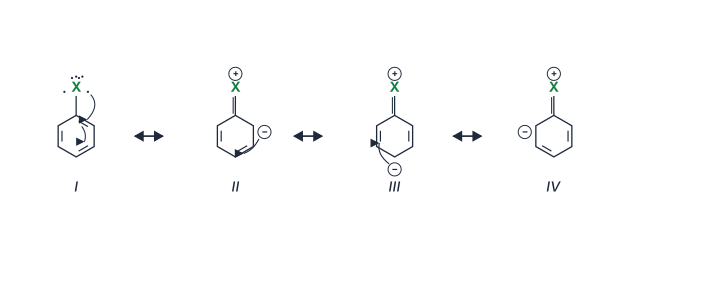
The halogen atom in a haloarene has three lone pairs of electrons. One of these lone pairs can delocalise into the -electron system of the benzene ring. This is possible because the halogen’s -orbital overlaps with the -orbitals of the adjacent carbon atom in the ring.
Draw the resonance structures for chlorobenzene:
- The major contributor is the usual Kekulé structure with a C–Cl single bond.
- But there are minor contributors where the lone pair from chlorine forms a bond with the ring carbon, pushing the electrons around. This puts a negative charge on the ortho and para positions, and a positive charge on chlorine.
The key consequence: the C–X bond now has partial double-bond character. A double bond is shorter and stronger than a single bond. This is the single most important idea for understanding haloarene chemistry.
3. Step-by-step consequences of this partial double-bond character
1. Bond length decreases.
A C–Cl single bond in a haloalkane is about 177 pm. In chlorobenzene, it shrinks to roughly 169 pm. The resonance hybrid has a bond order between 1 and 2, pulling the atoms closer.
2. Bond dissociation energy increases.
Because the bond is stronger, more energy is needed to break it. The C–Cl bond dissociation energy in chlorobenzene is about 400 kJ/mol, compared to ~330 kJ/mol in chloroethane. This directly explains why haloarenes are much less reactive in nucleophilic substitution — you simply cannot break the bond as easily.
3. Polarity decreases.
In a haloalkane, the bond is highly polarised. But in a haloarene, the resonance delocalisation spreads the electron density. The positive charge that would normally sit on carbon is partially neutralised by the donation from the ring. The dipole moment of chlorobenzene (1.69 D) is actually smaller than that of cyclohexyl chloride (2.20 D), even though the aromatic ring is more electronegative than an alkyl group. This seems counterintuitive — until you remember that resonance puts some negative charge back on the halogen.
A common mistake is to think that the inductive effect of the ring (which is electron-withdrawing) would increase the polarity. But resonance dominates here, and it reduces the polarity. The net dipole is the sum of both effects, and resonance wins.
4. Reactivity toward nucleophiles plummets.
For an reaction, the nucleophile needs to attack the carbon from the back. The partial double-bond character makes the C–X bond rigid and planar with the ring — the backside is sterically hindered by the ring itself. For an reaction, you would need to form a carbocation, but the aryl carbocation (phenyl cation) is extremely unstable because the empty -orbital cannot be stabilised by resonance (it is orthogonal to the system). So both pathways are blocked under normal conditions.
5. The dipole is weakened, not reversed. …
Unlock everything free for 14 days
- Full step-by-step solutions
- Concept-first explanations
- Methods, shortcuts & mistakes
- PYQ mapping + timed mock tests
Full access for 14 days. No credit card required.