Chemistry · Ch 3 — Thermodynamics
Lattice Enthalpy
Lattice Enthalpy
Lattice Enthalpy
Definition: The lattice enthalpy of an ionic compound is the enthalpy change which occurs when one mole of an ionic compound dissociates into its ions in the gaseous state.
Since it is impossible to determine lattice enthalpies directly by experiment, we use an indirect method where we construct an enthalpy diagram called a Born-Haber Cycle.
Born-Haber Cycle for NaCl
Let us calculate the lattice enthalpy of Na⁺Cl⁻(s) by following these steps:
Step 1: Sublimation of sodium metal
Step 2: Ionization of sodium atoms
Step 3: Dissociation of chlorine (half the bond dissociation enthalpy)
Step 4: Electron gain by chlorine atoms
Step 5: Formation of NaCl(s) from gaseous ions
The sequence of steps is shown in the enthalpy diagram (Fig. 5.9) and is known as a Born-Haber cycle.
The importance of the cycle is that the sum of the enthalpy changes round a cycle is zero (Hess's law).
Applying Hess's law:
The internal energy change is smaller by (because ) and is equal to .
Ionization Energy and Electron Affinity
Ionization energy and electron affinity are defined at absolute zero. At any other temperature, heat capacities for the reactants and the products have to be taken into account.
For the reactions:
- (ionization)
- (electron gain)
At temperature :
…
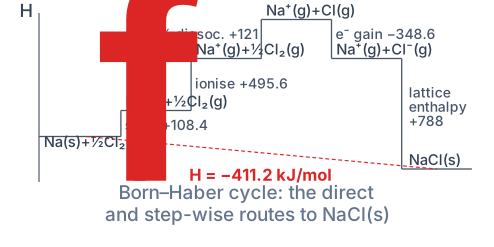
Drawn by us to help you understand the concept clearly, and verified to make sure it's accurate. For exams, practice from your textbook's own diagram.
The Born–Haber cycle is a visual accounting of the energy changes linking an ionic solid, its elements, and its gaseous ions. Fig. 5.9 is an enthalpy ladder: each horizontal rung is a state, each vertical arrow a step with its enthalpy change, drawn with the figure's own printed values.
Reading the ladder upward from the elements: sublimation of solid sodium, Na(s) Na(g), costs kJ mol; ionisation Na(g) Na(g) + e costs kJ mol (the running text rounds this to 496); dissociating half a mole of Cl into Cl(g) costs kJ mol; and electron gain Cl(g) + e Cl(g) releases kJ mol. Separately, the direct formation Na(s) + Cl(g) NaCl(s) has kJ mol, and the lattice enthalpy step is the dissociation of the solid into its gaseous ions, NaCl(s) Na(g) + Cl(g), drawn as the tall upward leg .
Because enthalpy is a state function, the changes around the closed cycle sum to zero, so:
In this textbook's convention the lattice enthalpy is defined for breaking the lattice apart — NaCl(s) Na(g) + Cl(g) — so is positive ( kJ mol for NaCl). Some books define it for the reverse (formation of the lattice from gaseous ions), which flips the sign; always check the convention before comparing values. …