Q.A shell of mass 0.020 kg is fired by a gun of mass 100 kg. If the muzzle speed of the shell is 80 m s−1, what is the recoil speed of the gun?
🔒You're viewing a preview — the full solution, concept, methods & PYQ mapping are locked.
🔒 Start your 14-day free trial to unlock the full solution →Concept understanding — Conservation of Momentum
Conservation of Momentum: From Push to Principle
Imagine you're standing on perfectly smooth ice, wearing skates. You're completely still. Now, you push a heavy medicine ball away from you. What happens? You roll backward. The harder you push the ball, the faster you roll back.
That's the core intuition: you can't push something away without being pushed back yourself. The push you give the ball is matched by an equal push on you, in the opposite direction. This isn't a special property of ice or skates — it's a fundamental rule of how forces work in the universe.
The Hidden Quantity That Never Changes
Physicists call the "amount of motion" an object has its momentum. For everyday speeds, momentum is simple:
p=mv
Where m is mass (how much stuff) and v is velocity (speed with direction). Momentum is a vector — it cares about which way you're going.
A truck creeping forward has huge momentum (big mass, small speed). A bullet zipping through air has moderate momentum (tiny mass, huge speed). A parked car has zero momentum (speed is zero).
Now here's the key: in any isolated system (no outside forces), total momentum stays the same. Always. Before, during, and after any interaction.
The Precise Statement
Law of Conservation of Momentum:
In a closed, isolated system (no external forces), the total vector momentum of the system remains constant over time.
Mathematically, for two objects that interact (collide, push apart, explode):
p1,initial+p2,initial=p1,final+p2,final
Or in terms of masses and velocities:
m1u1+m2u2=m1v1+m2v2
Where u means initial velocity and v means final velocity.
Why This Works: Newton's Third Law in Disguise
When you push the medicine ball, your hand exerts a force F on the ball. By Newton's Third Law, the ball exerts an equal and opposite force −F back on your hand. These forces act for the same time Δt.
Force times time equals impulse, which equals change in momentum:
FΔt=Δp
For you and the ball:
- Ball's momentum change: +FΔt (ball goes forward)
- Your momentum change: −FΔt (you go backward)
Add them: +FΔt+(−FΔt)=0
Total change is zero. Momentum is conserved because forces always come in equal-and-opposite pairs.
This is why a rocket works in the vacuum of space. It throws exhaust backward (one momentum change), and the rocket itself moves forward (equal opposite momentum change). No air needed — just Newton's Third Law and conservation of momentum.
What This Law Does NOT Mean
- It does NOT mean individual objects keep constant momentum. Only the total of all objects in the system stays constant. Individual momenta can change wildly.
- It does NOT apply if external forces act. If friction, gravity from outside, or a wall stops something, momentum is not conserved for that system. (You can expand the system to include the Earth or the wall, and then momentum is conserved again.)
- It does NOT require collisions to be elastic. Even in a messy, sticky, energy-losing collision, momentum is still perfectly conserved. Energy can be lost to heat or deformation, but momentum never disappears.
A Quick Example …
Concept: Conservation of momentum
The gun and shell form an isolated system. Before firing, both are at rest, so the total momentum is zero. After firing, the forward momentum of the shell must equal the backward momentum of the gun.
Initial momentum:
pi=0
Final momentum (taking the shell's direction as positive):
pf=mshellvshell+mgunvgun
By conservation of momentum:
0=(0.020)(80)+(100)vgun …
When the gun fires, momentum is conserved: the forward momentum of the shell equals the backward momentum of the gun. The recoil speed works out to 0.016 m s−1.
Why conservation of momentum?
Before the trigger is pulled, the system (gun + shell) is at rest. The total momentum is zero. When the gun fires, internal forces between the gun and shell accelerate them in opposite directions, but no external horizontal force acts on the system. This means the total momentum must remain zero afterward—whatever momentum the shell gains forward, the gun must gain an equal amount backward.
This is the heart of recoil: momentum is conserved in isolated systems, and the explosion inside the gun is an internal force.
Step-by-step solution
- Set up the initial state. Both gun and shell are at rest, so the initial momentum is:
pinitial=0
-
Define the final momenta.
Let the shell move forward with velocity vs=+80 m s−1 (taking forward as positive). The gun recoils backward with velocity vg, which we expect to be negative.
The shell's momentum is:
ps=msvs=0.020×80=1.6 kg m s−1
The gun's momentum is:
pg=mgvg=100×vg
- Apply conservation of momentum. Total momentum after firing must equal total momentum before:
pfinal=pinitial
ps+pg=0
1.6+100vg=0
- Solve for the recoil velocity. 100vg=−1.6 …
Concept: Conservation of Momentum — Recoil
Step 1: State the initial momentum
Before firing, gun and shell are both at rest:
pi=0
Step 2: Write the final momentum
Taking the shell's direction as positive:
pf=mshellvshell+mgunvgun
Step 3: Apply conservation of momentum
0=(0.020)(80)+(100)vgun
100vgun=−1.6
Step 4: Solve for the recoil velocity …
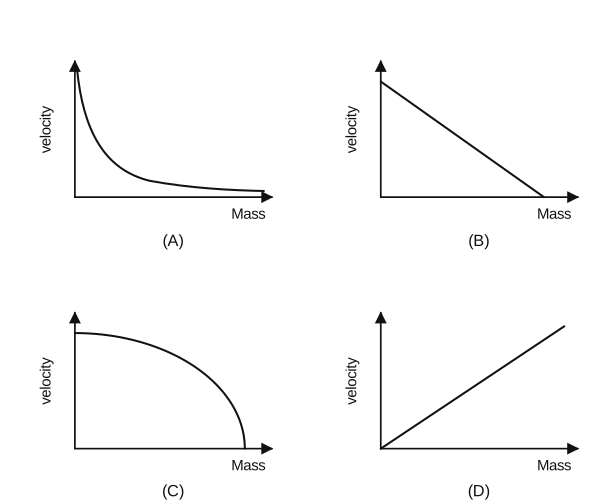
- COMEDK 2025Set 2025-E1 markMCQQ.The velocity - mass graph of body with constant linear momentum is represented by the graph: (A) (B) (C) (D)
›Reveal solutionSolution
For constant linear momentum p=mv, velocity and mass are inversely proportional, so the graph is a rectangular hyperbola — only option (A) matches this shape.
Concept & Intuition
Linear momentum is defined as p=mv. If p is constant, then v=p/m. This is an inverse relationship: as mass increases, velocity decreases, and vice versa. The graph of v vs. m is therefore a rectangular hyperbola — a curve that falls steeply at small masses and flattens out, approaching zero as mass grows large, but never actually reaching zero. Among the given options, only one shows this characteristic shape.
Step-by-step reasoning
- Write the relation Constant momentum means p=constant. Hence
v=mp.
This is of the form v=k/m with k=p>0.
-
Identify the graph type
The equation v=k/m is a rectangular hyperbola. Its key features:
- As m→0+, v→∞ (vertical asymptote at m=0).
- As m→∞, v→0 (horizontal asymptote at v=0).
- The curve is decreasing and convex (curving downward) for all m>0.
-
Match with the options
- (A) shows a curve that starts high near the velocity axis, drops steeply, then flattens and approaches the mass axis — exactly a hyperbola.
- (B) is a straight line with negative slope — that would mean v decreases linearly with m, which is not v∝1/m.
- (C) is a concave-down arc that meets the mass axis at a finite point — a hyperbola never touches the mass axis (it only approaches it).
- (D) is a straight line through the origin with positive slope — that would mean v∝m, which is the opposite of the required relation. …
- COMEDK 2025Set 2025-M1 markMCQQ.A bomb of mass 20 kg at rest explodes into two pieces of masses 12 kg and 8 kg . If the velocity of 8 kg mass is 6 ms−1, then the kinetic energy of the other mass is: (A) 144 J (B) 64 J (C) 86 J (D) 96 J
›Reveal solutionSolution
Using conservation of momentum (the bomb is initially at rest) and the given velocity of the 8 kg fragment, we find the velocity of the 12 kg fragment, then compute its kinetic energy. The result is 96 J, corresponding to option (D).
Concept & Intuition
When an object at rest explodes, no external horizontal forces act (we ignore air resistance and gravity’s effect on horizontal motion). Therefore, the total momentum before and after the explosion must be equal. Before the explosion, momentum is zero. After, the two fragments fly apart in opposite directions (or at least with opposite velocity components) so that their vector sum remains zero. Once we know the velocity of one piece, we can find the other’s velocity from momentum conservation, and then kinetic energy follows directly.
-
State the given data
- Total mass: M=20 kg
- Mass of first fragment: m1=12 kg
- Mass of second fragment: m2=8 kg
- Velocity of the 8 kg fragment: v2=6 m/s (direction is not needed for magnitude, but we’ll treat it as positive; the other fragment will move opposite).
-
Apply conservation of momentum
Initial momentum = 0.
Final momentum: m1v1+m2v2=0.
So
12v1+8×6=0
12v1+48=0
v1=−1248=−4 m/s
The negative sign means the 12 kg fragment moves in the opposite direction to the 8 kg fragment. Its speed is 4 m/s.
- Compute the kinetic energy of the 12 kg mass …
-
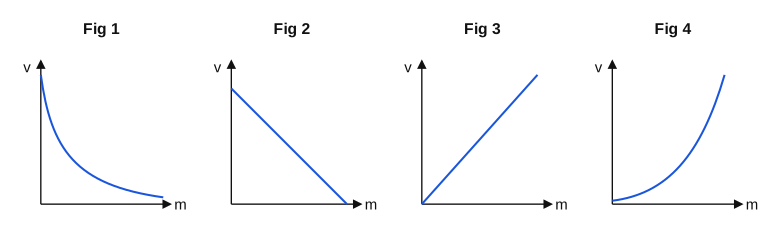
- COMEDK 2024Set 2024-M1 markMCQQ.Which of the following graph shows the variation of velocity with mass for the constant momentum? (A) Fig 3 (B) Fig 1 (C) Fig 2 (D) Fig 4
›Reveal solutionSolution
For constant momentum p=mv, velocity and mass are inversely proportional, so the graph of v vs. m is a rectangular hyperbola — a smooth curve that falls steeply at small masses and approaches the axes asymptotically. This matches Fig 1.
The key idea is that momentum is defined as p=mv. If momentum is held constant, then v=mp. This is an inverse relationship: as mass increases, velocity decreases, and vice versa. The graph of an inverse proportion is a rectangular hyperbola — not a straight line.
Let’s work through the options step by step.
-
Identify the relationship
Constant momentum means p=constant.
So v=mp. This is of the form v=mk where k=p.
This is an inverse variation: when m is small, v is large; when m is large, v is small. The curve never touches either axis (as m→0, v→∞; as m→∞, v→0).
-
Examine each figure
- Fig 1: A smooth curve that starts high on the v-axis at small m, falls steeply, then flattens and approaches the m-axis asymptotically. This is exactly the shape of v=k/m — a rectangular hyperbola.
- Fig 2: A straight line with constant negative slope. That would mean v decreases linearly with m, i.e., v=a−bm. This is not an inverse relationship.
- Fig 3: A straight line through the origin with positive slope. That means v∝m, i.e., direct proportion. This would imply momentum increases with mass, not constant.
- Fig 4: A smooth curve that rises slowly at first, then more steeply — concave up. This suggests v increases faster than m (e.g., v∝m2), which is the opposite of what we need.
-
Match the correct figure …
-
- COMEDK 2023Set 2023-E1 markMCQQ.If the resultant of all external forces acting on a system of particles is zero, then from an inertial frame one can surely say that (A) Linear momentum of the system does not change in time (B) Kinetic energy of the system does not change in time. (C) Potential energy of the system does not change in time. (D) Angular momentum of the system does not change in time
›Reveal solutionSolution
Newton's second law for a system, Fext=dp/dt, gives that zero net external force keeps total linear momentum constant — nothing more is guaranteed.
For a system of particles, Fext,net=dtdP. If Fext,net=0, then P= constant, so linear momentum is conserved. …
- COMEDK 2023Set 2023-E1 markMCQQ.A neutron makes a head on elastic collision with a lead nucleus. The ratio of nuclear mass to neutron mass is 206 . The fractional change in kinetic energy of a neutron is (A) 3% increase (B) 2% decrease (C) 2% increase (D) 3% decrease
›Reveal solutionSolution
Fractional KE transferred =4m1m2/(m1+m2)2=4⋅206/2072≈1.9%; the neutron loses it, so ~2% decrease.
In a one-dimensional elastic collision, the fraction of the incident particle's kinetic energy transferred to a stationary target is
KEΔKE=(m1+m2)24m1m2
With m1=1 (neutron), m2=206 (lead nucleus): …
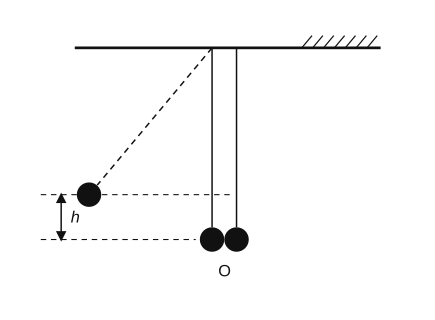
- COMEDK 2023Set 2023-M1 markMCQQ.In the figure, pendulum bob on left side is pulled a side to a height h from its initial position. After it is released it collides with the right pendulum bob at rest, which is of same mass. After the collision, the two bobs stick together and rise to a height (A) 43h (B) 32h (C) 2h (D) 4h
›Reveal solutionSolution
The collision is perfectly inelastic (the bobs stick together), so kinetic energy is not conserved, but momentum is. Using conservation of energy for the initial swing and the final swing, the maximum height after collision is h/4, which corresponds to option (D).
The key idea is to break the motion into three clean stages:
- Swing down – the left bob converts gravitational potential energy into kinetic energy.
- Collision – the two bobs stick together; momentum is conserved, but kinetic energy is lost.
- Swing up – the combined bobs convert their kinetic energy back into gravitational potential energy.
Because the bobs stick together, this is a perfectly inelastic collision. That means we cannot simply average the speeds; we must use momentum conservation to find the speed just after impact, then use energy conservation to find the height.
Step-by-step reasoning
- Speed of the left bob just before collision The left bob is released from rest at height h above the lowest point. By conservation of mechanical energy (no friction, strings are ideal):
mgh=21mv2⇒v=2gh.
This is the speed of the left bob just before it hits the stationary right bob.
- Momentum conservation during the collision Both bobs have the same mass m. The right bob is initially at rest. After the collision they stick together, so the combined mass is 2m and they move with a common speed V. Momentum before = momentum after:
mv+m⋅0=(2m)V⇒V=2v.
Substituting v=2gh:
V=22gh.
- Height reached after collision After the collision, the two bobs (mass 2m) swing upward together. Their kinetic energy just after collision is converted entirely into gravitational potential energy at the maximum height H:
21(2m)V2=(2m)gH.
Simplify:
- COMEDK 2022Set 20221 markMCQQ.A bullet of mass m hits a mass M and gets embedded in it. If the block rises to a height h as a result of this collision, the velocity of the bullet before collision is (A) v=2gh (B) v=2gh[1+(Mm)] (C) v=2gh(1+mM) (D) v=2gh[1−(Mm)]
›Reveal solutionSolution
[!TLDR]
Conserve momentum during the embedding, then equate the post-collision kinetic energy to (m+M)gh; the result has the 2gh(1+mass ratio) form of option (B).
Concept
This is the ballistic-pendulum problem (CBSE Class-11 Work, Energy and Collisions). The collision is perfectly inelastic — momentum is conserved but kinetic energy is not — after which mechanical energy of the combined block-plus-bullet is conserved as it rises.
Solution
Let the bullet (mass m, speed v) embed in the block (mass M), giving common speed V.
Momentum conservation during the collision:
mv=(m+M)V⇒V=m+Mmv.
Energy conservation as the combined mass rises to height h:
21(m+M)V2=(m+M)gh⇒V=2gh.
Combining:
m+Mmv=2gh⇒v=mm+M2gh=2gh(1+mM). …
- KCET 2021Set B-21 markMCQQ.A ball hits the floor and rebounds after an inelastic collision. In this case (A) the momentum of the ball is conserved (B) the mechanical energy of the ball is conserved (C) the total momentum of the ball and the earth is conserved (D) the total mechanical energy of the ball and the earth is conserved
›Reveal solutionSolution
Momentum conservation requires zero external force; enlarging the system to ball + Earth makes the contact and gravitational forces internal, while the inelastic collision destroys mechanical energy either way.
Step 1 — Test (A): momentum of the ball alone.
During the bounce the floor pushes up on the ball with a large normal force N for a time Δt. That is an external force on the ball, delivering an impulse
J=∫Ndt=Δpball=0.
Indeed the ball's momentum literally reverses direction (down → up). So (A) is false.
Step 2 — Test (C): momentum of the ball + Earth system.
Now the ball–floor contact force and the ball–Earth gravitational force are internal (Newton's third-law pairs inside the system: the ball pushes down on the Earth exactly as hard as the Earth pushes up on the ball). With no external force,
dtdpsystem=Fext=0⟹pball+pEarth=constant.
The Earth recoils imperceptibly (its mass is ∼1025 times larger), but its momentum change exactly cancels the ball's. So (C) is true. …
- KCET 2020Set A-11 markMCQQ.One end of a string of length 'l' is connected to a particle of mass 'm' and the other to a small peg on a smooth horizontal table. If the particle moves in a circle with speed 'v', the net force on the particle (directed towards the centre) is: (T is the tension in the string) (A) T (B) T−lmv2 (C) T+lmv2 (D) 0
›Reveal solutionSolution
Draw the free-body diagram: on a frictionless horizontal table the only horizontal force is the tension, so the net inward force is simply T.
Step 1 — List every real force on the particle.
- Weight mg, vertically down.
- Normal reaction N from the table, vertically up.
- Tension T in the string, horizontal, directed from the particle towards the peg — i.e. towards the centre of the circle.
The table is smooth, so there is no friction, and the motion is horizontal, so
N−mg=0⇒N=mg.
The vertical forces cancel exactly and contribute nothing to the horizontal (radial) direction.
Step 2 — Apply Newton's second law along the radius.
For circular motion the net radial (centripetal) force must supply the required centripetal acceleration ac=v2/l:
Fnet, centre=lmv2
But the only force with a component towards the centre is T. Hence
Fnet, centre=Tand alsoT=lmv2.
Step 3 — Why the other options are traps. …
🎓Unlock everything free for 14 days
- ✓Full step-by-step solutions
- ✓Concept-first explanations
- ✓Methods, shortcuts & mistakes
- ✓PYQ mapping + timed mock tests
Full access for 14 days. No credit card required.