Q.A large steel wheel is to be fitted on to a shaft of the same material. At 27 ∘C, the outer diameter of the shaft is 8.70 cm and the diameter of the central hole in the wheel is 8.69 cm. The shaft is cooled using 'dry ice'. At what temperature of the shaft does the wheel slip on the shaft? Assume coefficient of linear expansion of the steel to be constant over the required temperature range: αsteel=1.20×10⁻⁵ K−1.
🔒You're viewing a preview — the full solution, concept, methods & PYQ mapping are locked.
🔒 Start your 14-day free trial to unlock the full solution →Concept understanding — Thermal Expansion Coefficient
Thermal Expansion Coefficient: From Intuition to Precision
The Intuition: What Happens When Things Get Hot?
Think about a metal railway track on a summer day. The track is laid in sections with small gaps between them. On a hot afternoon, those gaps get smaller — sometimes the track even buckles. Why? Because the metal expands when heated.
Or consider a mercury thermometer. The liquid mercury sits in a bulb at the bottom. When your body warms the bulb, the mercury expands and rises up the narrow tube. The hotter you are, the higher it climbs.
This is thermal expansion: most materials get bigger when heated and smaller when cooled. The atoms inside vibrate more vigorously as temperature rises, pushing their neighbours slightly farther apart. The entire object grows in every direction.
But different materials expand by different amounts. A steel rod and an aluminium rod of the same length, heated by the same amount, will not end up the same length. Aluminium expands more. So we need a number that tells us how much a given material expands per degree of temperature change. That number is the thermal expansion coefficient.
The Precise Statement: Defining the Coefficient
There are actually three coefficients, depending on whether we care about length, area, or volume. For a first meeting, we focus on the most common one: the linear thermal expansion coefficient, denoted by the Greek letter α (alpha).
α=L01⋅ΔTΔL
Where:
- L0 is the original length of the object (at some starting temperature)
- ΔL is the change in length (final length minus original length)
- ΔT is the change in temperature (final temperature minus initial temperature)
What this formula says in plain English: The coefficient α is the fractional change in length per degree of temperature change. If α=2.5×10⁻⁵per∘C, it means that for every 1∘C rise in temperature, the material expands by 0.0025% of its original length.
How to Use It: The Working Formula
From the definition, we can rearrange to get the practical formula:
ΔL=αL0ΔT
So the final length L after a temperature change is:
L=L0+ΔL=L0(1+αΔT)
For small temperature changes (say, less than 100∘C), this linear approximation is excellent. For very large changes, the coefficient itself may change slightly with temperature, but at the introductory level we treat α as constant.
A Concrete Example
A steel bridge girder is 50.00m long at 20∘C. The linear expansion coefficient of steel is α=1.2×10⁻⁵/∘C. How much longer is it on a 40∘C day?
Step 1: Identify the quantities.
- L0=50.00m
- ΔT=40−20=20∘C
- α=1.2×10⁻⁵/∘C
Step 2: Apply the formula.
ΔL=αL0ΔT=(1.2×10⁻⁵)(50.00)(20)
Step 3: Calculate.
ΔL=1.2×10−5×1000=0.012m=1.2cm
So the girder expands by 1.2cm. That is why bridges have expansion joints — without them, the structure would buckle.
Two Important Cousins: Area and Volume Expansion
For a thin sheet (like a metal plate), we care about area expansion. The area expansion coefficient is approximately 2α. For a solid object, the volume expansion coefficient is approximately 3α. These come from the same idea: if every linear dimension grows by a factor (1+αΔT), then area grows by (1+αΔT)2≈1+2αΔT, and volume by (1+αΔT)3≈1+3αΔT.
These approximations (2α and 3α) are valid only when αΔT is small compared to 1. For most solids and modest temperature changes, this is true. For gases, the expansion is much larger and a different treatment is needed.
What the Coefficient Tells Us About Materials
| Material | α (per ∘C) | Behaviour |
|----------|--------------------------------|-----------| …
Concept: Thermal Expansion Coefficient — the fractional change in length per degree change in temperature.
Reasoning:
- For the wheel to slip onto the shaft, the shaft’s outer diameter must shrink to at most the wheel’s hole diameter (8.69 cm). The change needed is:
ΔD=8.69−8.70=−0.01 cm
- Using linear expansion: ΔD=D0αΔT, where ΔT=Tf−T0 and T0=27 ∘C.
−0.01=(8.70)×(1.20×10−5)×(Tf−27)
- Solve for Tf:
Cooling the shaft shrinks its diameter from 8.70 cm to 8.69 cm. From ΔL=αL0ΔT the required change is ΔT≈−95.8 ∘C, so the shaft must reach about −69 ∘C.
The wheel slips on when the shaft's outer diameter, after cooling, has contracted to equal the wheel's hole diameter. Both parts are steel with the same α, but only the shaft is cooled; the hole diameter stays fixed.
Contraction condition. The shaft diameter must fall by ΔL=8.69−8.70=−0.01 cm from its value L0=8.70 cm at 27 ∘C:
ΔL=αL0ΔT⇒ΔT=αL0ΔL
Substitute α=1.20×10⁻⁵ K−1: …
Shortcut — fractional-change route. Skip solving for ΔD explicitly: the wheel slips once the shaft's diameter has shrunk by the fraction D0ΔD=8.708.69−8.70≈−1.15×10⁻³. Since D0ΔD=αΔT, the temperature drop follows in one step: ΔT=1.20×10⁻⁵−1.15×10⁻³≈−95.8 K, giving Tf≈27−95.8≈−68.8∘C. …
- COMEDK 2024Set 2024-E1 markMCQQ.The coefficient of volume expansion of glycerine is 49×10−5 K−1. The percentage change in its density for a 50∘C rise in temperature is (A) 3.54 (B) 5.24 (C) 4.25 (D) 2.45
›Reveal solutionSolution
The fractional change in density equals the negative of the fractional change in volume. Using γ=49×10−5K−1 and ΔT=50∘C, the percentage change in density is −γΔT×100%=−2.45%, so the magnitude is 2.45%, matching option (D).
Concept & Intuition
When a substance is heated, its volume expands. Since mass stays constant, density (ρ=m/V) must decrease. The volume expansion coefficient γ tells us the fractional change in volume per degree: ΔV/V=γΔT. Because density is inversely proportional to volume, the fractional change in density is the negative of the fractional change in volume (for small changes). So we can directly compute the percentage change in density from γ and ΔT without needing initial values.
Step-by-step solution
- Recall the relation between density and volume Density ρ=m/V. For a fixed mass m, a small change in volume V gives
ρΔρ≈−VΔV.
This is exact for infinitesimal changes; for finite but small changes (like here), it is an excellent approximation.
- Express the volume change The coefficient of volume expansion γ is defined by
VΔV=γΔT.
Given γ=49×10−5K−1 and ΔT=50∘C (a change of 50 K, since the size of a Celsius degree equals a kelvin),
VΔV=(49×10−5)×50=49×50×10−5=2450×10−5=0.0245.
- Find the fractional change in density Using step 1:
- KCET 2021Set B-21 markMCQQ.Which of the following curves represent the variation of coefficient of volume expansion of an ideal gas at constant pressure?
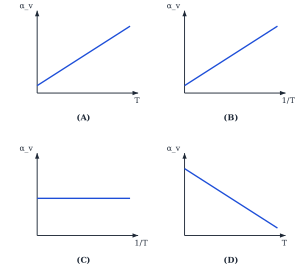 (A)
(B)
(C)
(D)
(A)
(B)
(C)
(D)›Reveal solutionSolution
For an ideal gas at constant pressure, the coefficient of volume expansion γ is inversely proportional to the absolute temperature T (γ=1/T), so the correct graph is a rectangular hyperbola — option (B).
The coefficient of volume expansion, γ, tells you how much the volume of a substance changes per unit change in temperature, relative to its original volume. For solids and liquids, γ is often nearly constant over small temperature ranges. But for an ideal gas, the behaviour is different — and beautifully simple — because the gas obeys a precise equation of state.
At constant pressure, the ideal gas law is PV=nRT. Since P, n, and R are fixed, volume V is directly proportional to absolute temperature T:
V=(PnR)T
This is a straight line through the origin when you plot V vs T (in kelvin). Now, the definition of the coefficient of volume expansion is:
γ=V1(∂T∂V)P
That is, the fractional change in volume per degree temperature change, at constant pressure.
- Find ∂T∂V at constant P. From V=PnRT, differentiate with respect to T:
(∂T∂V)P=PnR
- Substitute into the definition of γ.
γ=V1⋅PnR
- Replace V using the ideal gas law. Since V=PnRT, we get:
γ=PnRT1⋅PnR=T1
The nR/P cancels perfectly. So for an ideal gas at constant pressure:
γ=T1
This is a key result: the coefficient of volume expansion is not constant — it varies inversely with the absolute temperature.
γideal gas, const. P=T1
- Interpret the graph. The relation γ=1/T is a rectangular hyperbola. As T increases, γ decreases; as T approaches zero, γ blows up (but remember, the gas liquefies before absolute zero, so the ideal gas law fails there). The curve is smooth and decreasing, never touching either axis. …
🎓Unlock everything free for 14 days
- ✓Full step-by-step solutions
- ✓Concept-first explanations
- ✓Methods, shortcuts & mistakes
- ✓PYQ mapping + timed mock tests
Full access for 14 days. No credit card required.