Q.A brass wire 1.8 m long at 27 ∘C is held taut with little tension between two rigid supports. If the wire is cooled to a temperature of −39 ∘C, what is the tension developed in the wire, if its diameter is 2.0 mm? Coefficient of linear expansion of brass =2.0×10⁻⁵ K−1; Young's modulus of brass =0.91×10¹¹ Pa.
🔒You're viewing a preview — the full solution, concept, methods & PYQ mapping are locked.
🔒 Start your 14-day free trial to unlock the full solution →Concept understanding — Youngs Modulus
Young’s Modulus: The Stretchiness of a Solid
When you pull on a rubber band, it stretches easily. When you pull on a steel rod of the same size, it barely moves. Both are elastic — they return to their original shape when you let go — but they resist stretching very differently. Young’s modulus is the number that tells you exactly how much a material resists being stretched or compressed lengthwise.
The Intuition: Stiffness per Unit Size
Think of a spring. A stiff spring requires a large force to stretch it a little. A soft spring stretches a lot with a small force. Young’s modulus is like the “stiffness” of a material, but it’s cleverly designed to be independent of the object’s shape and size.
If you take a thick steel rod and a thin steel wire of the same length, the rod is harder to stretch. That’s because you’re pulling on more material. Young’s modulus removes this size effect — it tells you the stiffness of the material itself, not the particular piece you’re holding.
The Precise Definition
Young’s modulus (E or Y) is defined as the ratio of tensile stress to tensile strain, as long as the material obeys Hooke’s law (the deformation is reversible and proportional to the force).
Y=Tensile StrainTensile Stress
Let’s break down the two parts.
Tensile Stress (σ) is the force per unit area. If you pull with a force F on a rod of cross-sectional area A, the stress is:
σ=AF
Stress has units of pressure — pascals (Pa) or N/m2. It tells you how “intense” the pulling is, regardless of the rod’s thickness.
Tensile Strain (ε) is the fractional change in length. If the original length is L0 and it stretches by ΔL, the strain is:
ε=L0ΔL
Strain is a pure number — it has no units. A strain of 0.01 means the rod stretched by 1% of its original length.
Putting it together:
Y=ΔL/L0F/A=AΔLFL0
What the Number Tells You
A high Young’s modulus means the material is very stiff — it takes a huge stress to produce even a tiny strain. Steel has Y≈200×109 Pa. A low Young’s modulus means the material is easily stretched. Rubber has Y≈0.01×10⁹ Pa — about 20,000 times smaller than steel.
Young’s modulus is only valid in the elastic region — where the material returns to its original shape after the force is removed. If you stretch too far (past the elastic limit), the material deforms permanently or breaks, and Young’s modulus no longer applies.
A Worked Example
A steel wire of length 2.0 m and cross-sectional area 1.0×10⁻⁶ m2 is pulled by a force of 100 N. How much does it stretch? (Young’s modulus of steel = 2.0×10¹¹ Pa)
From Y=AΔLFL0, rearrange:
ΔL=AYFL0=(1.0×10−6)×(2.0×1011)100×2.0=2.0×105200=1.0×10⁻³ m=1.0 mm …
Concept: Thermal stress — when a constrained wire is cooled, it tries to contract but cannot, so a tensile stress develops. This stress is given by YαΔT, and tension is stress × area.
Step 1 — Temperature change
ΔT=Tf−Ti=−39−27=−66 K
(The magnitude 66 K is what matters for the strain.)
Step 2 — Thermal strain prevented
If free to contract, the wire would shrink by α∣ΔT∣. Since it is held at fixed length, the constraint produces an equivalent tensile strain:
strain=α∣ΔT∣=(2.0×10⁻⁵)(66)=1.32×10⁻³
Step 3 — Stress and tension
Stress = Y×strain:
σ=(0.91×10¹¹)(1.32×10⁻³)=1.2012×10⁸ Pa…Cooling the clamped wire prevents its contraction, producing a tensile thermal stress σ=Yα∣ΔT∣. The tension is F=σA=Yα∣ΔT∣πr2≈3.8×10² N.
Why this approach works
A wire free to contract simply shortens when cooled, with no stress. Held rigidly at both ends, its length is fixed, so the contraction it would have undergone, α∣ΔT∣, is held in the wire as a strain. Young's modulus converts that strain into a tensile stress, and stress times cross-sectional area gives the tension.
F=Yα∣ΔT∣πr2
Step 1 - Temperature change
ΔT=(−39)−27=−66 K,∣ΔT∣=66 K
Step 2 - Prevented (thermal) strain
α∣ΔT∣=(2.0×10⁻⁵)(66)=1.32×10⁻³
Step 3 - Thermal stress
σ=Yα∣ΔT∣=(0.91×10¹¹)(1.32×10⁻³)=1.20×10⁸ Pa …
Shortcut — combine into a single formula. Since the wire cannot change length, the induced strain equals exactly what free thermal contraction would have produced: ε=α∣ΔT∣. Chain the three steps (strain → stress → force) into one expression: F=YAα∣ΔT∣=Y⋅4πd2⋅α∣ΔT∣. Plugging numbers in directly skips the intermediate stress value: $F = (0.91\times10^{11})\left(\frac{\pi(2.0\times10^{-3})^2}{4}\right)(2.0\times …
Showing the 12 most recent of 19 on this concept.
- COMEDK 2026Set 2026-A1 markMCQQ.A wire, made of a certain material of length-l and area of cross section-a can withstand a maximum load =W without breaking. If, another wire of the same material and crosssectional area is used with double the original length, what will be the maximum load that the wire can withstand, without breaking? (A) Will be halved to 0.5 W (B) Will be doubled to 2 W (C) Remains the same =W (D) Would be four times =4 W
›Reveal solutionSolution
The maximum load a wire can withstand without breaking depends only on its material and cross-sectional area, not on its length. Therefore, doubling the length leaves the maximum load unchanged. The correct option is (C).
The key concept here is tensile strength — the maximum stress a material can endure before breaking. Stress is defined as force per unit area:
σ=AF
For a given material, the breaking stress is a fixed property (assuming no defects). The wire’s length does not appear in this formula. So, if the cross-sectional area stays the same, the maximum force (load) that causes breaking remains the same, regardless of length.
Let’s walk through it step by step:
- Recall the definition of breaking stress The wire breaks when the tensile stress reaches the material’s ultimate tensile strength, σmax.
σmax=aW
Here, W is the maximum load (force) and a is the cross-sectional area. This is the condition for the original wire.
-
Consider the new wire
The new wire is made of the same material (so σmax is identical) and has the same cross-sectional area a. Its length is doubled, but length does not appear in the stress equation.
-
Set up the breaking condition for the new wire
Let the new maximum load be W′. Then:
σmax=aW′
Since σmax is the same as before, we have:
aW=aW′
which simplifies to W′=W.
- Why length doesn’t matter here …
- COMEDK 2026Set 2026-M1 markMCQQ.A light rod of length 1 m is suspended from ceiling horizontally by means of two vertical wires of equal length tied to its ends. One of the wires is made of material X and is of cross-section 0.1 cm2. and the other of material Y of cross-section 0.3 cm2.A weight is hung from the wire at a point to produce equal strain in the wires. The ratio of Young's moduli of wires A to B is 3:1. The location of the point from one end of the wire is (A) 0.2 m (B) 0.75 m (C) 0.5 m (D) 0.25 m
›Reveal solutionSolution
Equal strain forces equal tension in both wires, so the load hangs at the rod's midpoint, 0.5m from either end.
Setting up the equal-strain condition
Strain in a wire is ε=Ystress=AYF, where F is the tension, A the cross-section and Y Young's modulus.
For equal strain in the two wires:
AXYXFX=AYYYFY
Given AX=0.1cm2, AY=0.3cm2 and YX:YY=3:1:
AXYX=0.1×3=0.3,AYYY=0.3×1=0.3
Since AXYX=AYYY, the equal-strain condition reduces to FX=FY.
Locating the load …
- KCET 2026Set C21 markMCQQ.There are two wires of same material and same length while the diameter of second wire is two times the diameter of the first wire. Then the ratio of extensions produced in the wires by applying same load will be (A) 1:1 (B) 1:2 (C) 2:1 (D) 4:1
›Reveal solutionSolution
Extension from Young's modulus, e=FL/(AY), depends inversely on cross-sectional area for fixed force, length, and material.
Step 1 — Set up the two wires
Both wires share the same material (same Young's modulus Y), same length L, and the same applied load F. Let wire 1 have diameter d and wire 2 have diameter 2d.
A1=4πd2,A2=4π(2d)2=4(4πd2)=4A1
Step 2 — Compare the extensions …
- COMEDK 2025Set 2025-A1 markMCQQ.One end of a nylon rope of length 1 and diameter 10 mm is fixed to free limb. A monkey weighing 100 N jumps to catch the free end and stays there. The change in diameter of the rope is (Young's modulus of the wire is Y and Poisson Ratio is σ ) (A) πY4000σ (B) πY400σ (C) πY40000σ (D) σY40000π
›Reveal solutionSolution
The change in diameter is found from the lateral strain (Poisson effect) caused by the axial tensile stress. The answer is πY40000σ, so option (C) is correct.
Concept & Intuition
When the monkey hangs on the rope, the rope stretches lengthwise (axial strain). Because of the Poisson effect, a material that stretches in one direction contracts in the perpendicular directions. Here, the diameter decreases. The change in diameter is proportional to the original diameter, the axial strain, and the Poisson ratio. The axial strain itself comes from the tensile stress (weight divided by cross-sectional area) divided by Young's modulus. So we just need to compute the stress carefully, then apply the Poisson relation.
Step-by-step solution
-
Find the cross-sectional area of the rope
Diameter d=10 mm=10−2 m.
Area A=4πd2=4π(10−2)2=4π×10−4=4π×10−4 m2.
-
Compute the axial tensile stress
The monkey’s weight W=100 N is the tensile force.
Stress σaxial=AW=4π×10−4100=π×10−4100×4=π×10−4400=π400×104=π4×10⁶ Pa.
-
Find the axial strain
By Hooke’s law, axial strain εaxial=Yσaxial=πY4×106.
-
Relate lateral strain to axial strain via Poisson ratio
Poisson ratio σ (here the symbol given in the problem) is defined as
σ=−axial strainlateral strain. …
-
- COMEDK 2025Set 2025-E1 markMCQQ.A wire of negligible mass having uniform area of cross section ' A ' and young modulus ' Y ' is used to suspend a point mass ' m '. The point mass executes simple harmonic motion in a vertical plane with a period ' T ', then the length of the wire is : (A) L=4π2mTY2A (B) L=4πm2T2YA (C) L=4πm2TY2A (D) L=4π2mT2YA
›Reveal solutionSolution
The period of a mass on a vertical wire is determined by the wire's stiffness, which comes from its Young's modulus and geometry. Using the formula for the spring constant of a stretched wire and the period of a simple harmonic oscillator, we find L=4π2mT2YA, which corresponds to option (D).
The key concept here is that a wire under tension behaves like a spring for small oscillations. When the mass is displaced vertically, the wire stretches and exerts a restoring force proportional to the extension, exactly like Hooke's law. The "spring constant" k for a wire of length L, cross-sectional area A, and Young's modulus Y is k=LYA. Then the period of simple harmonic motion for a mass m on such a spring is T=2πkm. Combining these gives the length directly.
- Recall the spring constant for a wire under tension. Young's modulus is defined as Y=strainstress=ΔL/LF/A. Rearranging:
F=LYAΔL
This is exactly Hooke's law F=kΔL, so the effective spring constant is
k=LYA.
- Write the period of a mass-spring system. For a simple harmonic oscillator, the period is
T=2πkm.
- Substitute the expression for k.
T=2πYA/Lm=2πYAmL.
- Solve for L. Square both sides:
T2=4π2YAmL.
Multiply both sides by YA and divide by 4π2m:
- COMEDK 2025Set 2025-M1 markMCQQ.Young's modulus of the material of wires X and Y are in the ratio 4:1 and the areas of cross sections of the wires X and Y are in the ratio 2:1. If the same amount of load is applied to both the wires, the ratio of elongation produced in the wires X and Y will be: (Assume length of the wires X and Y initially are the same) (A) 1:8 (B) 1:1 (C) 8:1 (D) 1:2
›Reveal solutionSolution
Using Hooke’s law for elastic deformation, elongation is inversely proportional to Young’s modulus and cross‑sectional area. Given the ratios, the elongation ratio of X to Y is 1:8, so option (A) is correct.
Concept & Intuition
When the same load (force) is applied to two wires of equal initial length, the amount each stretches depends on how stiff the material is (Young’s modulus Y) and how thick the wire is (cross‑sectional area A). A larger Young’s modulus means the material resists stretching more; a larger area also resists stretching more. So elongation is inversely proportional to both Y and A. The problem gives ratios for Y and A, so we combine them to find the ratio of elongations.
Step‑by‑step reasoning
- Recall the elongation formula For a wire of length L, cross‑sectional area A, Young’s modulus Y, under a tensile force F, the elongation ΔL is given by Hooke’s law:
ΔL=AYFL.
Here F and L are the same for both wires (same load, same initial length), so ΔL∝AY1.
-
Write the given ratios
- Young’s modulus: YX:YY=4:1 → YYYX=4.
- Cross‑sectional area: AX:AY=2:1 → AYAX=2.
-
Set up the ratio of elongations
ΔLYΔLX=AYYY1AXYX1=AXYXAYYY.
- Substitute the known ratios
- COMEDK 2024Set 2024-E1 markMCQQ.The temperature of a wire is doubled. The Young's modulus of elasticity (A) Will decrease (B) Will also double (C) Will become four times (D) Will remain the same
›Reveal solutionSolution
Young's modulus measures a material's stiffness, which depends on interatomic forces. When temperature rises, atoms vibrate more, weakening these bonds and reducing the modulus. Doubling the temperature (in Kelvin) decreases Young's modulus, so the correct choice is (A).
Concept & Intuition
Young's modulus Y is defined as the ratio of stress to strain in the elastic region:
Y=strainstress=ΔL/LF/A.
It reflects how strongly atoms resist being pulled apart. At the atomic level, the modulus is proportional to the curvature of the interatomic potential energy curve near equilibrium. When temperature increases, atoms gain thermal energy and vibrate with larger amplitudes. This effectively reduces the "stiffness" of the bonds — the potential well becomes shallower on average — so the material becomes more compliant. Hence, Young's modulus decreases with increasing temperature for most solids.
Step-by-step reasoning
- Recall the temperature dependence of elastic moduli For most crystalline solids, Young's modulus decreases approximately linearly with temperature over a wide range. The empirical relation is
Y(T)=Y0[1−α(T−T0)],
where α is a positive constant (the temperature coefficient of the modulus). Doubling the temperature (say from T to 2T) means a large increase, so Y will drop.
-
Why it cannot double or stay the same
- If Y doubled, the material would become twice as stiff — opposite to the known effect of heating (bonds weaken).
- If Y remained the same, temperature would have no effect on bond strength, which contradicts the observed thermal expansion and softening.
- Becoming four times is even more unrealistic.
-
Consider the atomic picture …
- COMEDK 2024Set 2024-M1 markMCQQ.If the ratio of lengths, radii and Young's Moduli of steel and brass wires in the figure are a,b and c respectively, then the corresponding ratio of increase in their lengths would be (A) 3b2ca (B) 2b2c3a (C) 3b2c2a (D) c2ab2
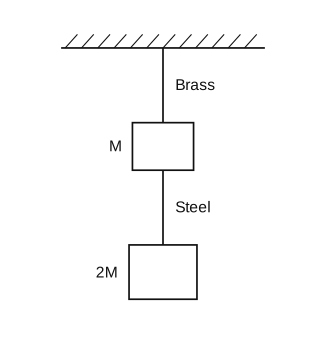
›Reveal solutionSolution
Using ΔL=πr2YFL for each wire, with the brass wire carrying 3Mg and the steel wire 2Mg, the ratio of extensions is 3b2c2a. The correct option is (C).
Concept
A loaded wire extends by ΔL=AYFL=πr2YFL. The two wires carry different tensions — the upper (brass) wire supports both hanging masses while the lower (steel) wire supports only the bottom one — so their tensions differ before the given length/radius/modulus ratios are applied.
Solution
- Tensions. Fbrass=(M+2M)g=3Mg, Fsteel=2Mg.
- Extension formula. ΔL=πr2YFL for each wire.
- Given ratios (steel : brass). LbLs=a, rbrs=b, YbYs=c.
- Ratio of extensions. …
- COMEDK 2023Set 2023-E1 markMCQQ.A man grows into a giant such that his height increases to 8 times his original height. Assuming that his density remains same, the stress in the leg will change by a factor of (A) 22 (B) 4 (C) 16 (D) 8
›Reveal solutionSolution
(This is exactly why giants are structurally impossible at the same material strength - stress grows in proportion to height.)
Concept: scaling of stress with linear size for a geometrically similar body of constant density.
Stress in the leg = (weight supported) / (cross-sectional area of the leg)
= (density * volume * g) / area
Under a uniform scale-up by a factor n = 8 (all lengths multiplied by 8, density unchanged):
- volume scales as L^3 -> 8^3 = 512 times, so weight scales 512 times …
- COMEDK 2023Set 2023-M1 markMCQQ.Two wire of same material having radius in ratio 2 : 1 and lengths in ratio 1: 2. If same force is applied on them, then ratio of their change in length will be (A) 1:1 (B) 1:2 (C) 1:4 (D) 1:8
›Reveal solutionSolution
Using Δl∝L/r2 with lengths 1:2 and radii 2:1 gives a change-in-length ratio of 1:8.
Elongation under a force F:
Δl=AYFL=πr2YFL.
Same material (Y common) and same force F, so Δl∝r2L.
Given r1:r2=2:1 and L1:L2=1:2: …
- COMEDK 2023Set 2023-M1 markMCQQ.Two wires are made of the same material and have the same volume. The first wire has cross-sectional area A and the second wire has cross-sectional area 3A. If the length of the first wire is increased by Δl on applying a force F, how much force is needed to stretch the second wire by the same amount? (A) 4F (B) 6F (C) 9F (D) F
›Reveal solutionSolution
Equal volume forces L2=L1/3; with F∝A/L for the same Δl, the second wire needs 3×3=9 times the force.
Required force for a given extension Δl:
F=LYAΔl.
Equal volume V=AL means L=V/A, so:
F=V/AYAΔl=VYA2Δl∝A2. …
- COMEDK 2022Set 20221 markMCQQ.A copper and a steel wire of same diameter are connected end to end. A deforming force F1 is applied to the wire which causes an elongation of 1 cm. The two wires will have (A) the same stress (B) different stress (C) the same strain (D) different strain
›Reveal solutionSolution
[!TLDR]
In a series (end-to-end) arrangement both wires carry the same force over the same area, so they experience the same stress.
Concept
Stress is defined as force per unit area, σ=F/A (CBSE Class 11 elasticity). For wires joined end to end, the applied force is transmitted equally through each section.
Solution
The two wires are connected end to end, so the same force F1 acts on both. They have the same diameter, hence the same cross-sectional area A. Therefore
σCu=AF1=σsteel, …
🎓Unlock everything free for 14 days
- ✓Full step-by-step solutions
- ✓Concept-first explanations
- ✓Methods, shortcuts & mistakes
- ✓PYQ mapping + timed mock tests
Full access for 14 days. No credit card required.