Q.A protoxin is:
🔒You're viewing a preview — the full solution, concept, methods & PYQ mapping are locked.
🔒 Start your 14-day free trial to unlock the full solution →Concept understanding — Bt Toxin Inactivity
Let’s start with something you already know. Imagine you eat a piece of stale, spoiled food. Your stomach immediately feels uneasy — maybe you get cramps or nausea. Your body is reacting to something harmful that entered it. Now, what if that harmful thing was a tiny crystal that only dissolves and becomes active in your stomach’s specific acidic environment? That’s the basic idea behind Bt toxin inactivity.
The everyday intuition
Think of a medicine capsule that has a special coating. That coating is designed to survive the acid in your stomach and only dissolve in your intestines, where the medicine is needed. If the coating dissolved too early, the medicine would be destroyed before it could work. If it never dissolved, the medicine would pass right through you, useless.
Bt toxin works on a similar principle — but in reverse. The toxin is produced by a bacterium called Bacillus thuringiensis (Bt). This bacterium makes a protein crystal that is harmless to most organisms, including humans, because it is produced in an inactive form. It only becomes dangerous when it reaches the very specific environment of an insect’s midgut.
The precise meaning
Bt toxin inactivity means that the toxin protein is initially non-toxic. It is a protoxin — a precursor that needs to be activated inside the body of a target insect. The activation happens only when the protoxin is eaten by a susceptible insect larva. Inside the insect’s midgut, which has a high pH (alkaline conditions) and specific digestive enzymes, the inactive crystal dissolves and gets chopped into a smaller, active toxin molecule.
That active toxin then binds to the insect’s gut wall, creating pores that cause the gut to leak. The insect stops feeding and eventually dies. But for any other animal — including humans, cattle, birds, or fish — the toxin remains inactive because their digestive systems lack the right alkaline pH and the specific enzymes needed to activate it.
This is why Bt toxin is considered safe for humans and non-target animals. The toxin is not poisonous by itself; it is the insect’s own digestive chemistry that turns it into a poison. If you ate the Bt crystal, it would pass through your body unchanged, like an undigested seed.
Why it matters
This concept is the foundation of Bt crops — genetically modified plants like Bt cotton, Bt corn, and Bt brinjal. Scientists take the gene that codes for this inactive toxin from the bacterium and insert it into the plant’s DNA. The plant then produces the inactive toxin in its tissues. When a pest insect chews on the plant, it ingests the inactive toxin, which becomes active only inside that insect.
The key advantage is target specificity. The toxin does not harm beneficial insects like bees, ladybugs, or earthworms, because their gut conditions are different. It also does not harm humans or livestock. This reduces the need for chemical insecticides, which are broad-spectrum poisons that kill many organisms, including helpful ones.
What the NCERT textbook says
The NCERT Class 12 Biology textbook (Chapter 12: Biotechnology and its Applications) explains this clearly: …
The term "protoxin" refers to an inactive form of a toxin that requires activation to become harmful. The classic example from biotechnology is the Bt toxin produced by Bacillus thuringiensis.
When the bacterium synthesizes Bt toxin, it exists as an inactive protoxin in crystalline form. This protoxin remains harmless until it enters the gut of an insect pest. Once inside the alkaline environment of the insect gut, the protoxin crystal dissolves and gets converted into its active toxic form by gut enzymes. The activated toxin then binds to receptors on the midgut epithelial cells, creating pores that cause cell swelling, lysis, and eventually insect death. …
A protoxin is an inactive form of a toxin that requires activation (usually by specific conditions or enzymes) to become toxic — the answer is (D) Inactive toxin.
The term "protoxin" breaks down neatly: the prefix "pro-" means "before" or "precursor," signaling that this is something that comes before the active toxin itself. Think of it as a dormant version, a molecular blueprint that hasn't yet been switched on.
The classic example from biotechnology — and the one NCERT highlights — is the Bt toxin produced by the bacterium Bacillus thuringiensis. Inside the bacterial cell, the toxin exists as an inactive protoxin (also called a prototoxin or crystal protein). This is a safety mechanism for the bacterium itself: if the toxin were active inside the cell, it would damage the bacterium's own machinery. So the bacterium produces it in a harmless, inactive form.
The magic happens when an insect — say, a caterpillar feeding on a Bt cotton plant — ingests this protoxin. The alkaline pH of the insect's gut, along with specific proteases (protein-cutting enzymes), cleaves the protoxin and converts it into its active, toxic form. This activated toxin then binds to receptors on the gut epithelial cells, creates pores in the cell membranes, and kills the insect. The plant remains unharmed, and so do humans and other animals, because our gut conditions don't activate the protoxin in the same way.
The protoxin is inactive by design — it protects the producing organism and only becomes lethal under specific environmental conditions (like the alkaline insect gut). This specificity is why Bt crops are considered safe for non-target organisms.
Now, why the other options don't fit: …
Method — break the word into its parts
"Proto-" = before/precursor; "-toxin" = the harmful protein.
So a protoxin = a toxin's precursor form, before it is switched on — i.e. an inactive toxin. …
- KCET 2025Set C-41 markMCQQ.Some strains of Bacillus thuringiensis produce proteins that kill insects. Which one of the following is not killed by proteins of Bacillus thuringiensis? (A) Armyworm (B) Cotton bollworm (C) Tapeworm (D) Tobacco budworm
›Reveal solutionSolution
Bt Cry proteins are insect-specific — they need an alkaline insect midgut and a specific midgut receptor — so the non-insect of the four, the tapeworm, is not killed.
Step 1 — How the Bt toxin actually works (this is the whole question).
Bacillus thuringiensis forms protein crystals containing the Cry protein, which exists as an inactive protoxin. When an insect eats it:
- The insect's midgut is alkaline (pH>9.5), which solubilises the crystal.
- The protoxin is then converted into the active toxin.
- The active toxin binds to specific receptors on the midgut epithelium, punching pores in the cells, which swell, lyse and kill the insect.
Every one of these three steps is insect-specific. That is exactly why the toxin is safe for humans and other animals — our stomachs are acidic, so the crystal is never solubilised, and we lack the midgut receptor.
Step 2 — Classify the four organisms.
Option Organism Phylum (A) Armyworm Spodoptera — a lepidopteran caterpillar Arthropoda (insect) ✓ killed (B) Cotton bollworm Helicoverpa armigera — a lepidopteran Arthropoda (insect) ✓ killed (this is what Bt-cotton targets, via cryIAc) - KCET 2025Set C-41 markMCQQ.Which among the three layers of blood vessel wall – Tunica intima, Tunica media and Tunica Externa is comparatively thin in the veins? (A) Tunica intima (B) Tunica externa (C) Both tunica media and tunica externa (D) Tunica media
›Reveal solutionSolution
The middle layer (tunica media) is the muscular/elastic one that resists pressure; since venous pressure is low, it is the layer that is comparatively thin in veins.
Step 1 — The three layers of a blood-vessel wall
Both arteries and veins are built of the same three coats, from inside out:
Layer Composition Function Tunica intima inner endothelium (single layer of squamous cells) smooth, friction-free lining Tunica media smooth muscle + elastic fibres withstands pressure; regulates lumen diameter (vasoconstriction/dilation) Tunica externa (adventitia) fibrous connective tissue with collagen anchoring, structural support Step 2 — Apply the pressure argument
Arteries receive blood ejected from the ventricles under high, pulsatile pressure. To absorb and smooth that surge, they need a thick, muscular, elastic tunica media. …
- KCET 2024Set B-41 markMCQQ.The functional unit of contraction is a (A) Portion of myofibril between two successive Z-lines (B) Portion of myofibril between two successive M-lines (C) Centre of the H-zone (D) Centre of the I-band
›Reveal solutionSolution
The contractile unit of a muscle is the sarcomere, defined as the stretch of a myofibril lying between two consecutive Z-lines.
Step 1 — Recall the architecture of a myofibril
Each muscle fibre contains many myofibrils. A myofibril shows alternating light and dark bands:
- I-band (light) — contains only thin (actin) filaments; it is bisected by the Z-line.
- A-band (dark) — contains the thick (myosin) filaments; its centre carries the lighter H-zone, bisected by the M-line.
Step 2 — Define the functional (contractile) unit
The sarcomere is the portion of the myofibril between two successive Z-lines. It contains one full A-band flanked by two half I-bands. This is the smallest repeating assembly that contains everything needed to contract: anchored thin filaments (Z-line), overlapping thick filaments (A-band) and the cross-bridge machinery.
Step 3 — Why the sliding-filament model makes the Z-line the boundary
During contraction, myosin heads form cross-bridges and pull the actin filaments towards the centre of the A-band. The thin filaments are attached to the Z-lines, so the Z-lines are dragged inward:
Sarcomere length↓,I-band↓,H-zone↓,A-band=constant
Because the shortening is measured between the Z-lines, that span is by definition the functional unit. …
- KCET 2024Set B-41 markMCQQ.The Government of India legalised MTP with some strict regulations in the year (A) 1951 (B) 1961 (C) 1971 (D) 2001
›Reveal solutionSolution
The Government of India legalised MTP — with strict conditions — in 1971.
Step 1 — What MTP is
MTP = Medical Termination of Pregnancy, the intentional/voluntary termination of a pregnancy before full term. It is not a contraceptive method — it is a remedial measure.
Step 2 — The legislation
The Government of India legalised MTP in 1971, but attached strict regulations to it. The reason was twofold:
- A very large number of unsafe, illegal abortions were being performed, endangering women's lives; and
- The procedure was liable to misuse — most notoriously for illegal female foeticide after sex determination of the foetus.
Step 3 — The conditions attached
- MTP is considered relatively safe up to 12 weeks (first trimester); terminations after 12 weeks up to 20 weeks are much riskier and require stricter clearance (in the NCERT text, the approval of two doctors).
- MTPs are legally allowed on grounds such as risk to the mother's life/health, contraceptive failure, foetal abnormality, or pregnancy from rape. …
- KCET 2024Set B-41 markMCQQ.Which of these enzymes is required to cleave a plasmid ? (A) Ligase (B) Endonuclease (C) Exonuclease (D) Polymerase
›Reveal solutionSolution
Cutting a circular plasmid open requires an internal cut, which by definition is made by an endonuclease (a restriction enzyme), not by ligase, exonuclease or polymerase.
Step 1 — Classify the four enzymes by what they physically do to DNA.
- Nucleases cut phosphodiester bonds. They come in two kinds:
- Exonucleases remove nucleotides from the ends of the DNA.
- Endonucleases make cuts at specific positions within the DNA.
- Ligases join two DNA fragments by sealing the phosphodiester backbone.
- Polymerases synthesise new DNA on a template.
Step 2 — Ask what "cleave a plasmid" requires.
A plasmid is a small, circular, extra-chromosomal DNA molecule. A circle has no free ends. Therefore:
- An exonuclease literally cannot start on an intact circular plasmid — there is no terminus to attack. ✗ (C)
- To linearise/open the plasmid so that a foreign gene can be inserted, the cut must be made inside the molecule → an endonuclease. ✓ (B)
Step 3 — The specific enzyme used in practice.
In rDNA technology the enzyme used is a restriction endonuclease. Each such enzyme:
- inspects the DNA and binds at a specific palindromic nucleotide sequence (e.g. EcoRI: 5′-GAATTC-3′/3′-CTTAAG-5′),
- cuts each strand a little away from the centre, between the same two bases on both strands, …
- Nucleases cut phosphodiester bonds. They come in two kinds:
- KCET 2024Set B-41 markMCQQ.Which among the following is used to treat Emphysema ? (A) Human Hormone-α-Antitrypsin (B) Human-α-Interferon (C) Human protein-α-Antitrypsin (D) Human-α-Lactalbumin
›Reveal solutionSolution
Emphysema is treated with α-1 antitrypsin, and the option must also classify it correctly — it is a protein, not a hormone.
Step 1 — Identify the molecule that treats emphysema.
Among the products obtainable by genetic engineering, the textbook list of human proteins reads: insulin (diabetes), α-1 antitrypsin (emphysema), factor VIII (haemophilia), α-interferon (viral infections/cancer) and α-lactalbumin (a milk protein). The molecule paired with emphysema is unambiguously α-1 antitrypsin. That leaves options (A) and (C) — both name antitrypsin — and the question then turns on how it is described.
Step 2 — The biology of why it works.
Emphysema is the progressive destruction of the alveolar walls of the lung. The enzyme neutrophil elastase digests elastin in lung tissue; α-1 antitrypsin is a protease inhibitor — a plasma protein — that neutralises this elastase and thereby protects the alveoli. A hereditary deficiency of α-1 antitrypsin leaves the elastase unopposed, the alveolar walls are destroyed, and emphysema results. Administering the (recombinant/purified) protein restores the missing inhibitor. Note that it works by inhibiting an enzyme, which is exactly what a protease-inhibitor protein does — it does not act on a receptor as a signalling molecule, so it cannot be a hormone.
Step 3 — Distinguish (A) from (C) — the actual discriminator. …
- KCET 2023Set B-41 markMCQQ.Eukaryotic genes are monocistronic but they are split genes because (A) Introns are interrupted with Mutons. (B) they contain Exons only. (C) they contain Introns only. (D) Exons are interrupted by Introns.
›Reveal solutionSolution
"Split gene" = the exons (expressed, coding) are broken up by introns (intervening, non-coding), which are spliced out of the hnRNA.
Step 1 — Define the two terms
- Exon — the expressed sequence; it appears in the mature mRNA and is translated.
- Intron — the intervening sequence; it is transcribed but removed during splicing and never appears in mature mRNA.
Step 2 — What "monocistronic but split" means
- Monocistronic → one eukaryotic mRNA codes for one polypeptide (unlike prokaryotic polycistronic mRNA, e.g. the lac operon, which codes for several).
- Split → the coding information of that one gene is not in one continuous block; it is interrupted.
Step 3 — The processing that follows
DNAtranscriptionhnRNA (exons + introns)splicingmRNA (exons only)
The hnRNA additionally receives capping (methyl guanosine triphosphate at the 5′ end) and tailing (poly-A at the 3′ end) before it is exported for translation.
Step 4 — Eliminate the other options …
- KCET 2021Set C-31 markMCQQ.The concept of “Contagium vivum fluidum” was given by (A) D.J. Ivanowsky (B) W.M. Stanley (C) M.W. Beijerinck (D) R.H. Whittaker
›Reveal solutionSolution
The term Contagium vivum fluidum ("contagious living fluid") was coined by M.W. Beijerinck in 1898 for the agent of tobacco mosaic disease.
Step 1 — The historical sequence of virus discovery
The discovery of viruses came from work on tobacco mosaic disease, and each worker in the options contributed a different step:
Scientist Year Contribution D.J. Ivanowsky 1892 Showed the causal agent of tobacco mosaic disease passes through bacteria-proof filters; he thought it was a very small bacterium. M.W. Beijerinck 1898 Demonstrated that the sap of infected plants could infect healthy plants, and named the infectious fluid Contagium vivum fluidum — a contagious living fluid. W.M. Stanley 1935 Crystallised the virus, showing it is largely made of proteins — proof it is not an ordinary cellular organism. R.H. Whittaker 1969 Not a virologist at all — he proposed the five-kingdom classification. Step 2 — Match the term to the worker …
- KCET 2021Set C-31 markMCQQ.Which among the following plants is a source of drug which is native to America? (A) Papaver somniferum (B) Erythroxylum coca (C) Cannabis sativa (D) Atropa bellodona
›Reveal solutionSolution
The drug cocaine is obtained from Erythroxylum coca, a plant native to South America. The correct option is (B).
The question asks for a plant that is both a source of a drug and native to America. The key is to connect each plant to its geographical origin and the drug it yields. Many medicinal and psychoactive plants have been spread globally by humans, but their native ranges are specific. America here refers to the Americas (North and South America).
Let’s examine each option:
-
Papaver somniferum (opium poppy) – This is the source of morphine, codeine, and heroin. It is native to the eastern Mediterranean region and western Asia, not America. It was introduced elsewhere later.
-
Erythroxylum coca – This shrub is the source of cocaine. It is native to the eastern slopes of the Andes in South America (Peru, Bolivia, Colombia). Indigenous peoples have used its leaves for centuries. This matches the requirement perfectly.
-
Cannabis sativa – Source of marijuana (THC) and hemp fiber. Its native range is debated but is generally considered to be Central Asia or the Indian subcontinent. It is not native to the Americas.
-
Atropa belladonna (deadly nightshade) – Source of atropine and other tropane alkaloids. It is native to Europe, North Africa, and western Asia. Not native to America. …
-
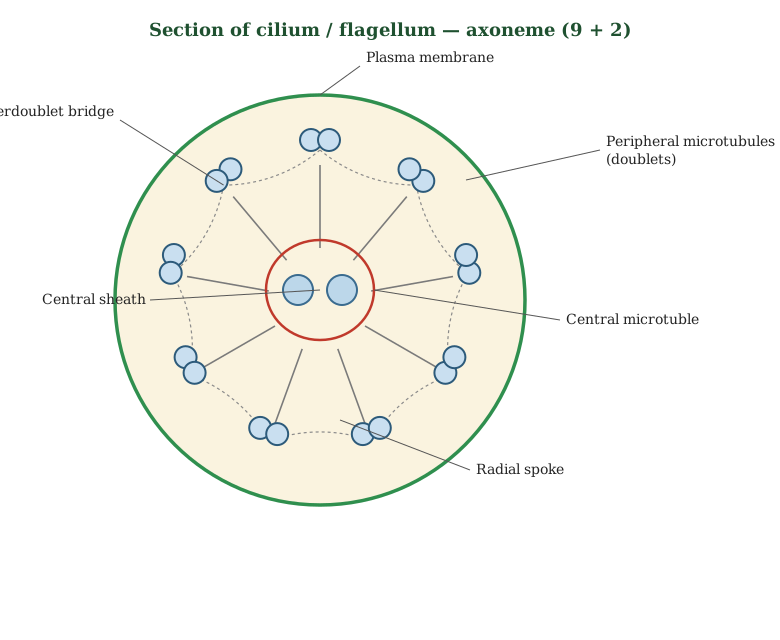
- KCET 2020Set A-11 markMCQQ.In the below diagram, identify the part which connects the peripheral microtubules to the central sheath.:
 (A) Plasma membrane
(B) Interdoublet bridge
(C) Central microtubule
(D) Radial spoke
(A) Plasma membrane
(B) Interdoublet bridge
(C) Central microtubule
(D) Radial spoke›Reveal solutionSolution
In the 9+2 axoneme, the link that runs inward from a peripheral doublet to the central sheath is the radial spoke; the interdoublet bridge runs sideways between adjacent doublets.
Step 1 — Read the parts of the axoneme.
A cilium/flagellum is a
9 + 2array enclosed by the plasma membrane:- 9 peripheral doublets — pairs of microtubules arranged in a ring.
- 2 central microtubules — the central pair, wrapped in a proteinaceous central sheath.
Step 2 — Distinguish the two kinds of cross-link (this is the whole question).
Link Runs from → to Function Interdoublet (nexin) bridge one peripheral doublet → the adjacent peripheral doublet holds the ring of nine together; converts dynein sliding into bending Radial spoke a peripheral doublet → the central sheath couples the outer ring to the central pair; regulates the beat - KCET 2019Set A-11 markMCQQ.Which of these is not an advantages in Genetically modified crops? (A) Reduces the reliance on chemical pesticides. (B) Increases the post harvest losses (C) Increases efficiency of mineral usage in plants. (D) Enhances the nutritional value of food.
›Reveal solutionSolution
The question asks which option is not an advantage of genetically modified (GM) crops. The correct answer is (B) Increases the post harvest losses, because GM crops are designed to reduce such losses, not increase them.
The key here is to understand what "advantage" means in the context of genetically modified crops. An advantage is a benefit — something that improves farming, the environment, or human well-being. The question tests whether you can spot the one statement that describes a disadvantage or a false claim.
Let’s examine each option carefully.
-
Option (A): Reduces the reliance on chemical pesticides.
This is a well-known advantage. Many GM crops are engineered to be pest-resistant (e.g., Bt cotton produces a protein toxic to certain insects). This means farmers need to spray fewer chemical pesticides, which saves money and reduces environmental harm. So this is an advantage.
-
Option (B): Increases the post harvest losses.
"Post harvest losses" refer to the spoilage or damage of crops after they are harvested — during storage, transport, or handling. GM crops are often modified to have longer shelf life, resist bruising, or tolerate better storage conditions (e.g., Flavr Savr tomato). So they decrease post harvest losses, not increase them. This statement is the opposite of an advantage — it is a disadvantage. Therefore, this is the correct answer.
-
Option (C): Increases efficiency of mineral usage in plants.
Some GM crops are designed to use minerals (like nitrogen or phosphorus) more efficiently. This means they can grow well even in poorer soils, reducing the need for fertilizers. That is clearly an advantage — it lowers costs and environmental pollution. …
-
- KCET 2018Set A-11 markMCQQ.During replication of retrovirus (A) Viral protein is introduced in the host cell. (B) Viral RNA is introduced into the host cell. (C) Viral DNA is introduced into the host cell. (D) Transcriptase enzyme is introduced into the host cell.
›Reveal solutionSolution
Retroviruses carry an RNA genome; the RNA enters the host and is reverse-transcribed into DNA inside the cell.
Step 1 — What defines a retrovirus.
A retrovirus is an RNA virus that reverses the usual flow of information: instead of DNA → RNA, it goes RNA → DNA, using the enzyme reverse transcriptase. HIV is the standard example.
Step 2 — The replication cycle (as in NCERT).
- The virus attaches to a host cell (in HIV, a helper T-lymphocyte / macrophage) and its envelope fuses with the cell membrane.
- The viral RNA genome enters the host cell. ← this is the step the question asks about
- Inside the cell, reverse transcriptase copies the viral RNA into complementary DNA (cDNA).
- That viral DNA is integrated into the host cell's DNA (as a provirus).
- The infected cell then transcribes and translates viral genes, producing new virus particles.
Step 3 — Eliminate the distractors.
- (A) Viral protein: capsid/envelope proteins are not what is delivered as the genome. …
🎓Unlock everything free for 14 days
- ✓Full step-by-step solutions
- ✓Concept-first explanations
- ✓Methods, shortcuts & mistakes
- ✓PYQ mapping + timed mock tests
Full access for 14 days. No credit card required.