Q.How are alleles of a particular gene different from each other? Explain its significance.
You're viewing a preview — the full solution, concept, methods & PYQ mapping are locked.
Start your 14-day free trial to unlock the full solution →Alleles are alternative forms of the same gene that differ in their DNA sequence, producing variations in traits; this variation is the foundation of inheritance, diversity, and evolution.
What makes alleles different?
Every gene occupies a specific position—called a locus—on a chromosome. Alleles are simply different versions of that same gene, sitting at the same locus but carrying slightly different genetic information. The difference lies in their DNA sequence: even a small change in the nucleotide sequence can alter the protein the gene codes for, or change how much of that protein is made.
Think of a gene as a recipe for a particular trait—say, flower color in pea plants. One allele might carry instructions for purple pigment, while another allele of the same gene carries instructions for white. Both are versions of the "flower color gene," but the molecular difference between them—perhaps a mutation that occurred generations ago—means they produce different outcomes.
These differences arise through mutation. A change in even a single DNA base pair can create a new allele. Over time, populations accumulate multiple alleles for many genes, each representing a historical accident that was then passed down through reproduction.
Not all alleles produce visible differences. Some code for proteins that function identically despite minor sequence changes; others produce subtle variations that only become apparent under specific conditions.
The significance of allelic variation
The existence of multiple alleles is what makes inheritance interesting and life diverse. When Mendel crossed pea plants, he was really observing the behavior of different alleles—one for tallness, one for shortness—and discovering how they segregate and recombine in offspring.
For individuals and families, allelic differences explain why children resemble but don't duplicate their parents. You inherit one allele from each parent at every gene locus. The combination you receive determines your traits, and because alleles can be dominant or recessive, the same pair of parents can produce children with different characteristics.
For populations, allelic variation is the raw material of evolution. Natural selection acts on the differences alleles create: if one allele confers an advantage—better disease resistance, say, or improved drought tolerance in plants—individuals carrying it are more likely to survive and reproduce, and that allele becomes more common over generations. Without allelic variation, populations would be genetically uniform and unable to adapt to changing environments. …
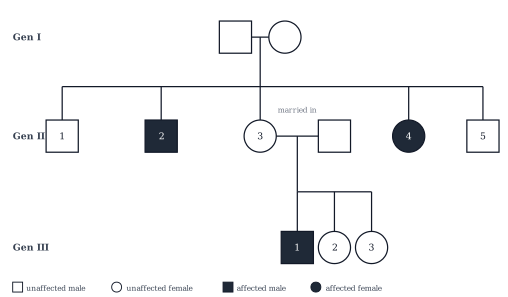 (A) Autosomal recessive
(B) Sex-linked document
(C) Sex-linked recessive
(D) Autosomal dominant
(A) Autosomal recessive
(B) Sex-linked document
(C) Sex-linked recessive
(D) Autosomal dominantUnlock everything free for 14 days
- Full step-by-step solutions
- Concept-first explanations
- Methods, shortcuts & mistakes
- PYQ mapping + timed mock tests
Full access for 14 days. No credit card required.