Q.A, B, D are three independently assorting genes with their recessive alleles a, b, d, respectively. A cross was made between individuals of Aa bb DD genotype with aa bb dd. Find out the type of genotypes of the offspring produced.
🔒You're viewing a preview — the full solution, concept, methods & PYQ mapping are locked.
🔒 Start your 14-day free trial to unlock the full solution →Concept understanding — Mendelian Genetics Basics
Mendelian Genetics Basics
Imagine you have a box of coloured beads — red and white. If you pick one bead from the box, you get either red or white. Now imagine that the colour of your eyes, or the shape of your earlobe, is decided by something like that: a tiny "packet" inside your cells that comes in two versions, and you inherit one from each parent. That is the core idea of Mendelian genetics.
The everyday intuition
You have probably noticed that children often look like their parents — same hair colour, same dimples, same height. But they are never exact copies. Why? Because each parent contributes half of the "instructions" for building a child. Those instructions come in pairs, one from mother and one from father. Sometimes one instruction overrides the other; sometimes they blend. Gregor Mendel, a 19th-century monk, figured out the rules by watching pea plants — tall vs short, yellow vs green seeds — and counting what appeared in the next generation.
The precise meaning
Mendelian genetics is the study of how traits are passed from parents to offspring through genes. A gene is a unit of heredity — a stretch of DNA that codes for a specific characteristic, like flower colour. Each gene comes in different versions called alleles. For every gene, you inherit two alleles: one from your mother, one from your father.
If the two alleles are identical, you are homozygous for that trait. If they are different, you are heterozygous. In a heterozygous pair, one allele may be dominant — it shows up in the appearance — and the other recessive — it stays hidden unless both alleles are recessive.
Mendel's key insight was that traits are not blended like paint. Instead, alleles remain separate and are passed on intact. A recessive allele can skip a generation and reappear later, unchanged.
Why it matters
Mendelian genetics is the foundation of modern biology. It explains:
- Why some diseases run in families (like cystic fibrosis or sickle-cell anaemia)
- How plant and animal breeders create new varieties
- Why you might have your grandmother's eyes but not your mother's
The NCERT textbook states that Mendel's work established the laws of inheritance — the Law of Dominance, the Law of Segregation, and the Law of Independent Assortment. These laws describe how alleles separate during the formation of eggs and sperm, and how different genes are inherited independently of one another.
Key terms at a glance
- Gene: a unit of heredity on a chromosome
- Allele: a variant form of a gene
- Dominant: the allele that expresses itself even when paired with a different allele
- Recessive: the allele that expresses itself only when paired with an identical recessive allele
- Homozygous: having two identical alleles for a gene
- Heterozygous: having two different alleles for a gene …
When two parents are crossed, each passes one allele per gene to the offspring. Here the first parent is Aa bb DD and the second is aa bb dd.
For gene A: The first parent can give either A or a (heterozygous), while the second parent can only give a (homozygous recessive). The offspring will therefore be either Aa or aa in a 1:1 ratio.
For gene B: Both parents are bb (homozygous recessive), so every offspring must receive b from each parent. All offspring will be bb.
For gene D: The first parent is DD (homozygous dominant) and can only give D, while the second parent is dd and can only give d. Every offspring will be Dd. …
Crossing Aa bb DD x aa bb dd yields only two genotypes — Aa bb Dd and aa bb Dd — in a 1:1 ratio. The B locus stays bb and the D locus is uniformly Dd; only the A locus segregates.
Gametes each parent can form
- Parent 1 (Aa bb DD): heterozygous at A (gives A or a), homozygous at B (only b) and D (only D) -> gametes A b D and a b D.
- Parent 2 (aa bb dd): homozygous recessive at every locus -> a single gamete a b d.
Combining the gametes, locus by locus
Because the genes assort independently, each locus can be analysed on its own:
- A locus: Aa x aa -> Aa or aa (1 : 1)
- B locus: bb x bb -> bb in every offspring
- D locus: DD x dd -> Dd in every offspring …
Use the forked-line (branch) method instead of a combined table: draw the A locus outcome first (Aa or aa, each 1/2), then branch each of those into the B-locus outcome (always bb), then branch each again into the D-locus outcome (always Dd). Multiplying probabilities along each completed branch reproduc …
- KCET 2026Set UNKNOWN1 markMCQQ.Thalassemia and Sickle cell anaemia are due to a problem in globin molecule synthesis. Select the correct statement. (A) Sickle cell anaemia is due to a quantitative problem of globin molecule. (B) Both are due to qualitative defects in globin chain synthesis. (C) Both are due to quantitative defects in globin chain synthesis. (D) Thalassemia is due to less synthesis of globin molecules.
›Reveal solutionSolution
Distinguishing the two disorders comes down to qualitative versus quantitative defects: sickle cell anaemia changes the structure of the globin chain, while thalassemia reduces the amount of a normal globin chain that is made.
Step 1 — Recall the defect in sickle cell anaemia
Sickle cell anaemia results from a point mutation that changes one amino acid (glutamic acid to valine) in the beta-globin chain — this alters the structure/quality of the globin molecule produced, not the amount made. This is a qualitative defect.
Step 2 — Recall the defect in Thalassemia
Thalassemia is caused by mutations (often deletions or defects in regulatory/synthesis machinery) that reduce or completely stop the synthesis rate of one of the globin chains (alpha or beta) — the globin chains produced are structurally normal, but fewer of them are made. This is a quantitative defect.
Step 3 — Evaluate the options …
- KCET 2025Set C-41 markMCQQ.In a practical examination, the following pedigree chart was given as a spotter for identification. The students identify the given pedigree chart as_____:
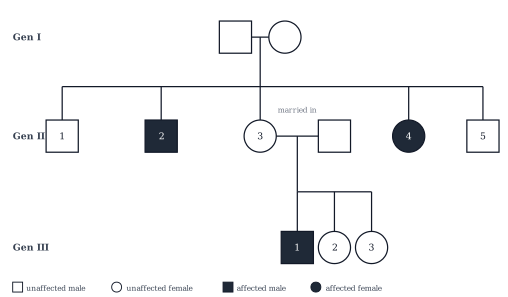 (A) Autosomal recessive
(B) Sex-linked document
(C) Sex-linked recessive
(D) Autosomal dominant
(A) Autosomal recessive
(B) Sex-linked document
(C) Sex-linked recessive
(D) Autosomal dominant›Reveal solutionSolution
Unaffected × unaffected parents giving affected children ⇒ recessive; affected individuals of both sexes, including an affected daughter from an unaffected father ⇒ autosomal, not X-linked.
Step 1 — Read the pedigree.
- Generation I: an unaffected male × an unaffected female.
- Generation II: five children — an affected son, an affected daughter, and three unaffected children.
- Generation III: an unaffected Gen-II daughter married to an unaffected male produces an affected son plus two unaffected daughters.
Step 2 — Dominant or recessive?
The trait skips: both Gen-I parents are unaffected, yet affected children appear. A dominant allele must be expressed in at least one parent (an affected child of a dominant trait must have an affected parent). Since the phenotype disappears in a generation and reappears, it is carried silently by heterozygotes ⇒ the allele is recessive. Both parents are carriers (Aa×Aa→41 aa affected).
This kills options (B) "Sex-linked dominant" and (D) "Autosomal dominant".
Step 3 — Autosomal or sex-linked (X-linked)?
Test the X-linked recessive hypothesis on the Gen-I family. An affected daughter would need genotype XaXa, i.e. one Xa from her mother (a carrier, fine) and one Xa from her father. But a father's only X carries the allele he expresses — so an Xa-bearing father would himself be affected. The Gen-I father is drawn unaffected. Contradiction. …
- KCET 2023Set B-41 markMCQQ.Which of the following statements is correct? (A) Female carrier for haemophilia may transmit the disease to sons. (B) Thalassemia is a qualitative problem. (C) Change in whole set of chromosomes is called aneuploidy. (D) Sickle cell anaemia is a quantitative problem.
›Reveal solutionSolution
Only (A) survives: haemophilia is X-linked recessive, so a carrier mother transmits it to ~50% of her sons. (B), (C) and (D) each state the opposite of the correct fact.
1. Statement (A) — check the cross
Haemophilia is a sex-linked (X-linked) recessive disorder. Let XH = normal allele, Xh = haemophilia allele.
A carrier mother is heterozygous XHXh (she is normal, because the dominant XH masks Xh). Cross her with a normal father XHY:
XHXh×XHY
XH (from mother) Xh (from mother) XH (father) XHXH — normal daughter XHXh — carrier daughter Y (father) XHY — normal son XhY — HAEMOPHILIC SON A son receives his single X from his mother and a Y from his father. With no second X to carry a masking dominant allele, he is hemizygous and expresses whatever is on that X. Hence half the sons of a carrier mother are haemophilic — statement (A) is CORRECT. ✓
2. Why the other three are wrong
(B) "Thalassemia is a qualitative problem." ✗ — inverted. The standard contrast is:
Disorder Defect Thalassemia QUANTITATIVE — reduced synthesis (too few globin chains are made) of an otherwise normal α or β globin chain Sickle-cell anaemia QUALITATIVE — a normal amount of globin is made, but it is structurally abnormal (Glu → Val at position 6 of the β-chain) So thalassemia is quantitative, not qualitative. …
- KCET 2021Set C-31 markMCQQ.Match the Column - I with Column - II Column - I i. Autosomal trisomy ii. Allosomal trisomy iii. Allosomal Monosomy iv. Cystic fibrosis Column - II p. Turner’s Syndrome q. Mendelian disorder r. Klinefelter’s Syndrome s. Down’s Syndrome (A) i-p, ii-q, iii-r, iv-s (B) i-p, ii-q, iii-s, iv-r (C) i-s, ii-r, iii-q, iv-p (D) i-s, ii-r, iii-p, iv-q
›Reveal solutionSolution
Classify each disorder by which chromosome set is affected and whether a chromosome is gained or lost — that fixes all four matches.
Step 1 — The two vocabularies you need
Autosome vs allosome: autosomes are chromosome pairs 1–22; allosomes (sex chromosomes) are the X and Y.
Trisomy vs monosomy: these are aneuploidies, caused by the failure of chromatids to segregate during cell division (non-disjunction):
- Trisomy = one EXTRA chromosome (2n+1).
- Monosomy = one chromosome MISSING (2n−1).
Separately, a Mendelian disorder is one caused by an alteration/mutation in a SINGLE GENE (not a change in chromosome number).
Step 2 — Work through Column I
i. Autosomal trisomy → (s) Down's Syndrome.
An extra copy of chromosome 21 (trisomy 21) — chromosome 21 is an autosome. Karyotype 47, i.e. 2n+1. Features: short stature, small round head, furrowed tongue, partially open mouth, palm crease, retarded mental and physical development.
ii. Allosomal trisomy → (r) Klinefelter's Syndrome.
Karyotype 47, XXY — an extra X on the SEX chromosomes. The individual is masculine in development but has gynaecomastia (feminine development, e.g. breast development) and is sterile.
iii. Allosomal monosomy → (p) Turner's Syndrome.
Karyotype 45, XO — one of the X chromosomes is MISSING, again on the SEX chromosomes. Such females are sterile, have rudimentary ovaries and lack other secondary sexual characters.
iv. Cystic fibrosis → (q) Mendelian disorder. …
🎓Unlock everything free for 14 days
- ✓Full step-by-step solutions
- ✓Concept-first explanations
- ✓Methods, shortcuts & mistakes
- ✓PYQ mapping + timed mock tests
Full access for 14 days. No credit card required.