Q.Write the IUPAC name of the following compound: CH3-CH2-C(CH3)=C(OH)-CH2OH. Here the left doubly-bonded carbon carries an ethyl group (from CH3-CH2-) and a methyl group, while the right doubly-bonded carbon carries a hydroxyl group (-OH) and a hydroxymethyl group (-CH2OH).
🔒You're viewing a preview — the full solution, concept, methods & PYQ mapping are locked.
🔒 Start your 14-day free trial to unlock the full solution →Concept understanding — IUPAC Nomenclature
IUPAC Nomenclature (Organic Compounds)
IUPAC nomenclature is a systematic way to name a compound so that its name alone tells you its exact structure, with no ambiguity. Every organic name follows the same underlying recipe, whatever the functional group.
The Recipe
-
Identify the principal characteristic group. If the molecule has a functional group senior enough to be named as a suffix (carboxylic acid > ester > amide > nitrile > aldehyde > ketone > alcohol > amine, and so on down the seniority order), that group decides the suffix and must be included in the parent chain. A halogen is never senior enough to be a suffix — it is always named as a prefix ("halo-"), whatever else is present.
-
Choose the parent chain. The parent is the longest continuous carbon chain that contains the principal characteristic group (if there is one). Among chains of the same length, the one with the most substituents wins.
-
Number the chain. Number from whichever end gives the LOWEST LOCANT to the principal characteristic group first. If there is no principal group (e.g. a simple haloalkane, or an alkene with a halogen substituent), lowest locant goes to the site of unsaturation (double/triple bond) first, then to substituents as a set.
Watch outWhen two numbering directions give the SAME locant for the principal group/unsaturation (a genuine tie), the tie-break is the lowest locant SET for the substituents as a group — compare the two sets at their first point of difference. Only if the sets are themselves tied does the alphabetically-first substituent get the lower number.
-
Name and cite the substituents as prefixes, in alphabetical order (ignoring multiplying prefixes like di-/tri- but not ignoring structural prefixes like iso-/cyclo-), each with its own locant.
-
Assemble the name: locants + substituent prefixes (alphabetical) + parent chain name + suffix (if any).
Worked Example
CH3−CH(Cl)−CH(CH3)−CH2−CH3: the longest chain is 5 carbons (pentane), no principal characteristic group (just a halogen substituent), so number for the lowest locant set. From the left: Cl at C2, methyl at C3 → set {2,3}. From the right: methyl at C3, Cl at C4 → set {3,4}. {2,3} is lower, so numbering from the left wins: 2-chloro-3-methylpentane. …
Why this formula?
IUPAC Nomenclature: Why the Rules Work the Way They Do
IUPAC nomenclature is not a single formula, but a system of rules designed to give every organic compound a unique, unambiguous name. The "why" behind these rules lies in clarity, consistency, and communication — ensuring that a chemist in Tokyo and one in Toronto draw the same structure from the same name.
1. The Core Principle: The Longest Carbon Chain
Rule: Identify the longest continuous chain of carbon atoms. This becomes the parent chain (e.g., pentane, hexane).
Why?
- The longest chain represents the backbone of the molecule.
- It gives the most stable, fundamental name — shorter chains would be branches, not the main structure.
- Example: In a molecule with 5 carbons in a row and a 2-carbon branch, calling it "pentane" (not "ethane") tells you the core skeleton is 5 carbons long.
Key idea: The parent chain is the maximum continuous path — not necessarily the one that looks "straight" on paper.
2. Numbering: Lowest Locants (The "First Point of Difference" Rule)
Rule: Number the parent chain so that substituents get the smallest possible numbers. When there's a tie, compare the first point of difference.
Why?
- This ensures reproducibility — two chemists will always number the same way.
- It avoids ambiguity: "2-methylpentane" is unambiguous; "3-methylpentane" would be a different compound.
- The first point of difference rule: If you have substituents at positions 2,4 and 3,5, choose 2,4 because 2 < 3 (the first number is smaller).
Example:
- For a methyl group on carbon 2 vs. carbon 4 of a 5-carbon chain:
- 2-methylpentane (correct)
- 4-methylpentane (wrong — higher number)
3. Alphabetical Order of Substituents
Rule: List substituents in alphabetical order (ignoring prefixes like di-, tri-, sec-, tert- but not iso-).
Why?
- Alphabetical order is a universal sorting convention — no need to remember priority based on size or complexity.
- It makes names searchable and predictable.
- Example: "3-ethyl-2-methylpentane" (e before m) — not "2-methyl-3-ethylpentane".
Exception: Prefixes like iso- and neo- are considered part of the name (e.g., isopropyl comes before methyl because "i" < "m").
4. Multiple Bonds: The "Lowest Locant" Rule for Alkenes/Alkynes
Rule: Number the chain so that the double or triple bond gets the lowest possible number, even if it means giving a substituent a higher number.
Why?
- The functional group (alkene/alkyne) is more important than alkyl substituents.
- The bond position defines the compound's reactivity and geometry.
- Example: In pent-2-ene (not pent-3-ene), the double bond is between carbons 2 and 3 — the lower number (2) is used.
Priority order:
- Principal functional group (e.g., -OH, -COOH, C=C)
- Multiple bonds
- Substituents (alkyl, halo, etc.)
5. The "Suffix" and "Prefix" System …
Take the longest chain that contains both hydroxyl-bearing carbons: five carbons (pentene). Numbering from the -CH2OH end gives -OH at C-1 and C-2, the double bond at C-2, and a methyl branch at C-3. …
The parent chain must include both hydroxyl-bearing carbons and the C=C double bond. The longest such chain has five carbons (pentene). Numbering from the -CH2OH end puts the two -OH groups at C-1 and C-2, the double bond starting at C-2, and a methyl substituent at C-3, giving 3-methylpent-2-ene-1,2-diol.
Concept
The principal characteristic group (here two -OH -> -diol) must be in the main chain and get the lowest locants; the chain must also include the double bond, expressed with the -ene infix.
Steps
- Identify the -OH-bearing carbons: the right double-bond carbon (bearing -OH) and the terminal -CH2OH carbon. The parent chain must contain both.
- Longest chain containing both: CH2OH-C(OH)=C(CH3)-CH2-CH3, five carbons -> pentene skeleton. …
Method: Combined Suffix-Priority Method for Unsaturated Diols (Ene-Diol Naming)
Core Concept
When a molecule contains BOTH a C=C double bond and multiple -OH groups, the parent chain must include all of them, and numbering is chosen to give the SUFFIX group (-OH, since -diol outranks -ene as the principal characteristic group) the lowest locants; the double bond position is then reported using whatever locant set results.
Steps
- Identify all hydroxyl-bearing carbons and the position of the C=C double bond in the structure.
- Find the longest chain that contains ALL of the -OH-bearing carbons and the full double bond — this fixes the parent chain length (here five carbons -> pentene skeleton).
- Number the chain from whichever end gives the -OH groups (the principal/suffix group) the lowest locant SET; compare both directions explicitly (here {1,2} from the -CH2OH end versus {4,5} from the other end — {1,2} wins).
- With that numbering fixed, read off the position of the double bond (the lower-numbered alkene carbon gives the "-ene" locant) and any alkyl branch position.
- Assemble the full name: branch prefix + locant, then the parent name with combined "-ene-...-diol" locants in order (double bond locant, then diol locants). …
Showing the 12 most recent of 15 on this concept.
- COMEDK 2026Set 2026-A1 markMCQQ.
[!FORMULA] Identify the correct structure of o-ethyl anisole.
(A) (B) (C) (D)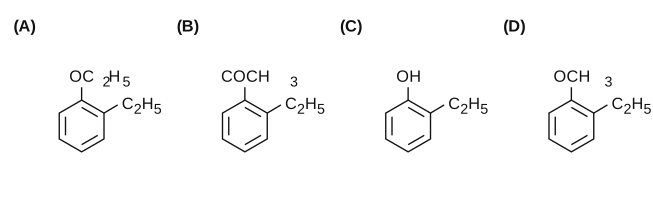
›Reveal solutionSolution
The name “o-ethyl anisole” tells us the substituents are an ethyl group and a methoxy group in the ortho (1,2) position. The correct structure is therefore the one with –OCH₃ and –C₂H₅ on adjacent carbons — option (D).
The key is to decode the name “o-ethyl anisole” systematically. Anisole is the common name for methoxybenzene (C₆H₅–OCH₃). The prefix “o-” (ortho) indicates that the ethyl group is attached to the ring carbon adjacent to the methoxy group. So the molecule is 1-methoxy-2-ethylbenzene.
Let’s check each option:
- Option (A) has –OC₂H₅ (ethoxy) and –C₂H₅. That would be o-ethyl phenetole, not anisole.
- Option (B) has –COCH₃ (acetyl) and –C₂H₅. That’s an ortho-substituted acetophenone, not anisole.
- Option (C) has –OH (hydroxyl) and –C₂H₅. That’s o-ethyl phenol, not anisole. …
- COMEDK 2026Set 2026-M1 markMCQQ.
[!FORMULA] Which one of the following is not the correct IUPAC name of the compound?
(A) 2-Bromo-3-methylbut-2-en-1-ol: (CH3)2−C=C(Br)−CH2OH (B) 2,5-Dimethylhexane-1,3-diol: (CH3)2−CH−CH2−CH(OH)−CH(CH2OH)−CH3 (C) 3-Methylbutoxybenzene: C6H5−O−(CH2)2−CH−(CH3)2 (D)›Reveal solutionSolution
[!TLDR]
Options A, B and C are each valid IUPAC names for the structures shown, so the name that is NOT correct is option (D).
Concept
An IUPAC name is correct only when the parent chain is the longest chain that carries the principal characteristic group with the lowest set of locants, and every substituent is numbered correctly (CBSE/NCERT nomenclature rules).
Solution
- (A) (CH3)2C=C(Br)−CH2OH: the chain is but-2-en-1-ol (OH at C1, double bond C2=C3) with Br on C2 and a methyl on C3 ⇒ 2-bromo-3-methylbut-2-en-1-ol. Correct. …
- KCET 2026Set D31 markMCQQ.The correct IUPAC name of CH3-C(CH3)2-O-C2H5 is (A) Tertiary butoxy ethane (B) 1, 1-Dimethyl-1-ethoxyethane (C) 2-ethoxy-2-methyl propane (D) Ethoxy tertiary butane
›Reveal solutionSolution
Ethers are named in the IUPAC substitutive system as an alkane parent chain carrying an "alkoxy" substituent, not by the older functional-class "alkyl alkyl ether" style.
Step 1 — Identify the skeleton
The compound is (CH3)3C−O−C2H5: a central carbon bearing three methyl groups (the tert-butyl-type carbon) connected through an oxygen to an ethyl group.
Step 2 — Choose the parent chain
Stripping away the ethoxy (-O-C2H5) substituent, the remaining carbon skeleton is CH3−C(CH3)2−CH3, a three-carbon chain (propane) with a methyl branch at C2. This gives the base name 2-methylpropane, and C2 also carries the ethoxy group.
Step 3 — Name the ether as an alkoxy-substituted alkane
The −O−C2H5 group becomes the substituent prefix ethoxy, attached at C2. Combining the substituents alphabetically on the 2-methylpropane parent gives 2-ethoxy-2-methylpropane. …
- KCET 2025Set D-41 markMCQQ.Among the following, identify the compound that is not an isomer of hexane (A) CH3−CH2−CH(CH3)−CH2−CH3 (B) CH3−CH2−CH2−CH2−CH2−CH3 (C)
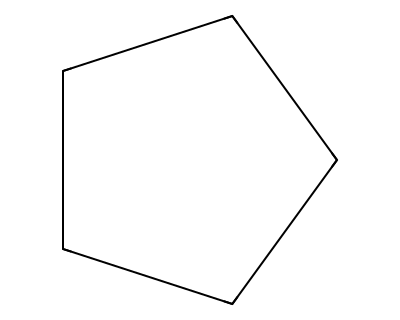 (D) CH3−CH(CH3)−CH2−CH2−CH3
›Reveal solutionSolution
Isomers must share the molecular formula C6H14; the cyclopentane ring in option (C) is C5H10, so it is not an isomer of hexane.
Step 1 — What must be true of an isomer of hexane.
Hexane is C6H14 (a saturated, acyclic alkane, CnH2n+2 with n=6). Any isomer of hexane must have exactly the same molecular formula, C6H14: six carbons, fourteen hydrogens, zero degrees of unsaturation.
Step 2 — Count the atoms in each option.
(A) CH3−CH2−CH(CH3)−CH2−CH3 — 3-methylpentane.
Carbons: 1+1+1+1+1 in the pentane chain =5, plus the CH3 branch =6. Saturated and acyclic ⇒C6H14. Is an isomer.
(B) CH3−CH2−CH2−CH2−CH2−CH3 — n-hexane itself.
Six carbons in a straight chain ⇒C6H14. It is hexane (the identity structure), so it certainly is not the odd one out.
(D) CH3−CH(CH3)−CH2−CH2−CH3 — 2-methylpentane.
Five-carbon chain + one methyl branch =6 carbons; saturated, acyclic ⇒C6H14. Is an isomer.
(C) the drawn five-membered ring — cyclopentane.
Five carbons, each bearing two hydrogens:
C5H10(CnH2n,n=5) …
- KCET 2025Set D-41 markMCQQ.The organic compound
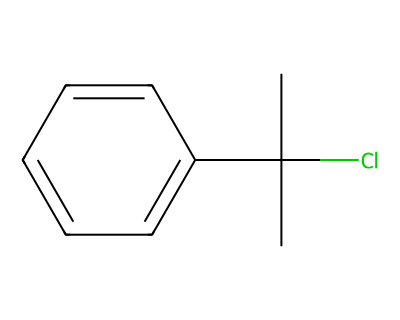 can be classified as ______________
(A) Allylic halide
(B) Benzyl halide
(C) Aryl halide
(D) Alkyl halide
can be classified as ______________
(A) Allylic halide
(B) Benzyl halide
(C) Aryl halide
(D) Alkyl halide›Reveal solutionSolution
Classify by which kind of carbon bears the halogen: here the C–Cl carbon is sp3 and directly attached to an aromatic ring — the definition of a benzylic halide.
Step 1 — Read the structure.
From the figure: a benzene ring is bonded to a carbon that also carries two CH3 groups and one Cl. So the compound is
C6H5−CH3CCH3−Cl≡2-chloro-2-phenylpropane
The carbon bearing the Cl is sp3 (four σ bonds: to the ring, to two methyls, to Cl) and it is directly attached to the aromatic ring.
Step 2 — The classification rules for halides.
Halides are classified by the hybridisation and environment of the carbon holding the halogen:
Class Where the halogen sits Alkyl halide on an sp3 carbon of a plain alkyl chain (no ring or double bond adjacent) Allylic halide on an sp3 carbon adjacent to a C=C double bond Benzylic halide on an sp3 carbon directly attached to an aromatic ring Aryl halide on an sp2 carbon of the ring itself (e.g. chlorobenzene) Step 3 — Apply the rules.
- Is it aryl? No — the Cl is not on a ring carbon. In chlorobenzene the C–Cl carbon is one of the six aromatic sp2 carbons. Here the C–Cl carbon is an extra, sp3 carbon hanging off the ring. Rejected.
- Is it allylic? No — there is no isolated C=C next to the C–Cl carbon; the unsaturation is an aromatic ring, which makes it benzylic, not allylic. Rejected. …
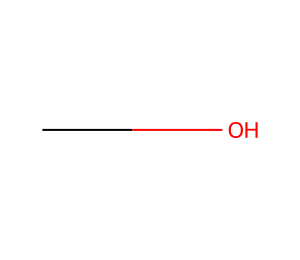
- KCET 2025Set D-41 markMCQQ.CH3−CH3∣C∣CH3−OCH3+HI⟶A+B A and B respectively are (A) A =
 , B =
, B = 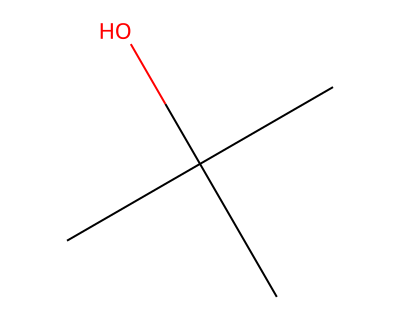 (B) A =
  , B =
(C) A = , B =
, B =
(C) A = , B =  (D) A = , B =
 ›Reveal solutionSolution
A tertiary alkyl ether cleaved by HI proceeds via SN1: the bond that breaks is the one that forms the more stable (tertiary) carbocation, sending iodide to the tert-butyl side and leaving methanol as the other fragment.
Step 1 — Protonation.
The ether oxygen is protonated by HI, making it a good leaving group.
Step 2 — C–O bond cleavage (SN1, tertiary substrate). …
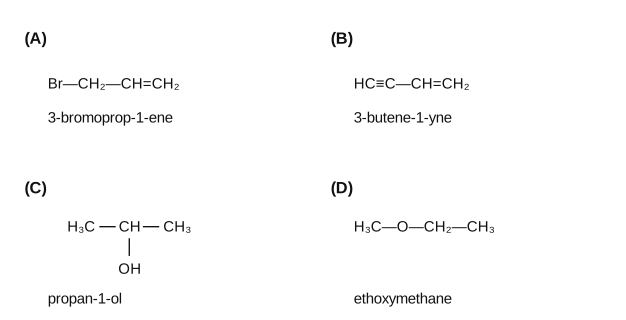
- COMEDK 2025Set 2025-A1 markMCQQ.Which of the following is the correct name according to IUPAC rules? (A) (B) (C) (D)
›Reveal solutionSolution
The key idea is to apply IUPAC nomenclature rules for alkenes, alkynes, alcohols, and ethers. Only option (A) correctly names its structure as 3‑bromoprop‑1‑ene; the others contain errors in numbering, suffix order, or functional group priority.
Concept and Intuition
IUPAC naming follows a strict hierarchy: the principal functional group determines the suffix, the longest carbon chain containing that group is chosen, and numbering gives the lowest locants to the principal group and then to multiple bonds. For compounds with multiple bonds, the suffix for the highest‑priority bond (alkene > alkyne) comes last, and locants are placed before the suffix. For alcohols, the –OH group takes precedence over multiple bonds, and the chain must include the carbon bearing the –OH. For ethers, the smaller alkyl group is named as an alkoxy substituent on the larger alkane. Each option must be checked against these rules.
Step‑by‑Step Analysis
-
Option (A): Br–CH₂–CH=CH₂ named “3‑bromoprop‑1‑ene”
- The longest chain is three carbons (prop‑) with a double bond between C1 and C2.
- The bromine is a substituent on C3.
- Numbering starts from the end nearer the double bond, so the double bond gets locant 1.
- The name “3‑bromoprop‑1‑ene” correctly places the bromine locant before the parent, and the double‑bond locant before “‑ene”.
- Verdict: Correct.
-
Option (B): HC≡C–CH=CH₂ named “3‑butene‑1‑yne”
- The longest chain is four carbons (but‑). It contains both a triple bond and a double bond.
- IUPAC rule: when both alkene and alkyne are present, the suffix “‑ene” comes before “‑yne” (alphabetical order of suffixes), and numbering gives the lowest locants to the multiple bonds as a set.
- Numbering from the left: triple bond at C1, double bond at C3 → locants 1 and 3.
- Numbering from the right: double bond at C1, triple bond at C3 → locants 1 and 3 (same).
- The correct name is but‑1‑en‑3‑yne (or 1‑buten‑3‑yne), not “3‑butene‑1‑yne”. The locant for the double bond should be before “‑ene”, and the triple bond locant before “‑yne”. The given name reverses the order and misplaces locants.
- Verdict: Incorrect.
-
Option (C): H₃C–CH(OH)–CH₃ named “propan‑1‑ol”
- The structure is propan‑2‑ol (the –OH is on the middle carbon).
- The longest chain is three carbons, and the –OH group must get the lowest locant. Numbering from either end gives the –OH at C2. …
-
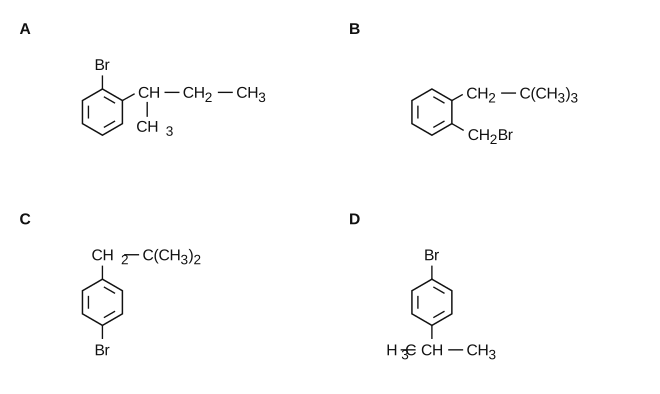
- COMEDK 2025Set 2025-E1 markMCQQ.Match the IUPAC names in Column II with the correct structures given in Column I. .tg {border-collapse:collapse;border-spacing:0;} .tg td{border-color:black;border-style:solid;border-width:1px;font-family:Arial, sans-serif;font-size:14px; overflow:hidden;padding:10px 5px;word-break:normal;} .tg th{border-color:black;border-style:solid;border-width:1px;font-family:Arial, sans-serif;font-size:14px; font-weight:normal;overflow:hidden;padding:10px 5px;word-break:normal;} .tg .tg-baqh{text-align:center;vertical-align:top} .tg .tg-amwm{font-weight:bold;text-align:center;vertical-align:top} .tg .tg-0lax{text-align:left;vertical-align:top} Structures of compounds IUPAC name A P 1-Bromomethyl-3-(2,2-dimethylpropyl)benzene B Q 1-Bromo-4-(1-methylethyl)benzene C R 1-Bromo-2-(1-methylpropyl)benzene D S 1-Bromo-4-(2-methylpropyl)benzene (A) A=RB=PC=SD=Q (B) A=SB=RC=QD=P (C) A=QB=PC=SD=R (D) A=SB=RC=PD=Q
›Reveal solutionSolution
Name each drawn structure yourself using IUPAC rules — identify the parent benzene, the substituents, their positions (ortho/meta/para) and the lowest locants — then compare with the given names P, Q, R, S. The matching is A→R, B→P, C→S, D→Q, which is option (A).
Concept & Intuition
This is a "match the structure to the name" problem. The reliable method is to name each structure yourself using IUPAC rules and then compare with the given names, rather than guessing from the drawings.
- Benzene is the parent ring.
- Substituents are named as prefixes (bromo, bromomethyl, alkyl groups).
- Number the ring for the lowest set of locants; bromo comes first alphabetically here, so it takes position 1.
- Know the common alkyl-group names: isopropyl = 1-methylethyl, isobutyl = 2-methylpropyl, sec-butyl = 1-methylpropyl, neopentyl = 2,2-dimethylpropyl.
Step-by-step naming
-
Structure A
- Two substituents: bromine (Br) and a side chain –CH(CH₃)CH₂CH₃, which is a 1-methylpropyl group (sec-butyl).
- They sit on adjacent carbons (ortho), so bromo is at position 1 and the side chain at position 2.
- IUPAC name: 1-Bromo-2-(1-methylpropyl)benzene → matches R.
-
Structure B
- Two substituents: –CH₂Br (bromomethyl) and –CH₂–C(CH₃)₃, a CH₂ attached to a carbon carrying three methyls, i.e. 2,2-dimethylpropyl (neopentyl).
- The only name in Column II built from a bromomethyl group together with a 2,2-dimethylpropyl group is P (1-Bromomethyl-3-(2,2-dimethylpropyl)benzene).
- So B matches P.
-
Structure C
- A –CH₂–CH(CH₃)₂ side chain (2-methylpropyl, isobutyl) para to Br.
- IUPAC name: 1-Bromo-4-(2-methylpropyl)benzene → matches S.
-
Structure D
- An isopropyl group, –CH(CH₃)₂ = 1-methylethyl, para to Br.
- IUPAC name: 1-Bromo-4-(1-methylethyl)benzene → matches Q.
Matching summary
| Structure | IUPAC name (derived) | Column II label | …
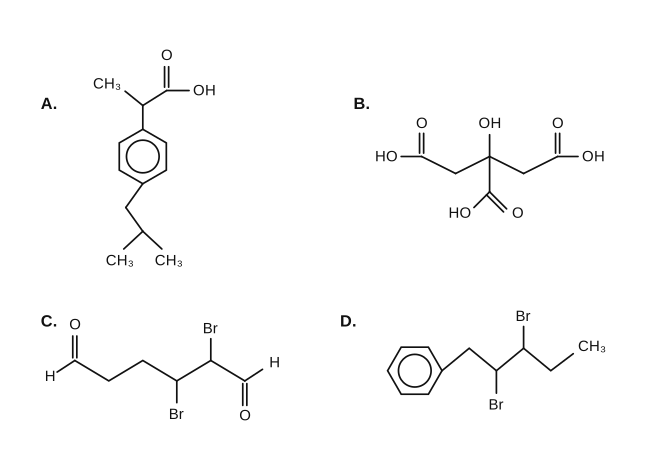
- COMEDK 2025Set 2025-M1 markMCQQ.Match the structures in Column I with their correct IUPAC names given in Column II. .tg {border-collapse:collapse;border-spacing:0;} .tg td{border-color:black;border-style:solid;border-width:1px;font-family:Arial, sans-serif;font-size:14px; overflow:hidden;padding:10px 5px;word-break:normal;} .tg th{border-color:black;border-style:solid;border-width:1px;font-family:Arial, sans-serif;font-size:14px; font-weight:normal;overflow:hidden;padding:10px 5px;word-break:normal;} .tg .tg-baqh{text-align:center;vertical-align:top} .tg .tg-amwm{font-weight:bold;text-align:center;vertical-align:top} .tg .tg-0lax{text-align:left;vertical-align:top} Column I Column II A. P. 2,3-Dibromo-1-phenylpentane. B. Q. 2,3- Dibromohexanedial. C. R. 2- ( 4- isobutylphenyl) propanoic acid D. S. 2- Hydroxy-1,2,3- propanetricarboxylic acid. (A) A=QB=PC=SD=R (B) A=RB=SC=QD=P (C) A=SB=RC=QD=P (D) A=SB=RC=PD=Q
›Reveal solutionSolution
The key is to systematically match each drawn structure to its IUPAC name by identifying the parent chain, functional groups, and substituents. The correct matches are: A → R, B → S, C → Q, D → P, which corresponds to option (B).
Let’s walk through each structure step by step, naming them from scratch so the matching becomes clear.
Concept & Intuition
IUPAC nomenclature is like a recipe: first find the longest carbon chain that includes the principal functional group (the one with highest priority, e.g., carboxylic acid > aldehyde > alcohol > alkane). Number the chain to give the functional group the lowest possible number, then name substituents (like bromo, phenyl, alkyl) with their positions. For rings, treat the ring as a substituent if the chain is longer, or as the parent if the ring is the main feature. Here, we have four distinct cases: a substituted benzene (A), a polyfunctional acid (B), a dialdehyde with bromines (C), and a phenyl-substituted alkane with bromines (D).
1. Structure A – The Ibuprofen-like molecule
- What we see: A benzene ring with a para-substituted pattern. On one side (top) is a carbon that has a methyl group and a carboxylic acid group – that’s a -CH(CH₃)COOH group. On the opposite side (bottom) is a -CH₂-CH(CH₃)₂ group (isobutyl).
- Parent chain: The longest chain attached to the ring is the isobutyl part? No – the carboxylic acid is the highest priority functional group. The ring is a substituent here because the acid-containing chain is only 2 carbons long (propanoic acid). So the parent is propanoic acid.
- Numbering: The carbon of the acid is C1. The carbon next to it (C2) bears the phenyl ring. So the name is 2-(4-isobutylphenyl)propanoic acid.
- Match: This is name R in Column II.
TipThe “isobutyl” group is a common name; in IUPAC it’s (2-methylpropyl). But here the given name uses “isobutyl”, so we match directly.
2. Structure B – Citric acid
- What we see: A central carbon with an –OH and a –COOH. From that central carbon, two -CH₂- arms each end in a –COOH. That’s three carboxylic acid groups total.
- Parent chain: The longest chain that includes all three carboxyls is a three-carbon chain (propane) with the central carbon bearing the –OH. The systematic name for citric acid is 2-hydroxy-1,2,3-propanetricarboxylic acid.
- Match: This is name S.
Watch outA common mistake is to think the central carbon is part of a longer chain, but the three carboxyls are on a three-carbon backbone. The numbering starts from the end nearest the first carboxyl, giving the –OH at position 2.
3. Structure C – Dialdehyde with bromines
- What we see: A six-carbon straight chain with an aldehyde (–CHO) at both ends. Two bromine atoms are on adjacent carbons near the right end.
- Parent chain: The longest chain includes both aldehyde carbons, so it’s a hexane chain with two aldehyde groups. The suffix for two aldehydes is “dial”. …
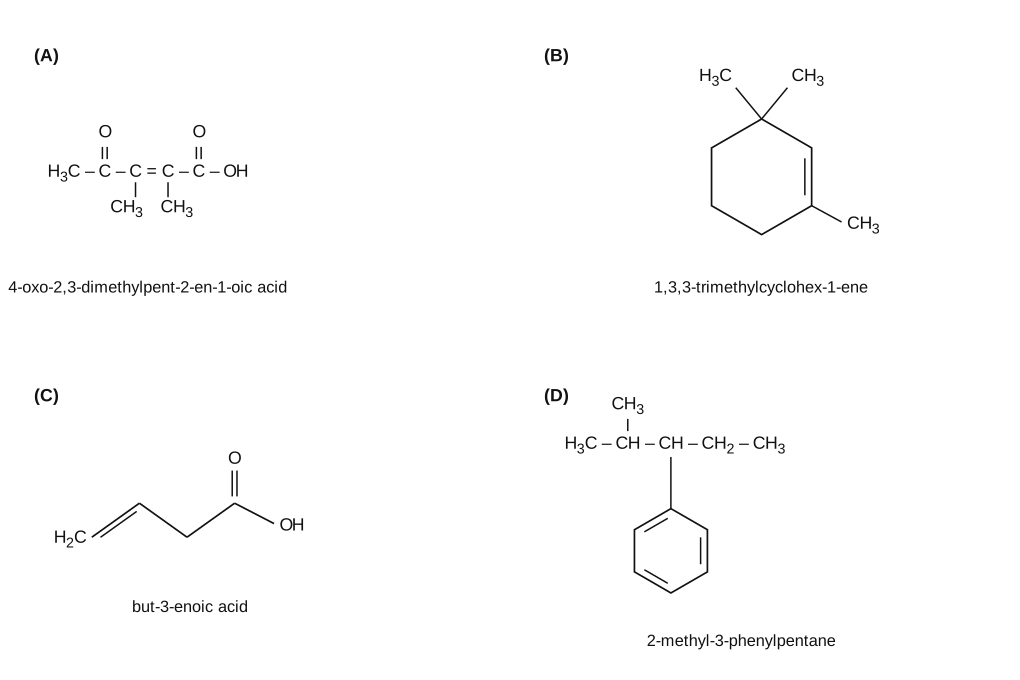
- COMEDK 2024Set 2024-A1 markMCQQ.Names of some organic compounds are given. Which one is not in IUPAC system? (A) (B) (C) (D)
›Reveal solutionSolution
The key idea is to check each name against IUPAC rules for numbering, substituent order, and functional group suffixes. Option (A) violates the rule that the carboxylic acid carbon must be number 1, making its numbering incorrect; the correct option is (A).
The question asks which name is not in the IUPAC system. That means three names follow IUPAC rules, and one does not. To find the odd one out, we must recall the core principles of IUPAC nomenclature:
- The principal functional group (here, the highest priority group) determines the suffix and gets the lowest possible locant.
- For carboxylic acids, the carbon of the –COOH group is always number 1.
- Double bonds and other substituents are numbered to give the lowest set of locants, but the acid carbon’s position is fixed.
Let’s examine each option step by step.
-
Option (A): “4-oxo-2,3-dimethylpent-2-en-1-oic acid”
- The structure is: H₃C–C(=O)–C(CH₃)=C(CH₃)–C(=O)OH. This is a five-carbon chain with a ketone (oxo) on carbon 4, two methyl groups on carbons 2 and 3, a double bond between carbons 2 and 3, and a carboxylic acid at the end.
- In IUPAC, the carboxylic acid carbon must be carbon 1. So the chain is numbered from the –COOH end: C1 is the acid carbon, C2 has a methyl and a double bond, C3 has a methyl and a double bond, C4 has the ketone, and C5 is the terminal methyl.
- The correct name should be: 5-oxo-2,3-dimethylpent-3-enoic acid (because the double bond is between C3 and C4, not C2 and C3, when numbering from the acid). The given name says “pent-2-en-1-oic acid,” which incorrectly places the double bond at position 2 and uses “-1-oic” (redundant, since the acid carbon is always 1). This is a clear violation.
- Conclusion: Option (A) is not in the IUPAC system.
-
Option (B): “1,3,3-trimethylcyclohex-1-ene”
- Structure: a cyclohexene ring with a double bond between C1 and C2, a methyl on C1, and two methyls on C3 (gem-dimethyl).
- Numbering: The double bond gets priority, so carbons 1 and 2 are the double-bonded atoms. The methyl groups are then at positions 1 and 3 (with two at 3). The name “1,3,3-trimethylcyclohex-1-ene” follows IUPAC: the locant for the double bond is given as “-1-ene” (the lower-numbered carbon of the double bond), and substituents are listed alphabetically (trimethyl is fine). This is correct.
-
Option (C): “but-3-enoic acid” …
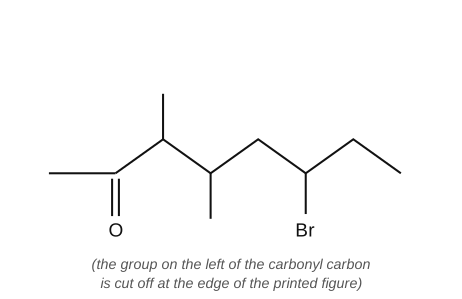
- COMEDK 2024Set 2024-M1 markMCQQ.Which one of the following is the correct IUPAC name of the given compound? (A) 5-Bromo-2, 3-dimethylheptanoyl chloride (B) 5,6-Dimethyl-3-bromohexanoyl chloride (C) 1-Chloro-5-bromo-2, 3-dimethyl-1-oxoheptane (D) 3-Bromo-5, 6-dimethylhexanoyl chloride
›Reveal solutionSolution
The compound is a seven-carbon acyl chloride with methyl groups on C2 and C3 and a bromine on C5; the correct IUPAC name is 5-Bromo-2,3-dimethylheptanoyl chloride, which corresponds to option (A).
The key to naming this compound correctly is to identify the principal functional group and the longest carbon chain that includes it. Here, the functional group is an acyl chloride (–COCl), which takes priority over all other substituents. The chain must be numbered starting from the carbonyl carbon of the acyl chloride, giving it the lowest possible locant (C1). Once the chain is numbered, we name the substituents (methyl groups and bromine) with their positions, and then assemble the name in alphabetical order.
Let’s work through it step by step.
-
Identify the principal functional group and the parent chain.
The structure shows a carbonyl (C=O) with a chlorine atom attached to the same carbon – that’s an acyl chloride group (–COCl). This group is the highest priority functional group, so the parent chain must include it. The longest continuous carbon chain that includes the carbonyl carbon has seven carbons (heptane). The acyl chloride suffix replaces the “-e” of heptane with “-oyl chloride”, giving the parent name heptanoyl chloride.
-
Number the chain from the carbonyl carbon.
In IUPAC nomenclature, the carbonyl carbon of an acyl halide is always assigned position 1. So we number the chain as:
C1 = carbonyl carbon (part of –COCl),
C2 = next carbon (has a methyl group up),
C3 = next carbon (has a methyl group down),
C4 = CH₂,
C5 = carbon with Br (down),
C6 and C7 = ethyl end.
-
Locate and name the substituents.
- At C2: a methyl group → 2-methyl
- At C3: a methyl group → 3-methyl
- At C5: a bromine atom → 5-bromo Since there are two methyl groups, we combine them as 2,3-dimethyl.
-
Assemble the name in alphabetical order.
Substituents are listed alphabetically (ignoring prefixes like di-). “Bromo” comes before “methyl”, so the order is:
5-bromo-2,3-dimethylheptanoyl chloride.
-
Check the other options for common mistakes. …
-
- KCET 2023Set D-21 markMCQQ.IUPAC name of the compound is (A) 2, 3-dimethylbut-2-ene (B) 2, 3-dimethyl butyne (C) 1, 1, 2, 2-tetra methylethene (D) 2, 3-dimethyl butene
›Reveal solutionSolution
The compound is a symmetrical alkene with four methyl groups on a two-carbon double bond; the longest chain is but-2-ene, and the correct IUPAC name is 2,3-dimethylbut-2-ene.
The question asks for the IUPAC name of a compound, but the compound itself is not drawn in the text. From the options, it is clear we are dealing with a six-carbon alkene — specifically, the one where the double bond is between C2 and C3 of a butane chain, and each of those two carbons carries two methyl groups. That structure is (CH3)2C=C(CH3)2, commonly called tetramethylethene.
The key to IUPAC naming is to identify the longest continuous carbon chain that includes the double bond. Here, the longest chain that contains the double bond has four carbons — that is the but-2-ene backbone. The two extra carbons (the methyl groups) are then treated as substituents.
Let’s work through the naming step by step.
-
Identify the parent chain. The longest chain containing the double bond is a four-carbon chain: C1–C2=C3–C4. The double bond is between C2 and C3, so the parent name is but-2-ene.
-
Number the chain to give the double bond the lowest possible locant. Since the double bond is between C2 and C3, numbering from either end gives the same locant (2). So the parent is but-2-ene.
-
Identify and locate substituents. On C2, there are two methyl groups; on C3, there are also two methyl groups. So we have four methyl substituents — two at position 2 and two at position 3.
-
Assemble the name. The substituents are listed alphabetically (ignoring multiplying prefixes like di-, tri-). Here, all substituents are methyl, so we combine: 2,3-dimethyl (for the two methyls on C2 and C3) — but wait, there are four methyls total. The correct prefix is tetramethyl, with locants 2,2,3,3. So the full name is 2,2,3,3-tetramethylbut-2-ene? That would be wrong — let’s check.
Watch outA common mistake is to write "2,2,3,3-tetramethylbut-2-ene". But that name implies the parent chain is butane with four methyl substituents, which is correct in terms of substituent count, but the IUPAC convention for alkenes requires the double bond to have the lowest possible locant, and here the double bond is already at position 2. However, the name "2,2,3,3-tetramethylbut-2-ene" is actually acceptable but not the simplest. The simpler name uses the fact that the two methyls on C2 and the two on C3 can be described as "2,3-dimethyl" if we consider that each of C2 and C3 already has one methyl from the parent chain? No — the parent chain is but-2-ene, which has no methyl groups on C2 or C3 in the parent. So each methyl is a substituent. …
-
🎓Unlock everything free for 14 days
- ✓Full step-by-step solutions
- ✓Concept-first explanations
- ✓Methods, shortcuts & mistakes
- ✓PYQ mapping + timed mock tests
Full access for 14 days. No credit card required.