Q.Which of the following reaction schemes will yield phenol? (Two or more options may be correct.) Scheme (a): chlorobenzene is fused with NaOH at high temperature and about 300 atm pressure, then treated with H2O/H+. Scheme (b): aniline (C6H5NH2) is treated first with NaNO2/HCl and then with H2O on warming. Scheme (c): benzene is treated with oleum, then with NaOH on heating, then with H+. Scheme (d): chlorobenzene is treated with aqueous NaOH at 298 K and 1 atm, then with HCl.
🔒You're viewing a preview — the full solution, concept, methods & PYQ mapping are locked.
🔒 Start your 14-day free trial to unlock the full solution →Concept understanding — Aromatic Synthesis Route
Aromatic Synthesis Route – First Principles
Imagine you are a chef who has been given a plain wooden board and told to carve a specific shape out of it. You can cut away wood, but you cannot add wood back. That is exactly the problem in aromatic synthesis: you start with a simple, cheap aromatic ring (like benzene) and you need to attach specific groups at specific positions. The ring itself is already there — you cannot rearrange its carbon skeleton. So the entire challenge is where to put the next group, and how to get it there.
The "route" is the sequence of reactions you choose. The order matters enormously because the groups already on the ring control where the next group will go. A wrong order can give you the wrong isomer, or force you into a dead end.
The Core Idea: The Ring Directs
Every substituent already on a benzene ring has a directing effect — it tells the next incoming group to go to certain positions. There are two families:
- Ortho/para directors (e.g., –OH, –NH₂, –CH₃, –Cl) — they push the next group to positions 2 and 4 (ortho and para).
- Meta directors (e.g., –NO₂, –CN, –CHO, –SO₃H) — they push the next group to position 3 (meta).
A common mistake is to think you can just "add any group in any order." The ring is not passive — it has a memory of what is already attached. If you ignore directing effects, you will get a mixture of products, often with the wrong isomer as the major one.
The Precise Statement
An aromatic synthesis route is a planned sequence of electrophilic aromatic substitution (EAS) reactions, chosen so that each new substituent is introduced at the correct position relative to the existing ones. The route must account for:
- Directing effects of all current substituents.
- Activation/deactivation — some groups make the ring more reactive (activators), some make it less reactive (deactivators). You cannot do a reaction on a strongly deactivated ring without special conditions.
- Order of introduction — sometimes you must introduce a meta director first, then an ortho/para director, or vice versa, to get the desired final pattern.
A Concrete Example: Making 4-Nitrobenzoic Acid
You want a benzene ring with –COOH at position 1 and –NO₂ at position 4 (para to each other).
–COOH is a meta director. –NO₂ is also a meta director. If you put –COOH first and then nitrate, the –COOH will send the –NO₂ to the meta position (3), not para (4). That gives the wrong isomer.
Correct route:
- Nitrate benzene first → nitrobenzene ( –NO₂ is meta directing).
- Then oxidise the methyl group (if you started with toluene) or use a different method to introduce –COOH. But wait — –NO₂ deactivates the ring strongly. So you cannot easily do Friedel-Crafts acylation on nitrobenzene.
So the actual correct route is different:
- Start with toluene (methylbenzene). The –CH₃ is an ortho/para director and an activator.
- Nitrate toluene → you get a mixture of ortho and para nitrotoluene. Separate the para isomer.
- Oxidise the –CH₃ to –COOH using KMnO₄. The –NO₂ survives this oxidation.
The order here is: introduce the ortho/para director first ( –CH₃ ), then nitrate to get para, then convert the –CH₃ to –COOH. If you had tried to put –COOH first, you would have a meta director that would send –NO₂ to the wrong place.
The General Strategy
When planning a route, ask yourself in order:
- What is the final substitution pattern? (1,2- ; 1,3- ; 1,4- ; etc.)
- Which groups are ortho/para directors and which are meta directors?
- Can I introduce the meta director first, then the ortho/para director? (Often yes, because meta directors deactivate the ring, making further substitution harder — so you want to do the deactivating step last if possible.)
- If I need a 1,3 pattern, I usually put a meta director first, then an ortho/para director. If I need a 1,4 pattern, I usually put an ortho/para director first, then a meta director (because the ortho/para director will send the next group to para, and the meta director will then be at the correct position). …
Why this formula?
Aromatic Synthesis Route: Understanding the Why Behind the Key Principles
In organic chemistry, an aromatic synthesis route refers to a sequence of reactions designed to construct or modify an aromatic ring (typically benzene or its derivatives). The "key formulas" here are not single equations but rather rules and principles that govern reactivity and orientation. Let's break down the reasoning behind the most critical ones.
1. The 4n+2 Hückel Rule — Why Aromaticity Exists
Formula: A planar, cyclic, conjugated molecule is aromatic if it has (4n+2) π electrons, where n=0,1,2,…
Why this holds (the derivation):
- In a cyclic conjugated system, the π electrons occupy molecular orbitals (MOs) that form a ring.
- The energy levels of these MOs are given by the Frost circle (or polygon rule):
- For a regular polygon with N vertices (atoms), inscribe it in a circle with one vertex at the bottom.
- The energy of each MO corresponds to the vertical coordinate of each vertex.
- For benzene (N=6), the MOs split into:
- 1 low-energy bonding orbital
- 2 degenerate bonding orbitals
- 2 degenerate antibonding orbitals
- 1 high-energy antibonding orbital
- Key insight: The 6 π electrons fill the 3 bonding MOs completely. This gives a closed-shell, highly stable configuration — the aromatic stabilization energy (~150 kJ/mol for benzene).
- For N=4 (cyclobutadiene), the MO pattern gives 2 degenerate non-bonding orbitals — filling with 4 electrons creates an open-shell, antiaromatic (unstable) system.
Takeaway: The (4n+2) rule is not arbitrary — it emerges from the symmetry of cyclic π systems and the filling of bonding MOs.
2. Electrophilic Aromatic Substitution (EAS) — The Reactivity Formula
General reaction:
Ar-H+E+catalystAr-E+H+
Why this is the only viable route for aromatic rings:
- Aromatic rings are electron-rich (due to the π cloud) but resistant to addition — addition would break aromaticity.
- Mechanism reasoning:
- The electrophile E+ attacks the ring, forming a σ-complex (arenium ion) — this step is slow (rate-determining).
- The σ-complex is non-aromatic (4 π electrons in the ring) — it is high-energy and unstable.
- To regain aromaticity, the complex loses a proton (H+) — this step is fast and thermodynamically driven.
- Why substitution, not addition: Addition would permanently destroy aromaticity; substitution restores it.
Key formula: The rate law is Rate=k[Ar-H][E+] — first order in both, because the slow step involves both reactants.
3. Orientation Rules — Why Substituents Direct Where the Next Group Goes
Rule:
- Activating groups (e.g., −OH,−NH2,−OCH3) direct to ortho/para positions.
- Deactivating groups (e.g., −NO2,−CN,−CHO) direct to meta positions.
Why this happens (resonance + inductive reasoning):
For ortho/para directors:
- The substituent has a lone pair or π bond that can donate electrons into the ring via resonance.
- Draw the resonance structures of the σ-complex for attack at ortho, meta, and para:
- Ortho attack: The positive charge can be delocalized onto the substituent (e.g., −OH becomes =OH+). This stabilizes the intermediate.
- Para attack: Similar stabilization — charge delocalized to the substituent.
- Meta attack: The positive charge cannot reach the substituent — less stable.
- Result: Ortho/para intermediates are lower in energy → faster reaction.
For meta directors:
- The substituent is electron-withdrawing (by induction or resonance, e.g., −NO2).
- Draw resonance for ortho attack: The positive charge is placed directly on the carbon bearing the withdrawing group — this is highly destabilizing (like putting a + charge next to a + pole).
- For meta attack: The positive charge is never on the carbon with the withdrawing group — relatively more stable.
- Result: Meta attack is the least destabilized → preferred. …
Schemes (a), (b) and (c) all give phenol (Dow process, diazonium hydrolysis, and the benzene sulphonation route). Scheme (d) fails because chlorobenzene does not react with NaOH at room tem …
Three classic routes to phenol are the Dow process from chlorobenzene (fused NaOH under high temperature/pressure, then acid), diazonium-salt hydrolysis from aniline, and the sulphonation route from benzene (oleum -> alkali fusion -> acid). All of (a), (b) and (c) succeed; (d) fails because the aryl C-Cl bond is inert to aqueous NaOH under mild (298 K, 1 atm) conditions.
Scheme (a) - Dow process (yields phenol)
Chlorobenzene fused with NaOH at high temperature and high pressure gives sodium phenoxide; acidification (H2O/H+) liberates phenol. The forcing conditions are what make nucleophilic aromatic substitution possible.
Scheme (b) - via benzenediazonium salt (yields phenol)
Aniline + NaNO2/HCl (cold) gives benzenediazonium chloride; warming with water hydrolyses it to phenol (with loss of N2). Correct.
Scheme (c) - sulphonation route (yields phenol)
Benzene + oleum -> benzenesulphonic acid; fusion with NaOH (heating) -> sodium phenoxide; acidification (H+) -> phenol. Correct. …
Method: Reaction-Route Feasibility Evaluation Method (Named Routes to Phenol)
Core Concept
To judge whether a given multi-step scheme actually produces phenol, check each step against the KNOWN mechanistic requirements of the classic named routes to phenol (Dow process, diazonium-salt hydrolysis, benzene-sulphonation/alkali-fusion route) — a scheme fails if any step's stated reagents/conditions are insufficient for the transformation that step claims to perform.
Steps
- Recognise which "named route" a given scheme is attempting to replicate, based on its starting material (chlorobenzene -> Dow process; aniline -> diazonium hydrolysis; benzene -> sulphonation route).
- For each step in the scheme, check whether the stated reagent AND stated conditions (temperature, pressure) match what that transformation actually requires.
- Specifically flag any step where a normally-inert bond (like the aryl C-Cl bond in chlorobenzene) is claimed to react under conditions too mild to achieve that reactivity (e.g., aqueous NaOH at room temperature and 1 atm cannot displace chlorine from an aryl ring, since the required Dow-process conditions are ~623 K and ~300 atm).
- Confirm that steps which ARE mechanistically sound (e.g., diazonium salt formation followed by warming with water to hydrolyse it, or sulphonation followed by alkali fusion and acidification) proceed all the way through to phenol, including the final acidification of any phenoxide intermediate.
- Classify each scheme as "yields phenol" (all steps mechanistically valid and complete) or "does not yield phenol" (at least one step's conditions are insufficient for the claimed transformation). …
[!FORMULA] Identify the correct order of the type of reactions taking place in this sequence:
Showing the 12 most recent of 21 on this concept.
- COMEDK 2026Set 2026-A1 markMCQQ.Identify the final product formed when benzenamine reacts with the given reagents in the sequential order as: i. (CH3−CO)2O/ Pyridine. ii. Conc. HNO3+H2SO4 & then reacted with H3O+ iii. NaNO2HCl(273 K) & then reacted with H3PO2(aq). (A) 2- Chloro- 4-Nitrophenol (B) 4-Chloro-2-Nitroaniline (C) Nitrobenzene (D) 4-Nitrophenol
›Reveal solutionSolution
Aniline is acetylated (protection), nitrated at the para position, hydrolysed back to p-nitroaniline, then diazotised and reduced by H3PO2, which replaces the diazonium group by H — leaving nitrobenzene, option (C).
Concept. The acetyl group protects the strongly activating −NH2 so that nitration is controlled and para-directed; after nitration the amine is regenerated, converted to a diazonium salt, and finally the diazonium group is removed (replaced by H) using hypophosphorous acid.
Step i — Acetylation.
C6H5NH2 with (CH3CO)2O / pyridine gives acetanilide, C6H5NHCOCH3. The amide is a moderated ortho/para director.
Step ii — Nitration then hydrolysis.
Conc. HNO3+H2SO4 nitrates acetanilide predominantly at the para position to give p-nitroacetanilide; the subsequent H3O+ hydrolyses the amide back to the free amine, giving p-nitroaniline, 4-O2N-C6H4-NH2.
Step iii — Diazotisation and reductive deamination. …
- COMEDK 2026Set 2026-M1 markMCQQ.
[!FORMULA] Identify the correct order of the type of reactions taking place in this sequence:
(A) Reduction, Diazotization, Coupling (B) Oxidation, Coupling, Diazotization (C) Reduction, Diazotization, Addition (D) Reduction, Coupling, Diazotization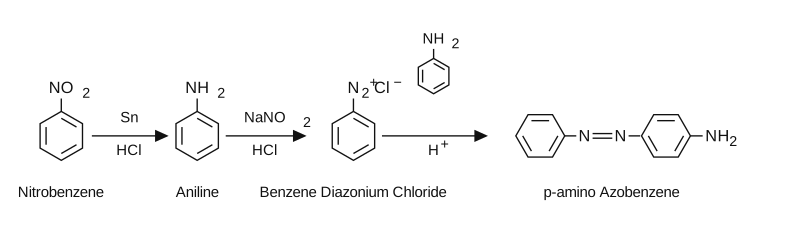
›Reveal solutionSolution
The sequence is reduction of nitrobenzene to aniline, then diazotization of aniline to the diazonium salt, then coupling with aniline to form an azo dye. The correct order is Reduction, Diazotization, Coupling — option (A).
The key concept here is reaction classification in organic chemistry, specifically for aromatic compounds. Each arrow in the sequence transforms a functional group in a characteristic way. By recognizing the reagents and the structural changes, we can name each step without memorizing the whole scheme.
-
Step 1: Nitrobenzene → Aniline
The reagent is Sn (tin) in HCl. This is a classic reduction of the nitro group (−NO2) to an amino group (−NH2). The nitro group gains hydrogen atoms (and loses oxygen), so the oxidation state of nitrogen decreases. Hence, this is a reduction reaction.
-
Step 2: Aniline → Benzene Diazonium Chloride
The reagents are NaNO₂ and HCl at low temperature (implied by the context). This converts a primary aromatic amine into a diazonium salt (−N2+Cl−). This specific transformation is called diazotization. It is not an oxidation or reduction in the usual sense; it’s a substitution/elimination sequence that forms the diazonium group.
-
Step 3: Benzene Diazonium Chloride + Aniline → p‑Aminoazobenzene …
-
- KCET 2026Set D31 markMCQQ.The reaction sequence is: Benzene Conc.HNO3, Conc.H2SO4, 323−333K A Fe/HCl B NaNO2/HCl, 273K C C2H5OH Benzene + D + HCl + N2. Organic compound 'D' is (A) Phenol (C6H5OH) (B) Acetic acid (CH3COOH) (C) Ethanal (CH3CHO) (D) N-ethylaniline (C6H5NH-C2H5)
›Reveal solutionSolution
This is the classic diazonium-salt "deamination" sequence: benzene → nitrobenzene → aniline → benzenediazonium chloride → benzene (with ethanol acting as the reducing agent and getting oxidised itself).
Step 1 — Nitration (A)
Benzene with conc. HNO3/conc. H2SO4 at 323–333 K undergoes electrophilic nitration to give nitrobenzene, A.
Step 2 — Reduction (B)
Fe/HCl reduces the nitro group to an amino group, giving aniline, C6H5NH2, B.
Step 3 — Diazotisation (C)
Treating a primary aromatic amine with NaNO2/HCl at 273–278 K (an ice-cold, low-temperature condition needed because aryl diazonium salts are unstable above ~283 K) converts it to the benzenediazonium chloride, C.
Step 4 — Reaction with ethanol …
- COMEDK 2025Set 2025-A1 markMCQQ.Complete the following 2 reactions A & B by choosing appropriate reactants [X]&[Y]. (A) [X]=C6H5CHO [Y]=CH3−CO−CH3 (B) [X]=C6H5Br [Y]=CH3CH2−N−(CH3)2 (C) [X]=C6H5OH [Y]=C6H5−N−(CH3)2 (D) [X]=C6H5NH2 [Y]=C6H5OH
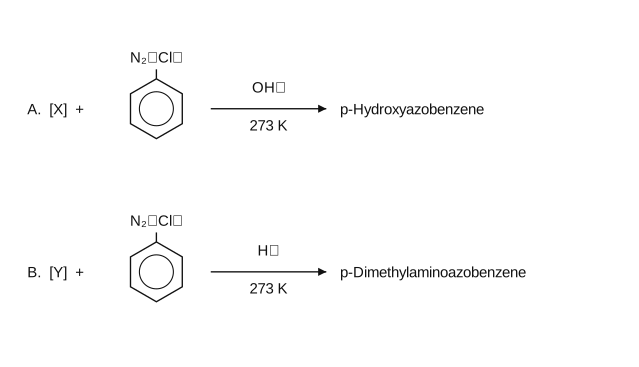
›Reveal solutionSolution
The key idea is that benzenediazonium chloride couples with activated aromatic rings (phenols and aromatic amines) under mild conditions; the correct partners are phenol for alkaline coupling and N,N‑dimethylaniline for acidic coupling, so the answer is option (C).
The problem shows two coupling reactions of benzenediazonium chloride (ArN₂⁺Cl⁻). In Scheme A, the coupling occurs under basic conditions (OH⁻, 273 K) to give p-hydroxyazobenzene. In Scheme B, the coupling occurs under acidic conditions (H⁺, 273 K) to give p-dimethylaminoazobenzene. The task is to identify which pair of reactants [X] and [Y] from the options will produce these products.
Concept & Intuition
Diazonium salts are excellent electrophiles, but they are not very reactive toward plain benzene. They need an aromatic ring that is strongly activated (electron-rich) to undergo electrophilic aromatic substitution. The classic coupling partners are:
- Phenols (Ar–OH) – they couple best in alkaline medium, because the phenoxide ion (Ar–O⁻) is even more activating than phenol itself.
- Aromatic amines (Ar–NR₂) – they couple best in weakly acidic medium, because the amino group is a strong activator, but too much acid would protonate it and deactivate the ring; the conditions here (H⁺, 273 K) are mild enough to keep the amine free for reaction.
Thus, for Scheme A (OH⁻), the partner must be a phenol; for Scheme B (H⁺), the partner must be an aromatic amine (specifically N,N‑dimethylaniline, since the product is p-dimethylaminoazobenzene).
Now let’s check each option:
-
Option (A): [X] = benzaldehyde, [Y] = acetone.
- Benzaldehyde has a carbonyl group that is deactivating (meta-directing). It does not undergo diazo coupling.
- Acetone is an aliphatic ketone; it can undergo coupling only if it has an α‑hydrogen (the Japp–Klingemann reaction), but the product here is an azo dye on an aromatic ring, not a hydrazone. So this is wrong.
-
Option (B): [X] = bromobenzene, [Y] = N‑ethyl‑N‑methylamine (CH₃CH₂–N–(CH₃)₂).
- Bromobenzene is deactivated (halogens are deactivating, though ortho/para‑directing). It does not couple with diazonium salts under these mild conditions.
- The amine [Y] is aliphatic, not aromatic. Aliphatic amines do not give stable azo dyes; they react differently (e.g., formation of triazenes). So this is wrong.
-
Option (C): [X] = phenol, [Y] = N,N‑dimethylaniline. …
- COMEDK 2025Set 2025-A1 markMCQQ.Identify the product (Y) formed in the given reaction and the name of the reaction where (X)→(Y). (A) Y= Ethoxybenzene Wurtz-Fittig reaction (B) Y= Diphenyl Fittig reaction (C) Y=1,4 - Diiodobenzene Wurtz reaction (D) Y= Iodobenzene Sandmeyer's reaction
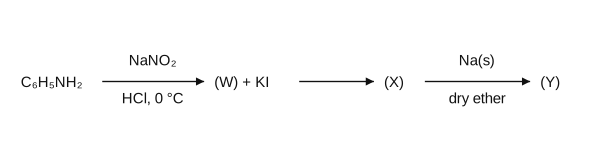
›Reveal solutionSolution
The reaction sequence converts aniline to iodobenzene via diazotization and then to diphenyl via a Fittig reaction (coupling of two aryl halides with sodium in dry ether). The correct option is (B).
The key is to recognize each step in the sequence. Aniline (CX6HX5NHX2) is first diazotized with NaNOX2/HCl at 0∘C to form the diazonium salt (CX6HX5NX2X+ClX−), which is intermediate (W). This diazonium salt then reacts with KI to replace the diazonium group with iodine, giving iodobenzene (CX6HX5I), which is intermediate (X). Finally, iodobenzene is treated with sodium metal in dry ether — this is the classic Fittig reaction (or more precisely, the Wurtz–Fittig reaction when an alkyl halide is also present, but here only an aryl halide is used, so it is the Fittig reaction). Two molecules of iodobenzene couple to form diphenyl (CX6HX5−CX6HX5), which is product (Y).
Let’s walk through each step carefully.
- Step 1: Diazotization Aniline (CX6HX5NHX2) reacts with NaNOX2 and HCl at 0∘C to form the benzene diazonium chloride:
CX6HX5NHX2+NaNOX2+2HCl0X∘X22∘CCX6HX5NX2X+ClX−+NaCl+2HX2O
This is intermediate (W). The low temperature is crucial because diazonium salts are unstable at higher temperatures.
- Step 2: Substitution with iodide The diazonium salt (W) reacts with potassium iodide (KI) in a nucleophilic aromatic substitution:
CX6HX5NX2X+ClX−+KICX6HX5I+NX2+KCl
The diazonium group is replaced by iodine, releasing nitrogen gas. This gives iodobenzene, which is intermediate (X).
- Step 3: Coupling with sodium Iodobenzene (X) is treated with sodium metal in dry ether. This is the Fittig reaction (a variant of the Wurtz reaction for aryl halides):
2CX6HX5I+2Nadry etherCX6HX5−CX6HX5+2NaI
Two aryl radicals couple to form diphenyl (also called biphenyl), which is product (Y). …
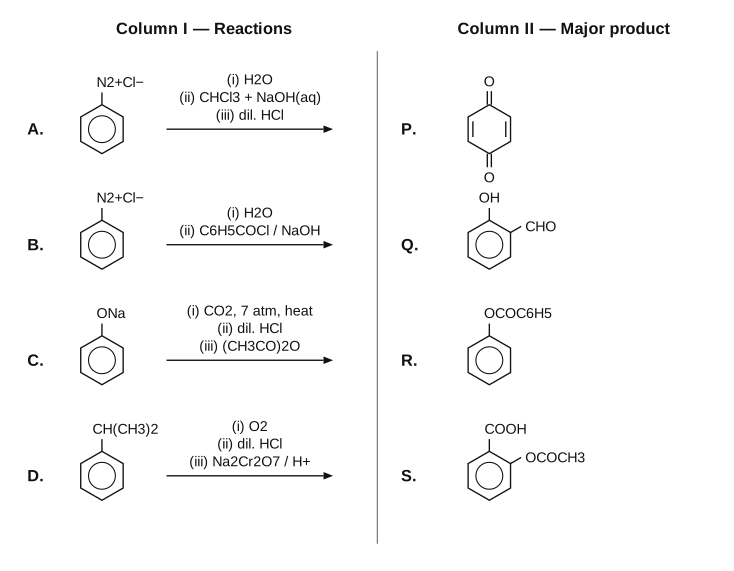
- COMEDK 2025Set 2025-E1 markMCQQ.Match the reactions given in Column I with the major product formed given in Column II. .tg {border-collapse:collapse;border-spacing:0;} .tg td{border-color:black;border-style:solid;border-width:1px;font-family:Arial, sans-serif;font-size:14px; overflow:hidden;padding:10px 5px;word-break:normal;} .tg th{border-color:black;border-style:solid;border-width:1px;font-family:Arial, sans-serif;font-size:14px; font-weight:normal;overflow:hidden;padding:10px 5px;word-break:normal;} .tg .tg-c3ow{border-color:inherit;text-align:center;vertical-align:top} .tg .tg-7btt{border-color:inherit;font-weight:bold;text-align:center;vertical-align:top} .tg .tg-0pky{border-color:inherit;text-align:left;vertical-align:top} S.No. Reactions S.No. Major product formed A. P. B. Q. C. R. D. S. (A) A=QB=RC=SD=P (B) A=QB=PC=SD=R (C) A=RB=SC=QD=P (D) A=SB=RC=QD=P
›Reveal solutionSolution
This matching problem tests your ability to predict the major organic product from four classic reactions: diazonium salt hydrolysis followed by Reimer–Tiemann formylation, diazonium coupling with benzoyl chloride, Kolbe–Schmitt carboxylation followed by acetylation, and cumene oxidation to phenol followed by oxidation to quinone. The correct pairing is A→Q, B→R, C→S, D→P, which corresponds to option (A).
Concept & Intuition
Each reaction in Column I is a well-known name reaction or a multi-step sequence. The key is to recognize the functional group transformations step by step, not just the final structure. The products in Column II are drawn with specific substituents (OH, CHO, COOH, OCOCH₃, OCOC₆H₅, and a quinone). By tracing the reagents, you can deduce which product matches which reaction. The classic pitfall is confusing the Reimer–Tiemann product (ortho-hydroxybenzaldehyde) with the Kolbe–Schmitt product (salicylic acid) or misidentifying the cumene oxidation product.
Step-by-step reasoning
-
Reaction A: Benzenediazonium chloride → (i) H₂O, (ii) CHCl₃ + NaOH(aq), (iii) dil. HCl
- Step (i): Diazonium salt with water gives phenol (via nucleophilic substitution, releasing N₂).
- Step (ii): Phenol undergoes the Reimer–Tiemann reaction with chloroform in strong base. This installs a –CHO group ortho to the –OH (the major product is salicylaldehyde).
- Step (iii): Dilute HCl neutralizes the reaction mixture, giving the free phenol and aldehyde.
- Product: A benzene ring with –OH and –CHO in ortho positions. This matches Q in Column II.
- So A → Q.
-
Reaction B: Benzenediazonium chloride → (i) H₂O, (ii) C₆H₅COCl / NaOH
- Step (i): Again, water converts the diazonium salt to phenol.
- Step (ii): Phenol reacts with benzoyl chloride (C₆H₅COCl) in the presence of NaOH. This is a Schotten–Baumann esterification: the phenoxide ion attacks the acyl chloride, forming phenyl benzoate.
- Product: A benzene ring with –O–CO–C₆H₅ (an aryl ester). This matches R (the structure labeled “OCOC₆H₅”).
- So B → R.
-
Reaction C: Sodium phenoxide → (i) CO₂, 7 atm, heat, (ii) dil. HCl, (iii) (CH₃CO)₂O
- Step (i): Sodium phenoxide undergoes the Kolbe–Schmitt reaction: CO₂ attacks the ortho position of the phenoxide ring under pressure and heat, forming sodium salicylate.
- Step (ii): Dilute HCl protonates the carboxylate to give salicylic acid (ortho-hydroxybenzoic acid).
- Step (iii): Acetic anhydride ((CH₃CO)₂O) acetylates the –OH group, forming acetylsalicylic acid (aspirin). The product has –COOH and –O–CO–CH₃ in ortho positions.
- Product: A benzene ring with –COOH and –OCOCH₃ (acetoxy group). This matches S.
- So C → S. …
-
- COMEDK 2025Set 2025-E1 markMCQQ.An optically active compound [X] (Molecular formula C8H11 N ) reacts with CHCl3 / Ethanolic KOH on heating to form an isocyanide. On reaction with NaNO2/HCl, it yields an alcohol with liberation of N2. Identify the compound [X]. (A) 2-Ethylaniline. (B) 1-Phenylethanamine. (C) 3, 4-Dimethylaniline. (D) 2, 4-Dimethylaniline.
›Reveal solutionSolution
The compound must be a primary amine that is optically active and gives a positive carbylamine test. Only 1‑phenylethanamine (option B) is chiral and fits all reactions.
The key is to decode each reaction clue and then see which option satisfies all conditions.
-
Carbylamine test (isocyanide formation)
The reaction with CHCl3 and ethanolic KOH on heating to form an isocyanide is the carbylamine test. This test is specific to primary amines (RNH2). Secondary and tertiary amines do not give this reaction.
Therefore, [X] must be a primary amine.
-
Reaction with NaNO2/HCl (diazotisation followed by decomposition)
When a primary aliphatic or aromatic amine reacts with NaNO2/HCl at low temperature, a diazonium salt forms. Upon warming, this salt decomposes to give an alcohol and liberates N2 gas.
- For aliphatic primary amines, the diazonium salt is unstable even at low temperature and immediately decomposes to give an alcohol + N2.
- For aromatic primary amines, the diazonium salt is stable at 0–5°C but decomposes on heating to give phenol + N2. The problem says “it yields an alcohol with liberation of N2” — this is consistent with either case, but the molecular formula C8H11N suggests an aromatic ring (degree of unsaturation = 4, consistent with a benzene ring plus one more double bond or ring). So [X] is likely an aromatic primary amine.
-
Optical activity
The compound is described as “optically active”. For a molecule to be optically active, it must be chiral — it must have no plane of symmetry and exist as non‑superimposable mirror images.
- Aniline derivatives (like 2-ethylaniline, 3,4-dimethylaniline, 2,4-dimethylaniline) are not chiral because the benzene ring is planar and the substituents do not create a chiral centre. …
-
- COMEDK 2025Set 2025-M1 markMCQQ.Convert Benzene →3-Bromophenol by choosing appropriate reagents [(i) to (v)] in the correct sequence.(i) NaNO2/HCl(0∘C)(ii) Conc. HNO3/H2SO4(iii) H2O/283 K(iv) Fe/HCl(v) Br2/Fe (A) v, ii, iii, i, iv (B) ii, v, iv, i, iii (C) iii, iv, v, ii, i (D) v, ii, i, iv, iii
›Reveal solutionSolution
The conversion of benzene to 3-bromophenol requires a sequence that introduces a nitro group, reduces it to an amine, brominates, diazotizes, and hydrolyzes — the correct order is (ii) nitration, (v) bromination, (iv) reduction, (i) diazotization, (iii) hydrolysis, which corresponds to option (B).
Concept & Intuition
We need to go from benzene to 3-bromophenol. The product has two substituents: a bromine atom and a hydroxyl group, meta to each other. Direct bromination of phenol would give ortho/para products, not meta. So we must use a directing group that forces meta substitution. The nitro group (−NO₂) is a strong meta-director. After introducing it, we can brominate, then convert the nitro group to an amino group, then to a diazonium salt, and finally hydrolyze to get the −OH group. The trick is the order: we must brominate after nitration (so the nitro group directs bromine to the meta position), but before reducing the nitro group (because an amino group is ortho/para-directing and would ruin the regiochemistry).
Step-by-step reasoning
- Introduce a meta-directing group via nitration Benzene is treated with conc. HNO₃ / H₂SO₄ (reagent ii). This gives nitrobenzene. The −NO₂ group is strongly electron-withdrawing and directs incoming electrophiles to the meta position.
C6H6HNO3/H2SO4C6H5NO2
- Brominate at the meta position Nitrobenzene is treated with Br₂ / Fe (reagent v). The Fe generates FeBr₃, which polarizes Br₂. The nitro group directs the bromonium ion to the meta position, giving meta-bromonitrobenzene.
C6H5NO2Br2/Fem-BrC6H4NO2
- Reduce the nitro group to an amino group Use Fe / HCl (reagent iv). This reduces −NO₂ to −NH₂, giving meta-bromoaniline.
m-BrC6H4NO2Fe/HClm-BrC6H4NH2
- Diazotize the amino group Treat with NaNO₂ / HCl at 0°C (reagent i). This converts the −NH₂ group into a diazonium salt (−N₂⁺). The low temperature is crucial to keep the diazonium ion stable.
m-BrC6H4NH2NaNO2/HCl,0∘Cm-BrC6H4N2+Cl−
- Hydrolyze the diazonium salt to phenol …
- COMEDK 2024Set 2024-A1 markMCQQ.4-methyl benzamide (A) on reaction with ethanolic solution of KOH and bromine gives another compound (B). The compound (B) on treatment with benzoyl chloride gives compound (C). Identify the correct structure of compound (C) from the following. (A) (B) (C) (D)
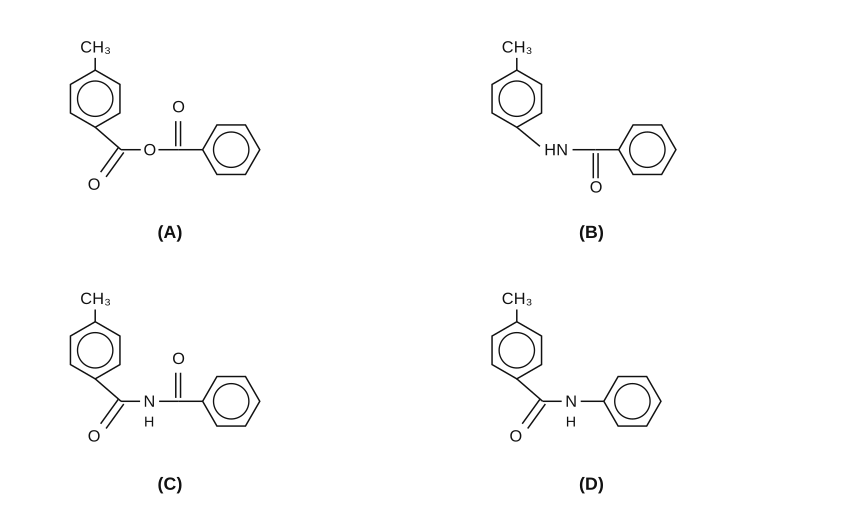
›Reveal solutionSolution
The sequence is a Hofmann rearrangement (A → B), converting 4-methylbenzamide into 4-methylaniline, followed by benzoylation (B → C) to give N-(4-methylphenyl)benzamide, p-tolyl–NH–CO–C₆H₅. That structure is option (B).
Concept & Intuition
The problem tests two classic transformations:
- Hofmann rearrangement – a primary amide (–CONH₂) treated with bromine and a strong base (ethanolic KOH) gives a primary amine with one fewer carbon. The carbonyl carbon leaves as CO₂ and the amide nitrogen becomes the amine nitrogen, bonded directly to the ring.
- Benzoylation – a primary amine reacts with benzoyl chloride (C₆H₅COCl) to form a secondary amide (an N-substituted benzamide).
Step-by-step reasoning
- Starting compound (A) is 4-methylbenzamide:
H3C–C6H4–CONH2
the amide group para to the methyl on the ring.
- Hofmann rearrangement (A → B) with Br₂ / ethanolic KOH:
R–CONH2Br2/KOHR–NH2+CO2
with R = 4-methylphenyl (p-tolyl). Compound (B) is 4-methylaniline (p-toluidine):
H3C–C6H4–NH2
- Benzoylation (B → C) with benzoyl chloride. The amine nitrogen attacks the carbonyl carbon of C₆H₅COCl, displacing chloride, to give the secondary amide:
H3C–C6H4–NH–CO–C6H5
This is N-(4-methylphenyl)benzamide. …
- COMEDK 2024Set 2024-E1 markMCQQ.One of the reactions A, B, C, D given below yields a product which will not answer Hinsberg's test when reacted with Benzene sulphonyl chloride. Identify the reaction. (A) C (B) B (C) A (D) D
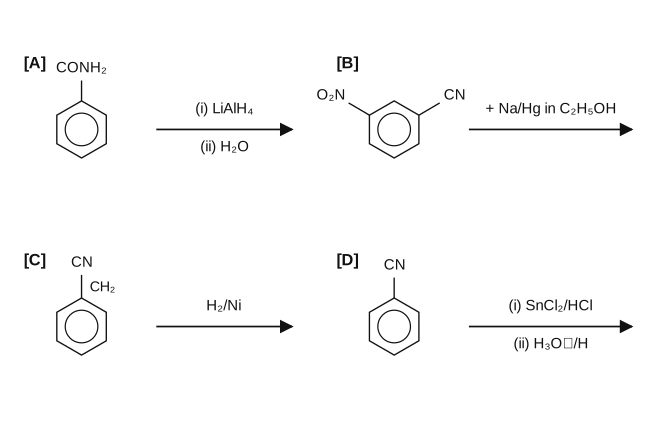
›Reveal solutionSolution
Hinsberg’s test distinguishes primary, secondary, and tertiary amines via reaction with benzenesulphonyl chloride. The product that fails the test must be a tertiary amine (or a non‑amine). Among the four reactions, only one yields a tertiary amine — that is the answer.
The key concept is Hinsberg’s test:
- A primary amine (RNHX2) reacts with benzenesulphonyl chloride (CX6HX5SOX2Cl) to form a sulphonamide that is soluble in alkali (because the N−H hydrogen is acidic).
- A secondary amine (RX2NH) gives a sulphonamide that is insoluble in alkali (no acidic hydrogen).
- A tertiary amine (RX3N) does not react at all — it fails to form a sulphonamide, so it “will not answer Hinsberg’s test”.
Thus, we need to identify which reaction produces a tertiary amine (or a compound that cannot form an N−H or N−S bond with the reagent).
-
Reaction [A]: Reduction of benzamide
Starting material: CX6HX5CONHX2 (benzamide).
Reagent: LiAlHX4 followed by HX2O.
LiAlHX4 reduces the carbonyl group to a methylene, converting −CONHX2 into −CHX2NHX2.
Product: benzylamine (CX6HX5CHX2NHX2), a primary amine.
→ This will answer Hinsberg’s test (forms an alkali‑soluble sulphonamide).
-
Reaction [B]: Reduction of a nitro‑cyano compound
Starting material: OX2N−CX6HX4−CN (a benzene ring with both −NOX2 and −CN).
Reagent: Na/Hg in CX2HX5OH — a classic reducing system for nitro groups (and sometimes for nitriles, but here the main effect is on −NOX2).
Na/Hg in ethanol reduces −NOX2 to −NHX2, while the −CN group is often reduced to −CHX2NHX2 under these conditions.
Product: a diamine (both groups become −NHX2 or −CHX2NHX2), so the product is a primary amine (or two primary amines).
→ This will answer Hinsberg’s test.
-
Reaction [C]: Reduction of a benzyl cyanide
Starting material: CX6HX5CHX2CN (phenylacetonitrile).
Reagent: HX2/Ni — catalytic hydrogenation.
HX2/Ni reduces the nitrile group to a primary amine: −CN−CHX2NHX2.
Product: 2‑phenylethylamine (CX6HX5CHX2CHX2NHX2), a primary amine.
→ This will answer Hinsberg’s test.
-
Reaction [D]: Reduction of benzonitrile …
- COMEDK 2024Set 2024-E1 markMCQQ.Identify the final product formed when Benzamide undergoes the following reactions: (A) Acetanilide (B) Acetophenone (C) Aniline (D) Benzoic acid
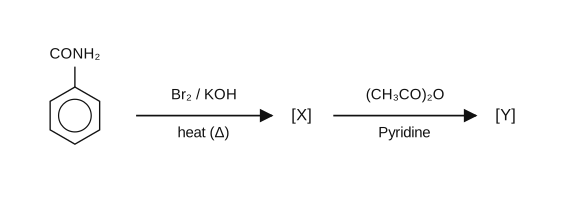
›Reveal solutionSolution
The reaction sequence is the Hofmann rearrangement (Br₂/KOH) of benzamide to aniline, followed by acetylation with acetic anhydride/pyridine to give acetanilide. The final product is acetanilide, option (A).
Concept & Intuition
The first step—benzamide treated with bromine in aqueous potassium hydroxide under heat—is a classic Hofmann rearrangement. This reaction converts a primary amide into a primary amine with one fewer carbon atom. The mechanism involves formation of an isocyanate intermediate, which hydrolyzes to the amine. Here, benzamide (C₆H₅CONH₂) loses the carbonyl carbon and becomes aniline (C₆H₅NH₂). The second step is a simple acetylation: aniline reacts with acetic anhydride in the presence of pyridine (a base that neutralizes the acid byproduct) to form acetanilide (C₆H₅NHCOCH₃). Thus the final product is acetanilide.
Step-by-step reasoning
-
Identify the first transformation (Br₂/KOH, Δ)
- Benzamide has the structure C₆H₅–CO–NH₂.
- Under Hofmann rearrangement conditions, the amide is converted to an amine with loss of the carbonyl carbon as CO₂.
- The product is aniline: C₆H₅–NH₂.
- Why? The bromine forms an N-bromoamide, which under basic conditions rearranges to an isocyanate; hydrolysis then gives the amine.
-
Identify the second transformation [(CH₃CO)₂O, pyridine]
- Aniline (a primary aromatic amine) reacts with acetic anhydride.
- Pyridine acts as a mild base to scavenge the acetic acid formed, driving the reaction forward.
- The product is acetanilide: C₆H₅–NH–CO–CH₃.
-
Match to the options
- (A) Acetanilide → correct. …
-
- COMEDK 2024Set 2024-M1 markMCQQ.A sweet smelling organic compound [A](C9H10O2) undergoes acid hydrolysis to form an acid [B]. Compound [B] further reacts with Ammonia followed by heating to yield [C]. Compound [C] when reacted with Br2 in caustic potash gave compound [D](C6H7 N) which gives a white precipitate with aqueous Br2. Identify compounds [A] & [D] (A) A: Methyl Pentanoate D: N-methylpentanamine (B) A: Methyl benzoate D: Aniline (C) A: Ethyl benzoate D: Aniline (D) A: Ethyl heptanoate D: N-ethylbutanamine
›Reveal solutionSolution
The problem traces an ester (C₉H₁₀O₂) through acid hydrolysis, amide formation, Hofmann rearrangement, and a positive bromine-water test for aniline. The only option consistent with all steps is ethyl benzoate → aniline, so the correct choice is (C).
Concept & Intuition
We are given a sequence of reactions starting from an ester [A] with formula C₉H₁₀O₂. The key is to work backwards from the final compound [D], which has formula C₆H₇N and gives a white precipitate with aqueous Br₂. That test is classic for aniline (C₆H₅NH₂): bromine water reacts with aniline to form 2,4,6-tribromoaniline, a white solid. So [D] is almost certainly aniline.
Aniline is produced from a primary amide via the Hofmann rearrangement (reaction with Br₂ in KOH). That means [C] must be a primary amide that, upon losing one carbon, gives aniline. Since aniline has 6 carbons, the amide [C] must have 7 carbons: benzamide (C₆H₅CONH₂).
Benzamide is formed by heating the ammonium salt of a carboxylic acid [B]. So [B] must be benzoic acid (C₆H₅COOH).
Finally, [A] is an ester that hydrolyses to benzoic acid. With formula C₉H₁₀O₂, the ester must be ethyl benzoate (C₆H₅COOCH₂CH₃): benzoic acid + ethanol.
Now let’s verify each step systematically.
-
Identify [D] from its formula and test
- [D] = C₆H₇N.
- It gives a white precipitate with aqueous Br₂ → characteristic of an aromatic primary amine (aniline). Aniline (C₆H₅NH₂) has exactly C₆H₇N.
- So [D] is aniline.
-
Work backwards to [C] via Hofmann rearrangement
- The Hofmann reaction: RCONH₂ + Br₂ + KOH → RNH₂ + CO₂ + KBr + H₂O.
- Here [C] (amide) → [D] (amine) with loss of one carbon.
- Since [D] is C₆H₅NH₂, the amide [C] must be C₆H₅CONH₂ (benzamide, C₇H₇NO).
- So [C] = benzamide.
-
Find [B] from the formation of [C]
- [C] is made by reacting [B] with ammonia, then heating.
- Carboxylic acid + NH₃ → ammonium salt → heat → primary amide.
- So [B] must be benzoic acid (C₆H₅COOH).
- Check: C₆H₅COOH + NH₃ → C₆H₅COONH₄ → heat → C₆H₅CONH₂ (benzamide). Perfect.
-
Determine [A] from acid hydrolysis
- [A] (C₉H₁₀O₂) + H₂O (acid) → [B] (benzoic acid) + an alcohol. …
-
🎓Unlock everything free for 14 days
- ✓Full step-by-step solutions
- ✓Concept-first explanations
- ✓Methods, shortcuts & mistakes
- ✓PYQ mapping + timed mock tests
Full access for 14 days. No credit card required.