Q.Give reasons for the following :
You're viewing a preview — the full solution, concept, methods & PYQ mapping are locked.
Start your 14-day free trial to unlock the full solution →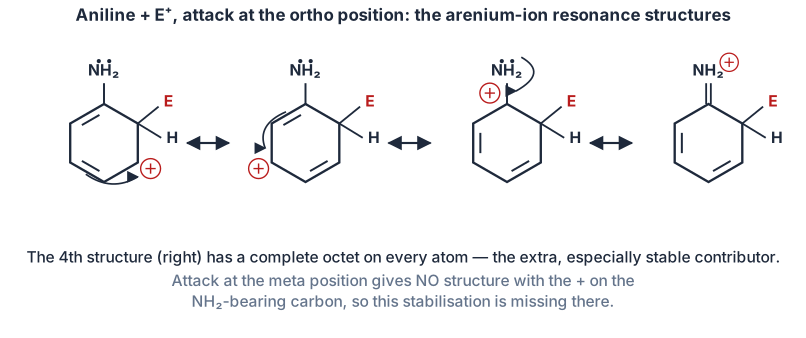
The directing effect of a substituent is determined by resonance stabilization of the intermediate arenium ion, not just inductive withdrawal. Chlorine donates electrons by resonance (ortho/para-directing) despite withdrawing inductively. Phenol’s C–O bond has partial double-bond character, making it resistant to nucleophilic substitution. Chloroform decomposes in light and air to form phosgene, a toxic gas.
(a) Why chlorine is ortho-, para-directing despite being electron-withdrawing
This is one of the most common conceptual traps in organic chemistry. The key is to separate inductive effect (through sigma bonds) from resonance effect (through pi bonds). Chlorine is strongly electronegative, so it pulls electron density toward itself inductively — that makes it deactivating overall. But the direction of attack (ortho/para vs meta) depends entirely on the stability of the intermediate carbocation (arenium ion) formed during electrophilic substitution.
When an electrophile attacks the benzene ring, a resonance-stabilized carbocation intermediate forms. Chlorine has lone pairs that can be donated into the ring by resonance. This donation is only possible when the positive charge ends up on the carbon bearing the chlorine (ortho/para attack) — because then the lone pair can delocalize onto that carbon, giving an extra resonance structure where chlorine bears a positive charge (a chloronium ion-like structure). That extra stabilization is not available for meta attack.
Many students think "electron-withdrawing = meta-directing". That is false. The directing effect depends on resonance, not induction. Halogens are the classic exception: they withdraw inductively but donate by resonance, so they are ortho/para-directing but deactivating.
Let’s compare the three possible arenium ions:
- Ortho attack: The positive charge can be placed on the carbon bearing Cl. The lone pair on Cl can then form a double bond, giving a structure where the positive charge is on Cl (which is more stable than having it on carbon).
- Para attack: Same stabilization — the positive charge can be placed on the carbon with Cl.
- Meta attack: The positive charge never lands on the Cl-bearing carbon. No resonance stabilization from Cl’s lone pairs. This intermediate is less stable.
So despite the inductive withdrawal (which slows the reaction overall), the relative stability of ortho/para intermediates over meta intermediates is what makes chlorine ortho/para-directing.
A quick way to remember: if the substituent has a lone pair on the atom attached to the ring (like Cl, Br, I, OH, NH₂), it will be ortho/para-directing — because that lone pair can stabilize the positive charge at the ortho/para positions.
(b) Why aryl halides cannot be prepared from phenol + HX or PX₃
The reaction of an alcohol with a halogen acid (like R–OH + HX → R–X + H₂O) works because the C–O bond in alcohols is a single bond that can be protonated and then broken as a leaving group (water). But phenol is different.
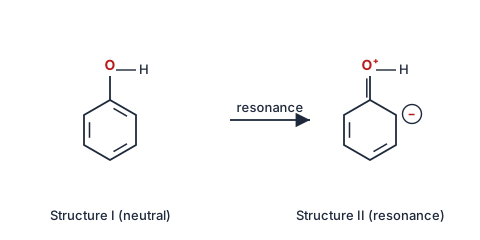
In phenol, the oxygen’s lone pair is in conjugation with the aromatic ring. This gives the C–O bond partial double-bond character — it’s shorter and stronger than a typical C–O single bond. The resonance structures show a positive charge on oxygen and a negative charge on the ring, meaning the C–O bond has about 40% double-bond character.
The resonance hybrid of phenol:
This delocalization makes the C–O bond difficult to break.
For nucleophilic substitution (SN1 or SN2), you need the C–O bond to break. In phenol:
- SN2: The carbon is sp² hybridized (part of the aromatic ring), so backside attack is geometrically impossible — the ring blocks it.
- SN1: You would need to form a phenyl carbocation (Ph⁺), which is extremely unstable — the positive charge cannot be stabilized by resonance because it would break aromaticity.
With phosphorus halides (PCl₃, PBr₅), the mechanism involves formation of a phosphite ester intermediate, which then undergoes substitution. But again, the strong C–O bond in phenol resists cleavage. Even if the intermediate forms, the aryl-oxygen bond won't break under these conditions. …
Unlock everything free for 14 days
- Full step-by-step solutions
- Concept-first explanations
- Methods, shortcuts & mistakes
- PYQ mapping + timed mock tests
Full access for 14 days. No credit card required.