Q.Draw a graph of λm V/s √C for acetic acid (weak electrolyte) solution.
🔒You're viewing a preview — the full solution, concept, methods & PYQ mapping are locked.
🔒 Start your 14-day free trial to unlock the full solution →Concept understanding — Molar Conductivity
From Resistance to Conductance: Flipping the Idea
You already know resistance (R) — it tells you how much a material opposes the flow of current. A high resistance means the wire fights the current; a low resistance means it lets current through easily.
Now flip that thought. Instead of asking "how much does it resist?", ask "how easily does it let current flow?" That's exactly what conductance measures.
Conductance (G) is the reciprocal of resistance:
G=R1
Unit: siemens (S) — named after Werner von Siemens. 1 S = 1 A/V (ampere per volt).
If a wire has R=10 Ω, its conductance is G=0.1 S. If R=0.5 Ω, G=2 S — it conducts twice as well.
Ohm's Law in Conductance Form
You know V=IR. Rearranging:
I=RV=GV
So current = conductance × voltage. A high-conductance material draws a large current for the same voltage — it's a "good conductor."
Now, Conductivity: The Material's Intrinsic Property
Resistance depends on two things: the material itself (its "resistivity" ρ) and the geometry (length L, cross-sectional area A):
R=ρAL
Conductance also depends on geometry. A thicker wire (larger A) or a shorter wire (smaller L) has higher conductance. To isolate the material's inherent ability to conduct, we define conductivity (σ):
σ=ρ1
And for a uniform wire:
G=σLA
Conductivity is the reciprocal of resistivity. It tells you how well the material itself conducts, independent of shape and size.
- Unit: siemens per metre (S/m).
- High σ → good conductor (copper: ≈5.8×10⁷ S/m).
- Low σ → poor conductor / insulator (glass: ≈10−12 S/m).
Don't confuse conductance (property of a specific object, depends on geometry) with conductivity (property of the material, independent of geometry). A short thick copper wire has high conductance; a long thin copper wire has lower conductance — but both have the same conductivity.
The Big Picture in One Table
| Quantity | Symbol | Definition | Depends on | Unit |
|---|---|---|---|---|
| Resistance | R | V/I | Material + geometry | Ω |
| Resistivity | ρ | RA/L | Material only | Ω⋅m |
| Conductance | G | 1/R | Material + geometry | S |
| Conductivity | σ | 1/ρ | Material only | S/m |
Intuitive Analogy
Think of a water pipe:
- Resistance = how hard it is to push water through (narrow, long pipe).
- Conductance = how easily water flows (wide, short pipe). …
Why this formula?
Conductance and Conductivity: Why the Formulas Hold
Let's build this from first principles — understanding the why before the what.
1. The Core Idea: How Easily Does Current Flow?
Think of a conductor (like a copper wire). When you apply a voltage across it, electrons drift through the material. Two questions arise:
- How much current flows for a given voltage? → This is conductance (G).
- How well does the material itself allow current? → This is conductivity (σ).
The key distinction: Conductance depends on the size and shape of the object. Conductivity is an intrinsic property of the material.
2. Ohm's Law in Terms of Conductance
You know Ohm's law:
V=IR
But we can rewrite it as:
I=RV
Define conductance G as the reciprocal of resistance:
G=R1
So:
I=GV
Why this makes sense:
- A larger G means more current for the same voltage — the conductor "conducts" better.
- G has units of siemens (S) = A/V.
3. From Resistance to Conductivity: The Geometry Factor
Resistance of a uniform conductor depends on:
- Length L (longer → more resistance)
- Cross-sectional area A (thicker → less resistance)
- Material property ρ (resistivity)
The formula:
R=ρAL
Now, conductivity σ is the reciprocal of resistivity:
σ=ρ1
So:
R=σ1⋅AL
Why this form?
- If you double the length, electrons have to travel twice as far, colliding more → resistance doubles.
- If you double the area, there's twice as many "lanes" for electrons → resistance halves.
4. The Key Formula: Conductance in Terms of Conductivity
Since G=1/R, we get:
G=σLA
This is the central relationship. Let's see why it holds:
- σ tells you how well the material conducts (intrinsic).
- A/L tells you how the geometry amplifies or reduces that.
Intuition:
- A fat, short wire (A large, L small) has high conductance.
- A thin, long wire (A small, L large) has low conductance.
- A material with high σ (like copper) gives higher G than one with low σ (like iron), for the same shape.
5. Microscopic Derivation (Why σ Exists)
At the microscopic level, conductivity arises from electron motion:
σ=neμ
Where:
- n = number of free electrons per unit volume
- e = electron charge …
For a weak electrolyte such as acetic acid, molar conductivity λm rises only slightly on dilution at first and then increases very steeply near infinite dilution, so a plot of λm vs C is a curve (not a straight line) that shoots up as C→0. …
Plot λm on the y-axis against C on the x-axis. For a weak electrolyte the curve stays low and almost flat at higher concentration and then rises very steeply near C=0, so λm∞ cannot be obtained by extrapolation.
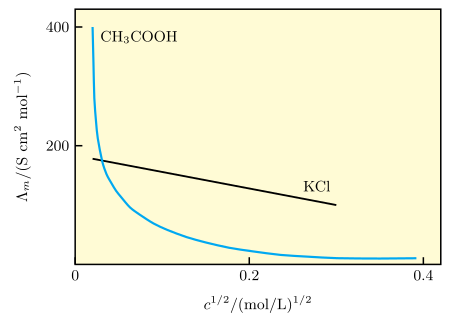
Concept: Molar conductivity depends on the number of ions present. A weak electrolyte like acetic acid is only slightly ionised at ordinary concentrations, so λm is small. On dilution its degree of dissociation increases sharply, so λm increases — slowly at first and then very rapidly close to infinite dilution.
Why this shape: Unlike a strong electrolyte (which gives a straight line following the Debye–Hückel–Onsager equation and lets us extrapolate to λm∞), the weak-electrolyte curve turns almost vertical near the axis, so λm∞ is found indirectly using Kohlrausch's law, not by extrapolation.
…
Showing the 12 most recent of 32 on this concept.
- CBSE 2025Set ANNUAL1 markQ.What is the SI unit of molar conductivity?
›Reveal solutionSolution
Molar conductivity's SI unit is S m² mol⁻¹.
Molar conductivity Λm=Cκ, where κ (conductivity) has SI unit Sm−1 and concentration C has SI unit molm−3.
Λm=molm−3Sm−1=Sm2mol−1
…
- CBSE 2025Set ANNUAL1 markQ.Define the following — Limiting molar conductivity
›Reveal solutionSolution
Limiting molar conductivity is molar conductivity extrapolated to zero concentration.
Limiting molar conductivity (Λm0 or Λm∞) is the molar conductivity of an electrolyte solution when the concentration approaches zero (i.e. at infinite dilution). At infinite dilution, dissociation of the electrolyte is essentially complete and inter-ionic attractions vanish, so each ion conducts independently and to its maximum extent. For strong electrolytes, Λm0 is obtained by extrapolating the Λm …
- CBSE 2025Set ANNUAL1 markMCQQ.Equivalent conductances of sodium acetate, sodium chloride and hydrochloric acid at infinite dilution are 224, 38.2, 203 ohm^-1 cm^2 eqv^-1 respectively at 298K. So the (lambda)0 CH3COOH is:(a) 288.5 ohm^-1 cm^2 eqv.^-1(b) 288.8 ohm^-1 cm^2 eqv.^-1(c) 388.8 ohm^-1 cm^2 eqv.^-1(d) 59.2 ohm^-1 cm^2 eqv.^-1
›Reveal solutionSolution
λ0(CH3COOH) = λ0(CH3COONa) + λ0(HCl) − λ0(NaCl) = 224 + 203 − 38.2 = 388.8 ohm^-1 cm^2 eqv^-1.
CH3COOH is a weak electrolyte, so its limiting equivalent conductance cannot be found by direct extrapolation. Instead, Kohlrausch's law of independent migration of ions lets us combine the limiting conductances of related strong electrolytes.
We want λ0(CH3COO-) + λ0(H+). Note that:
λ0(CH3COONa) = λ0(CH3COO-) + λ0(Na+) = 224
λ0(HCl) = λ0(H+) + λ0(Cl-) = 203
λ0(NaCl) = λ0(Na+) + λ0(Cl-) = 38.2
…
- CBSE 2025Set ANNUAL1 markQ.Fill in the blank: Molar conductivity ________ with decrease in concentration.
›Reveal solutionSolution
Molar conductivity increases as concentration decreases (i.e., on dilution), reaching a maximum limiting value at infinite dilution.
Molar conductivity is given by:
Λm = κ x 1000 / M
As a solution is diluted (concentration M decreases):
- For weak electrolytes: the degree of dissociation increases sharply with dilution, so more ions are produced per mole, increasing Λm markedly. …
- CBSE 2025Set ANNUAL1 markMCQQ.The unit of molar conductivity is(a) S cm^-2 mol^-1(b) S cm^2 mol^-1(c) S^-1 cm^2 mol^-1(d) S cm^2 mol
›Reveal solutionSolution
Molar conductivity relates conductivity (S/cm) to concentration (mol/cm^3), giving the composite unit S cm^2 mol^-1.
Molar conductivity is defined as:
Λm=Cκ×1000
where κ (specific conductivity) has units S cm^-1 and C (concentration) has units mol L^-1 (mol per 1000 cm^3).
…
- CBSE 2025Set ANNUAL1 markMCQQ.The molar conductivity of a 0.1mol L−1 solution of KCl with electrolytic conductivity 0.0129 S cm−1 at 298 K is –(a) 12.9 S cm2 mol−1(b) 1.29 S cm2 mol−1(c) 0.0129 S cm2 mol−1(d) 129 S cm2 mol−1
›Reveal solutionSolution
Converting conductivity (per cm) into molar conductivity requires dividing by the molar concentration expressed per cm³, giving a factor of 1000 in the standard formula.
Molar conductivity is related to the specific conductivity (electrolytic conductivity, κ) and molar concentration C (in molL−1) by:
Λm=Cκ×1000
…
- CBSE 2025Set ANNUAL1 markMCQQ.The formula used to calculate molar conductivity of an electrolyte is _____.(a) Λ=k1000c(b) c=k1000Λ(c) Λ=c1000k(d) k=Λc1000
›Reveal solutionSolution
Λm=c1000κ.
Molar conductivity (Λm) relates to specific conductivity (κ) and molar concentration c (in moldm−3) by:
Λm=cκ×1000
…
- CBSE 2025Set ANNUAL1 markQ.What is the SI unit of molar conductivity? OR Write the relation between specific conductivity and molar conductivity.
›Reveal solutionSolution
Molar conductivity's SI unit follows from Λm=κ/C: siemens metre-squared per mole.
Molar conductivity is defined as Λm=Cκ, where κ (specific/electrical conductivity) has SI unit Sm−1 and C (molar concentration) has SI unit molm−3. Dividing, the SI unit of Λm works out to
molm−3Sm−1=Sm2mol−1.
(In practical lab work, where κ is often expressed in Scm−1 and C in molL−1, the commonly used relation is Λm=C1000κ, giving the c.g.s.-style unit Scm2mol−1.)
…
- CBSE 2024Set A11 markMCQQ.When the concentration of electrolytic solution approaches zero, the resulting molar conductivity is known as ;(a) specific conductance(b) resistivity(c) conductivity(d) limiting molar conductivity
›Reveal solutionSolution
Molar conductivity at zero concentration (infinite dilution) is called the limiting molar conductivity — option (d).
Molar conductivity Λm increases as an electrolytic solution is diluted, because more of the electrolyte is present as free, effectively conducting ions. As the concentration approaches zero (infinite dilution), Λm reaches a limiting maximum value denoted Λm∘, the **limiting molar co …
- CBSE 2024Set B1 markQ.Answer in one word/sentence: Write the unit of Equivalence conductivity.
›Reveal solutionSolution
Equivalent conductivity is conductivity per gram-equivalent of electrolyte per unit volume, giving units of S cm^2 eq^-1.
Equivalent conductivity, Λeq, is defined as Λeq=κ×V, where κ (specific conductivity) has units of S cm^-1 (ohm^-1 cm^-1) and V is the volume in cm^3 containing one gram-equivalent of …
- CBSE 2024Set ANNUAL1 markQ.The molar conductivity of 2.5×10⁻² M of methanoic acid is 46.1 S cm2 mol−1. Calculate the degree of dissociation. (Molar conductivity of H+ and HCOO− at infinite dilutions are λ°H+=349.6 S cm2 mol−1 and λ°HCOO−=54.6 S cm2 mol−1).
›Reveal solutionSolution
Adding the limiting ionic molar conductivities gives Λm°, and dividing the measured Λm by it gives the degree of dissociation.
For a weak electrolyte, the degree of dissociation is given by:
α=Λm°Λm
Limiting molar conductivity of methanoic acid (using Kohlrausch's law of independent migration of ions):
Λm°=λ°H++λ°HCOO−=349.6+54.6=404.2 Scm2mol−1 …
- CBSE 2024Set ANNUAL1 markQ.Write SI unit of molar conductivity.
›Reveal solutionSolution
SI unit of molar conductivity is Sm2mol−1.
Molar conductivity Λm is defined as the conducting power of all the ions produced by dissolving one mole of an electrolyte, measured between electrodes 1 m apart.
…
🎓Unlock everything free for 14 days
- ✓Full step-by-step solutions
- ✓Concept-first explanations
- ✓Methods, shortcuts & mistakes
- ✓PYQ mapping + timed mock tests
Full access for 14 days. No credit card required.