Q.A tank with rectangular base and rectangular sides, open at the top is to be constructed so that its depth is 2 m and volume is 8 m3. If building of tank costs Rs 70 per sq metres for the base and Rs 45 per square metre for sides. What is the cost of least expensive tank?
🔒You're viewing a preview — the full solution, concept, methods & PYQ mapping are locked.
🔒 Start your 14-day free trial to unlock the full solution →Concept understanding — Optimization Word Problem
Optimization Word Problems
Imagine planning a garden with 40 metres of fencing and wanting the largest rectangular area. A long, thin rectangle wastes space; a square feels roomier; somewhere in between lies the best shape. That is an optimisation problem — a fixed resource and a quantity to make as large (or as small) as possible.
Every optimisation word problem has the same skeleton: the best outcome — maximum area, minimum cost, largest volume, shortest time — under a constraint — limited material, a fixed budget, a given perimeter.
The Plan of Attack
The problem gives you a story, not a graph. Your job is to turn it into a single-variable function and find its peak or valley:
- Name the quantity to optimise — call it Q, and write it using variables.
- Find the constraint — a relation between those variables (e.g. "perimeter =40").
- Reduce to one variable — use the constraint to eliminate the rest.
- Differentiate — solve Q′(x)=0 to find the critical points.
- Confirm — use Q′′(x)<0 for a maximum or Q′′(x)>0 for a minimum.
- Answer the question asked — give the actual dimensions/cost, not just x.
In board exams these problems almost always reduce to a quadratic or cubic. Once Q(x) is written, the calculus is mechanical.
The Garden, Worked
40 m of fencing encloses a rectangle; maximise the area.
- Objective: A=lw.
- Constraint: 2l+2w=40, so l+w=20.
- Reduce: w=20−l, giving A(l)=l(20−l)=20l−l2.
- Differentiate: A′(l)=20−2l=0⟹l=10.
- Confirm: A′′(l)=−2<0, a maximum.
So l=w=10 m — a 10 m × 10 m square.
A common slip: solving A′(l)=0 and stopping. Always check max vs min, and answer in the units asked.
The Common Families
| Problem type | Typical objective | Typical constraint |
|--------------|-------------------|--------------------| …
Concept: Optimization Word Problem — minimize cost given fixed volume and depth.
Let length =l m, breadth =b m, depth =2 m.
Volume: l⋅b⋅2=8⇒lb=4.
Cost: base area lb at Rs 70/m², side area 2(l+b)⋅2 at Rs 45/m².
So cost C=70(lb)+45⋅4(l+b)=70⋅4+180(l+b)=280+180(l+b). …
We minimise the total cost function of a rectangular tank (open top, fixed depth 2 m, fixed volume 8 m³) by expressing cost in terms of one variable, using calculus to find the critical point. The least expensive tank costs Rs 1000.
This is a classic optimisation problem from applied calculus. The key is to translate the physical constraints into a single-variable cost function, then find where its derivative is zero. Because the tank has a fixed depth and volume, the base dimensions are linked — you cannot choose both length and width independently.
Let’s set it up.
- Define variables and use the fixed volume. Let the length of the base be l metres and the width be w metres. Depth is given as 2 m. Volume = l×w×2=8 m³. So 2lw=8, which gives
lw=4.
This is our constraint: the product of length and width is fixed at 4.
-
Write the cost expression.
The tank is open at the top, so we have:
- Base area = lw (cost Rs 70 per m²)
- Two side walls of area l×2 each (cost Rs 45 per m²)
- Two side walls of area w×2 each (cost Rs 45 per m²)
Total cost C in rupees:
C=70(lw)+45(2l×2)+45(2w×2)
Simplify:
C=70(lw)+180l+180w
- Use the constraint to reduce to one variable. From lw=4, we have w=l4. Substitute into C:
C(l)=70(4)+180l+180(l4)
C(l)=280+180l+l720
Now l>0 (a physical length). Our job: find l that minimises C(l).
Because the cost function is symmetric in l and w, the minimum will occur when l=w. From lw=4, that gives l=w=2. You can guess the answer, but calculus confirms it.
- Differentiate and find the critical point. …
Method: Minimum-Cost Optimisation with a Fixed-Volume Constraint
This method applies to any "minimise cost/material given a fixed volume or capacity" word problem, where different faces of a solid have different unit costs.
Steps
Step 1: Name the free variables and write the fixed-quantity constraint
Identify which dimensions are given directly (like a fixed depth) and which are free (length l, breadth w), then use the given fixed volume to write one constraint equation linking the free variables.
l⋅w⋅(depth)=Volume⇒lw=constant
Step 2: Write the total cost as a sum over each distinct surface
Multiply each face's area by its own per-unit cost and add them up — for an open-top tank, remember the base contributes once but each pair of opposite side walls contributes with its own area and rate.
C=(ratebase)×(base area)+(ratesides)×(total side area)
Step 3: Use the constraint to write cost as a function of one variable …
Common Mistakes
Mistake 1: Forgetting that a rectangular tank has two pairs of side walls, each contributing separately
Why it's wrong: writing the side area needs the full perimeter of the base times the depth — a common slip is to use only one pair of walls, or to forget the depth factor, undercounting the total side area and therefore the cost. Correct approach: explicitly write the total side-wall area as (perimeter of the base) × depth =2(l+w)×depth, and double-check by counting all four walls individually if unsure.
Mistake 2: Treating the base cost rate and the side cost rate as if they were the same …
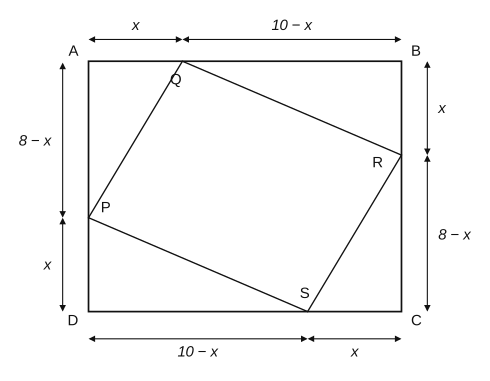
- COMEDK 2025Set 2025-A1 markMCQQ.Quadrilateral PQRS is inscribed inside a rectangle of dimensions 10 cm×8 cm. The value of ' x ', if the area of the quadrilateral is minimum is (A) 4 cm (B) 6.5 cm (C) 9 cm (D) 4.5 cm
›Reveal solutionSolution
The quadrilateral’s area is the rectangle’s area minus the sum of four right‑triangle areas at the corners. Writing that sum as a quadratic in x and finding its maximum (which makes the quadrilateral’s area minimum) gives x=4.5 cm. The correct option is (D).
Concept & Intuition
The quadrilateral PQRS is inscribed in the rectangle — each vertex lies on a different side. The area of the quadrilateral is not fixed; it changes as the vertices slide along the sides. The problem asks for the value of x that makes the quadrilateral’s area as small as possible.
A classic trick: instead of minimising the quadrilateral’s area directly, notice that the quadrilateral is what’s left of the rectangle after cutting off four right‑angled triangles at the corners. The rectangle’s area is constant (10×8=80 cm²), so minimising the quadrilateral’s area is equivalent to maximising the total area of the four corner triangles.
Each corner triangle is right‑angled, with legs given by the distances marked x and the leftover lengths on the sides. This turns the problem into a simple quadratic maximisation.
Step‑by‑step reasoning
-
Label the rectangle and the triangles
Rectangle ABCD:
- Top side AB = 10 cm, left side AD = 8 cm.
- Q on AB, with AQ = x cm → QB = 10−x cm.
- R on BC, with BR = x cm → RC = 8−x cm.
- S on CD, with CS = x cm → SD = 10−x cm.
- P on DA, with DP = x cm → PA = 8−x cm.
The four corner triangles are:
- △AQP (top‑left corner): legs AQ = x, AP = 8−x.
- △BQR (top‑right corner): legs BQ = 10−x, BR = x.
- △CRS (bottom‑right corner): legs CR = 8−x, CS = x.
- △DPS (bottom‑left corner): legs DP = x, DS = 10−x.
-
Write the total area of the four triangles
Area of a right triangle = 21×leg1×leg2.
So:
Atriangles=21x(8−x)+21(10−x)x+21(8−x)x+21x(10−x)=2⋅21x(8−x)+2⋅21x(10−x)=x(8−x)+x(10−x).
- Simplify the expression
Atriangles=8x−x2+10x−x2=18x−2x2.
- Relate to quadrilateral area
APQRS=Area of rectangle−Atriangles=80−(18x−2x2)=2x2−18x+80.
- Minimise the quadrilateral area …
-
- COMEDK 2024Set 2024-M1 markMCQQ.The most economical proportion of the height of a covered box of fixed volume whose base is a rectangle with one side three times as long as the other, is (A) 23× shorter side of base (B) Equal to shorter side of base (C) 21× shorter side of base (D) 3 times shorter side of base
›Reveal solutionSolution
The problem asks for the height that minimizes the surface area (most economical) of a covered box with a fixed volume and a rectangular base where one side is three times the other. The optimal height equals the shorter side of the base, so the answer is option (B).
We are told the box has a fixed volume, and we want the "most economical proportion" — meaning the dimensions that use the least material (minimum surface area) for that volume. The base is a rectangle where one side is three times the other. Let the shorter side of the base be x, so the longer side is 3x. Let the height be h. The volume V is fixed, so:
V=(base area)×h=(x⋅3x)⋅h=3x2h
We want to minimize the total surface area (including the lid, since it's a covered box). The surface area S consists of:
- Top and bottom: each 3x2, so total 2⋅3x2=6x2
- Four sides: two of size x⋅h and two of size 3x⋅h, so total 2xh+2(3x)h=2xh+6xh=8xh
Thus:
S=6x2+8xh
Now we use the fixed volume to eliminate h:
h=3x2V
Substitute into S:
S(x)=6x2+8x⋅3x2V=6x2+3x8V
We minimize S with respect to x. Take the derivative:
dxdS=12x−3x28V
Set to zero:
12x=3x28V⇒36x3=8V⇒x3=368V=92V
So:
x=392V
Now find h from the volume relation:
h=3x2V=3(392V)2V
Simplify: x2=(92V)2/3, so:
h=3V⋅(2V9)2/3=3V⋅(2V)2/392/3=3V1−2/3⋅22/392/3=3V1/3⋅22/3(9)2/3
Now 92/3=(91/3)2=(32/3)2=34/3. So:
h=3V1/3⋅22/334/3=V1/3⋅34/3−1⋅2−2/3=V1/3⋅31/3⋅2−2/3
But x=(92V)1/3=V1/3⋅21/3⋅3−2/3. Compare h and x:
- COMEDK 2023Set 2023-E1 markMCQQ.A triangular park is enclosed on two sides by a fence and on the third side by a straight river bank. The two sides having fence are of same length x. The maximum area enclosed by the park is (A) 8x3 (B) πx2 (C) 23x2 (D) 21x2
›Reveal solutionSolution
(Options (B) and (C) exceed this and are impossible; (A) is dimensionally wrong.)
Concept: maximise the area of a triangle with two given equal sides; the river bank supplies the third side, so no fencing constraint acts on it.
The two fenced sides each have length x, with an included angle theta between them.
Area A(theta) = (1/2) * x * x * sin theta = (1/2) x^2 sin theta. …
- COMEDK 2026Set 2026-M1 markMCQQ.If a straight line passing through a fixed point (a,b), where a,b>0, makes positive intercepts OA and OB on the coordinate axes, then the least value of OA+OB is: (A) (a+b)2 (B) (a+b)3 (C) a+b (D) (a−b)2
›Reveal solutionSolution
The problem asks for the minimum sum of the intercepts OA and OB of a line through a fixed point (a,b) in the first quadrant. Using the intercept form of a line and applying the AM–GM inequality, the least value is (a+b)2, which corresponds to option (A).
We start with the intercept form of a straight line:
px+qy=1
where p=OA>0 and q=OB>0 are the x- and y-intercepts. Since the line passes through the fixed point (a,b) with a,b>0, we have:
pa+qb=1.
Our goal is to minimize S=p+q subject to this constraint.
- Express one variable in terms of the other From pa+qb=1, solve for q:
qb=1−pa⇒q=1−pab=p−abp.
So S(p)=p+p−abp, with p>a (since q>0).
- Rewrite S(p) for AM–GM
S=p+p−abp=p+b⋅p−ap.
Write p=(p−a)+a:
S=(p−a)+a+b⋅p−a(p−a)+a=(p−a)+a+b(1+p−aa).
Simplify:
S=(p−a)+a+b+p−aab.
So
S=(p−a)+p−aab+(a+b).
- Apply AM–GM inequality For positive numbers x=p−a and y=p−aab, we have: x+y≥2xy=2(p−a)⋅p−aab=2ab. …
- COMEDK 2025Set 2025-M1 markMCQQ.A solid S is made from a cylinder surmounted by a hemisphere on top with both its circular faces sharing a common centre. The radius of cylinder and radius of hemisphere are x cm. The height of the cylinder is (20−4x)cm and the volume of S is V=31πy. Find the maximum value of y. (A) 480 (B) 360 (C) 320 (D) 160
›Reveal solutionSolution
The problem asks for the maximum volume of a solid composed of a cylinder and a hemisphere. By writing the volume as a function of the radius x, differentiating, and checking constraints, we find the maximum value of y is 320, corresponding to option (C).
Concept and Intuition
We have a solid that is a cylinder topped with a hemisphere. Both share the same radius x. The cylinder’s height is given as 20−4x, so the total volume is the sum of the cylinder’s volume and the hemisphere’s volume. The volume is expressed as V=31πy, so y is essentially 3V/π. To maximize y, we maximize V. The key is to treat x as a variable, write V(x), then use calculus (or algebra) to find the maximum, while respecting that the height must be positive (so x<5) and the radius positive.
Step-by-step solution
-
Write the volume of each part.
- Cylinder volume: πx2⋅height=πx2(20−4x).
- Hemisphere volume: half of a sphere of radius x, so 21⋅34πx3=32πx3.
-
Total volume V as a function of x.
V(x)=πx2(20−4x)+32πx3=π(20x2−4x3+32x3)=π(20x2−310x3).
- Relate V to y. Given V=31πy, we have
31πy=π(20x2−310x3)⇒y=3(20x2−310x3)=60x2−10x3.
- Find the maximum of y(x). Differentiate:
dxdy=120x−30x2=30x(4−x).
Set derivative to zero: 30x(4−x)=0 gives x=0 (minimum, trivial) or x=4.
- Check constraints. …
-
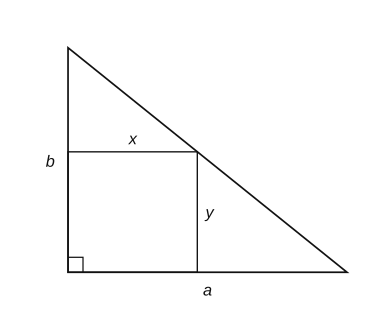
- COMEDK 2024Set 2024-A1 markMCQQ.The dimensions of the largest rectangle of side x and y that can be inscribed in the right angled triangle of sides a and b is (A) 2a,2b (B) 23a,23b (C) 4a,4b (D) a,b
›Reveal solutionSolution
The largest inscribed rectangle in a right triangle, with one vertex at the right angle, has dimensions half the legs: x=a/2 and y=b/2. The correct option is (A).
The problem asks for the dimensions of the largest rectangle that can be placed inside a right triangle, with one corner fixed at the right angle. The rectangle’s base lies along the horizontal leg a, its left side along the vertical leg b, and its top-right corner touches the hypotenuse. This is a classic optimization problem: we want to maximize the area A=x⋅y subject to the constraint that the point (x,y) lies on the hypotenuse.
Why this approach works:
The hypotenuse is a straight line connecting (0,b) to (a,0). Any point on it satisfies a linear relation between x and y. By expressing y in terms of x (or vice versa), the area becomes a quadratic function of one variable. The maximum of a quadratic occurs at its vertex, which we can find by symmetry or calculus. The result is beautifully simple: the rectangle’s dimensions are exactly half the triangle’s legs.
- Set up the coordinate system and the line of the hypotenuse. Place the right angle at the origin (0,0). Then the legs lie along the axes: the horizontal leg from (0,0) to (a,0), the vertical leg from (0,0) to (0,b). The hypotenuse connects (a,0) to (0,b). Its equation is:
ax+by=1
because the intercept form of a line is x/a+y/b=1.
- Express the rectangle’s dimensions and area. The rectangle has width x (along the base) and height y (along the left side). Its top-right corner (x,y) lies on the hypotenuse, so x and y satisfy the line equation. Solve for y:
y=b(1−ax)
The area is:
A(x)=x⋅y=x⋅b(1−ax)=b(x−ax2)
- Maximize the area. A(x) is a quadratic in x that opens downward (coefficient of x2 is negative). Its maximum occurs at the vertex. For a quadratic A(x)=−abx2+bx, the vertex is at: x=−2⋅(−ab)b=2a …
- COMEDK 2025Set 2025-A1 markMCQQ.The least area of a circle circumscribing any right-angle triangle of area π9 sq units is (A) 9 sq units (B) π sq units (C) 9π sq units (D) 4.5 sq units
›Reveal solutionSolution
For a right triangle of fixed area, the circumscribed circle’s area is minimized when the triangle is isosceles right-angled. The minimal area is 9 square units, corresponding to option (A).
The key idea: For any right triangle, the hypotenuse is the diameter of its circumcircle. So the circle’s area depends only on the hypotenuse length. Given a fixed triangle area, we want the smallest possible hypotenuse — that happens when the legs are equal, making the triangle isosceles right-angled.
- Relate triangle area to legs. Let the legs be a and b. The area is
21ab=π9⇒ab=π18.
- Express the circumcircle’s area in terms of the hypotenuse. In a right triangle, the hypotenuse c is the diameter of the circumcircle. So the radius is R=c/2, and the circle’s area is
Acircle=πR2=π(2c)2=4πc2.
- Write c2 in terms of a and b. By Pythagoras:
c2=a2+b2.
We want to minimize c2 given the product ab=18/π.
- Minimize a2+b2 for fixed product. By AM–GM or by symmetry, for a fixed product, the sum of squares is smallest when a=b.
a=b⇒a2=π18.
Then
c2=a2+b2=2a2=π36. …
- COMEDK 2021Set 2021-B1 markMCQQ.In a △ABC, ∠B=90∘, and a+b=4, The area of the triangle is maximum when ∠C= (A) π/5 (B) π/6 (C) π/3 (D) π/4
›Reveal solutionSolution
The area is maximum at ∠C=π/3.
Since ∠B=90∘, side b (opposite B) is the hypotenuse. With A=90∘−C: a=bsinA=bcosC and c=bsinC.
Constraint: a+b=bcosC+b=b(1+cosC)=4⇒b=1+cosC4.
Area =21ac=21b2sinCcosC=41b2sin2C=(1+cosC)24sin2C. …
- COMEDK 2026Set 2026-A1 markMCQQ.A movie screen on a wall is 20 feet high and 10 feet above the floor. What is the maximum viewing angle θ (in radians) that can be achieved by positioning yourself at the optimal distance from the wall? (A) 2π (B) 4π (C) 3π (D) 6π
›Reveal solutionSolution
The maximum viewing angle occurs when the viewer’s eye is at a distance from the wall equal to the geometric mean of the distances to the bottom and top of the screen. Solving the optimization gives θ=6π, so the correct option is (D).
The problem is a classic “best seat in a movie theater” optimization. You have a screen that starts 10 feet above the floor and ends 30 feet above the floor (since it’s 20 feet tall). Your eye height is at some fixed level — here we assume you stand on the floor, so your eye is roughly at floor level (or we can treat the floor as the reference). The angle θ is the angle subtended by the screen at your eye. As you move closer to the wall, the screen appears larger vertically, but you have to look up more steeply; as you move farther away, the vertical angle shrinks. Somewhere in between, the angle is maximized.
The key insight: For a fixed vertical segment, the angle subtended at a point on a horizontal line is maximized when the point’s horizontal distance is the geometric mean of the distances to the bottom and top of the segment. This is a consequence of the law of sines or the tangent subtraction formula.
-
Set up coordinates.
Place the wall along the y-axis, with the floor at y=0. The bottom of the screen is at y=10 ft, the top at y=30 ft. You stand at a point (x,0) on the floor, x>0 feet from the wall. The viewing angle θ is the angle between the lines from your eye to the top and bottom of the screen.
-
Express θ in terms of x.
Let α be the angle from horizontal to the top of the screen, and β the angle to the bottom. Then
tanα=x30,tanβ=x10.
The viewing angle is θ=α−β. Using the tangent subtraction formula:
tanθ=1+tanαtanβtanα−tanβ=1+x30⋅x10x30−x10=1+300/x220/x=x2+30020x.
- Maximize tanθ (or θ itself). Since θ is acute and tan is increasing on (0,π/2), maximizing θ is equivalent to maximizing tanθ. So we maximize
f(x)=x2+30020x.
Differentiate with respect to x:
f′(x)=(x2+300)220(x2+300)−20x(2x)=(x2+300)220x2+6000−40x2=(x2+300)26000−20x2.
Set f′(x)=0:
-
- KCET 2020Set A-11 markMCQQ.The maximum value of xlogex, if x>0 is (A) e (B) 1 (C) e1 (D) −e1
›Reveal solutionSolution
The function f(x)=xlogx attains its maximum at x=e, and the maximum value is e1.
The key idea here is to find where a function reaches its highest point — that’s a classic optimisation problem. For a differentiable function on an open interval like x>0, the maximum (if it exists) occurs at a critical point where the derivative is zero, provided the function changes from increasing to decreasing there.
Why does this particular function matter? xlogx appears often in comparisons of growth rates — it tells us that x1/x is maximised at x=e, a neat fact. But let’s not jump ahead; we’ll find the maximum step by step.
-
Define the function and its domain.
Let f(x)=xlogx, with x>0. We want the maximum value of f(x).
-
Differentiate f(x).
Use the quotient rule:
f′(x)=x2(1/x)⋅x−logx⋅1=x21−logx.
- Find critical points. Set f′(x)=0:
x21−logx=0⇒1−logx=0⇒logx=1⇒x=e.
So x=e is the only critical point in x>0.
- Check if it’s a maximum.
Look at the sign of f′(x) around x=e:
- For 0<x<e, logx<1, so 1−logx>0, hence f′(x)>0 — function is increasing.
- For x>e, logx>1, so 1−logx<0, hence f′(x)<0 — function is decreasing. …
-
🎓Unlock everything free for 14 days
- ✓Full step-by-step solutions
- ✓Concept-first explanations
- ✓Methods, shortcuts & mistakes
- ✓PYQ mapping + timed mock tests
Full access for 14 days. No credit card required.