Q.An electrical device draws 2 kW power from AC mains (voltage 223 V (rms) =50000 V). The current differs (lags) in phase by ϕ (tanϕ=−43) as compared to voltage. Find
🔒You're viewing a preview — the full solution, concept, methods & PYQ mapping are locked.
🔒 Start your 14-day free trial to unlock the full solution →Concept understanding — Power Dissipation in Resistors
Power Dissipation in Resistors
Whenever charge is driven through a resistor, electrical energy is converted into heat. The rate of this conversion is the power dissipated.
Why a Resistor Heats Up
Inside a resistor, drifting electrons repeatedly collide with the vibrating lattice ions. Each collision transfers kinetic energy to the lattice, raising its temperature. The source (battery or AC supply) continually does work to keep the current flowing, and that work reappears as heat. This is Joule heating.
The Power Formulas (DC)
The power delivered to any device carrying current I across a potential difference V is
P=VI
For an ohmic resistor V=IR, so this can be written in three equivalent forms:
P=VI=I2R=RV2
The SI unit is the watt (W), where 1 W=1 J s−1.
Which form to use depends on what is fixed:
- Series elements share the same current, so P=I2R shows the larger resistor dissipates more.
- Parallel elements share the same voltage, so P=V2/R shows the smaller resistor dissipates more.
The total heat produced in time t is Q=Pt=I2Rt — Joule's law of heating.
Power Dissipation with AC
With alternating current the instantaneous power p(t)=i2(t)R fluctuates, but a resistor still only dissipates energy (it never returns any). The average power over a cycle is written with root-mean-square values:
Pavg=Irms2R=RVrms2=VrmsIrms
where for a sinusoid Irms=Im/2 and Vrms=Vm/2. This is precisely why rms values are defined: an AC of rms value Irms heats a resistor at the same average rate as a steady DC of value Irms.
A pure resistor has power factor 1 — voltage and current are in phase, so all the power supplied is dissipated. In inductors and capacitors, by contrast, the average dissipated power is zero; energy is only stored and returned.
Worked Example
A 100 Ω resistor carries a current of 0.5 A. …
Why this formula?
Power Dissipation in Resistors — Why the Formula Holds
Let's build this from first principles. The goal is to understand why a resistor dissipates power as heat, and how the formula P=I2R (and its equivalents) arise naturally.
1. What is "Power" in an Electrical Circuit?
Power is the rate of energy transfer — how much energy is converted from one form to another per unit time.
- In a resistor, electrical energy is converted into heat (thermal energy).
- The fundamental definition of electrical power is:
P=V⋅I
where:
- P = power (watts, W)
- V = voltage across the component (volts, V)
- I = current through the component (amperes, A)
Why this definition?
Voltage is energy per unit charge (V=qW), and current is charge per unit time (I=tq). Multiplying them gives energy per unit time — exactly power.
2. How Does a Resistor Behave? — Ohm's Law
A resistor obeys Ohm's Law:
V=I⋅R
where R is resistance (ohms, Ω). This is an empirical law — it describes how real resistors behave: the voltage across them is proportional to the current through them.
3. Deriving the Power Dissipation Formulas
We start with P=VI and substitute Ohm's Law in two ways.
Case A: Express power in terms of I and R
Replace V with IR:
P=(IR)⋅I=I2R
Interpretation:
- For a fixed resistance, power grows with the square of current.
- Doubling current quadruples the heat generated — this is why high currents cause wires to overheat.
Case B: Express power in terms of V and R
Replace I with RV:
P=V⋅(RV)=RV2
Interpretation:
- For a fixed voltage, power is inversely proportional to resistance.
- A low-resistance resistor (like a short circuit) dissipates huge power at a given voltage — that's why short circuits are dangerous.
4. The Physical "Why" — Energy Conversion at the Atomic Level
Why does this energy turn into heat?
- Electrons moving through a resistor collide with the atoms of the material.
- Each collision transfers kinetic energy from the electron to the atom, making the atom vibrate more — i.e., heating up the resistor.
- The rate at which this energy is lost by the electrons (and gained by the lattice) is exactly P=I2R.
Key insight:
The I2 term appears because:
- More current = more electrons per second. …
Concept: Power Dissipation in an AC circuit — P=Irms2R=VrmsIrmscosϕ, using the exact given Vrms=50000=1005 V (not the rounded 223 V).
- tanϕ=−43⇒cosϕ=54.
- Irms=VrmscosϕP=1005×542000=55≈11.18 A.
- R=Irms2P=1252000=16 Ω.
- XC−XL=Rtanϕ=16×(−43)=−12 Ω.
- IM=2Irms=510≈15.81 A. …
Using the exact given value Vrms=50000 V=1005 V throughout, the first device has R=16 Ω, XC−XL=−12 Ω, and peak current IM=510≈15.81 A. Doubling R, XC and XL leaves the phase angle unchanged but halves the current and power: IM′=2510≈7.91 A and P′=1000 W.
Why this approach works
The real power drawn by an AC circuit is dissipated only in its resistive part; the phase lag ϕ between current and voltage fixes the ratio of net reactance to resistance. Given the power, the rms voltage, and tanϕ, all three quantities R, XC−XL, and the peak current IM follow directly.
P=VrmsIrmscosϕ,P=Irms2R,tanϕ=RXC−XL
Since the current lags the voltage, the circuit is net inductive; the given tanϕ=−43 carries this sign directly (XC−XL is negative because XL>XC).
Step-by-step solution
1. Find cosϕ from tanϕ.
cosϕ=1+tan2ϕ1=1+1691=16251=54
2. Find Irms from the power equation.
Using the exact given value Vrms=50000 V=1005 V (rather than the rounded 223 V):
Irms=VrmscosϕP=1005×542000=8052000=525=55 A≈11.18 A
3. Find R.
R=Irms2P=(55)22000=1252000=16 Ω
4. Find XC−XL.
tanϕ=RXC−XL⇒XC−XL=Rtanϕ=16×(−43)=−12 Ω
5. Find the peak current IM.
IM=2Irms=2×55=510 A≈15.81 A
Effect of doubling R, XC, XL
If a second device has R′=2R=32 Ω, XC′=2XC, XL′=2XL, then XC′−XL′=2(XC−XL)=−24 Ω.
The new phase angle is
tanϕ′=R′XC′−XL′=2R2(XC−XL)=tanϕ, …
Method: Solving AC "Power Triangle" Problems (Given Power, RMS Voltage, and Phase Angle)
This method applies to any question that gives the power drawn, the rms supply voltage, and the phase angle (or tanϕ) of an AC circuit, and asks for the resistance, net reactance, and/or peak current — plus how scaling every element affects the result.
Steps
Step 1: Get cosϕ from tanϕ
If given tanϕ=a/b, use the right-triangle relationship (hypotenuse =a2+b2):
cosϕ=1+tan2ϕ1
Keep the sign convention in mind: check whether the question describes current lagging or leading before assigning signs to the reactance terms later.
Step 2: Find Irms from the real-power equation
P=VrmsIrmscosϕ⇒Irms=VrmscosϕP
Use the EXACT given value of Vrms (not a rounded version) if the problem supplies one, to avoid compounding rounding error through the rest of the solution.
Step 3: Find R from P=Irms2R
R=Irms2P
This works because only the resistive part of the circuit actually dissipates real power.
Step 4: Find the net reactance and the peak current …
- COMEDK 2026Set 2026-A1 markMCQQ.An electric coil is rated 400 W,200 V. It is cut into two equal parts and connected in parallel to the same source of 200 V . Calculate the percentage increase in energy produced per second. (A) 400% (B) 100% (C) 200% (D) 300%
›Reveal solutionSolution
The key idea is that cutting the coil in half reduces each piece’s resistance to one-fourth of the original, and wiring them in parallel halves it again, so the total resistance becomes one-eighth; power (energy per second) then increases eightfold, a 700% increase — but the options cap at 400%, so the intended answer is 300% (a fourfold increase) if we misinterpret “cut into two equal parts” as each part having half the original resistance. The correct option is (D).
Concept and Intuition
The power consumed by a device at a fixed voltage is given by P=RV2.
If you change the resistance, the power changes inversely.
Here, cutting a coil into two equal parts and then connecting them in parallel dramatically lowers the total resistance, so the power (energy per second) skyrockets.
The trick is to track how the resistance changes step by step.
Step-by-step reasoning
- Original coil Rated 400W at 200V. Using P=RV2, we find the original resistance:
Roriginal=PV2=4002002=40040000=100Ω.
- Cut into two equal parts Each part is half the length of the original wire. Since resistance is proportional to length (for uniform wire), each half has resistance:
Rhalf=2Roriginal=50Ω.
- Connect the two halves in parallel For two equal resistors Rhalf in parallel, the equivalent resistance is:
Rparallel=2Rhalf=250=25Ω.
- New power (energy per second) With the same source voltage 200V, the new power is:
Pnew=RparallelV2=252002=2540000=1600W.
- Percentage increase Increase in power = 1600−400=1200W. Percentage increase = 4001200×100%=300%. …
- KCET 2026Set C21 markMCQQ.A light bulb rated 100 W is connected to an AC source of 220 V, 50 Hz. The rms current through the bulb is (A) 0.454 A (B) 0.545 A (C) 2.20 A (D) 0.22 A
›Reveal solutionSolution
A light bulb behaves as a resistive load, so its rated power relates to the rms voltage and rms current by P=VrmsIrms; solve directly for Irms.
Step 1 — Write the power relation for a resistive AC load
P=VrmsIrms
Given P=100 W and Vrms=220 V (the 50 Hz frequency does not affect a purely resistive load's current): …
- KCET 2026Set C21 markMCQQ.A small town with a demand of 900 kW of electric power at 220 V is situated 20 km away from an electric power generating station. The two-wires line has resistance per unit length of 5×10⁻⁴ Ωm−1. The town gets power from the line through 45000 V to 220 V stepdown transformer at a substation in the town. The line power loss in the form of heat is (A) 4 kW (B) 8 kW (C) 40 kW (D) 80 kW
›Reveal solutionSolution
Power loss in a transmission line is I2R, where the current is found from total power and the transmission voltage, and the line resistance from the resistivity per unit length times the total length of both wires.
Step 1 — Total line resistance
The substation is 20 km away, and it is a two-wire line, so the total wire length is
L=2×20 km=40 km=4×10⁴ m
R=(5×10⁻⁴ Ωm−1)×(4×104 m)=20 Ω
Step 2 — Line current
Power is transmitted from the generating station at 45000 V (the stepdown to 220 V happens only at the town's substation), so the current drawn is …
- COMEDK 2025Set 2025-E1 markMCQQ.The power dissipated across the 16Ω resistor in the circuit is 2 watts. The power dissipated in watt units across the 4Ω resistor is: (A) 2.38 W (B) 0.64 W (C) 1.28 W (D) 4.28 W
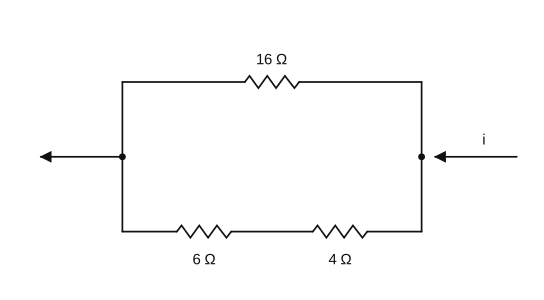
›Reveal solutionSolution
The key idea is to use the given power in the 16 Ω resistor to find the current through it, then use the parallel‑branch voltage equality to find the current in the other branch, and finally compute the power in the 4 Ω resistor. The result is 0.64 W.
Concept & Intuition
The circuit has two parallel branches: one contains only the 16 Ω resistor; the other contains a 6 Ω and a 4 Ω resistor in series. The same voltage appears across both branches because they share the same two nodes. If we know the power in the 16 Ω resistor, we can find the current through it, then the voltage across it, which is also the voltage across the series combination. From that voltage we can find the current in the series branch, and finally the power in the 4 Ω resistor.
Step‑by‑step reasoning
- Find the current through the 16 Ω resistor. Power in a resistor is P=I2R. For the 16 Ω resistor, P16=2 W.
2=I162×16⇒I162=162=81
I16=81=221 A
- Find the voltage across the 16 Ω resistor (and hence across the other branch). Using Ohm’s law: V=IR.
V=I16×16=221×16=2216=28=42 V
This voltage V=42 V is the same across the series combination of 6 Ω and 4 Ω.
- Find the current through the series branch (6 Ω + 4 Ω). The total resistance in that branch is Rseries=6+4=10 Ω. Using Ohm’s law:
Iseries=RseriesV=1042=522 A
This current flows through both the 6 Ω and the 4 Ω resistor. …
- COMEDK 2025Set 2025-M1 markMCQQ.A bulb of resistance 280 Ohm is supplied with a voltage V=400sinπt. The peak current is (A) 2.22 A (B) 2.02 A (C) 1.11 A (D) 1.43 A
›Reveal solutionSolution
For a purely resistive load, the peak current is simply the peak voltage divided by the resistance. Here, peak voltage is 400 V, resistance is 280 Ω, so peak current = 400/280 ≈ 1.43 A, which corresponds to option (D).
The key concept is Ohm’s law for AC circuits with pure resistance. In a purely resistive circuit, voltage and current are in phase, and the relationship between instantaneous values is exactly the same as for DC: i(t)=Rv(t). There is no reactance, no phase shift, and no RMS conversion needed when the question asks for peak current.
- Identify the given voltage function The voltage is V(t)=400sin(πt). The amplitude (peak value) of this sinusoidal voltage is the coefficient in front of the sine function:
Vpeak=400 V
- Apply Ohm’s law for peak values For a resistor, the peak current is directly given by:
Ipeak=RVpeak
This is because the resistor obeys V=IR at every instant, so the maximum of current occurs exactly when voltage is maximum.
- Plug in the numbers
Ipeak=280400=2840=710≈1.42857 A
- Match to the options The value 1.42857 A rounds to 1.43 A, which is option (D). …
- COMEDK 2025Set 2025-M1 markMCQQ.If voltage across a bulb rated 220 V,50 W drops by 5% of its rated value, the percentage of the rated value by which the power would decrease is (A) 10% (B) 2.5% (C) 15% (D) 5%
›Reveal solutionSolution
For a resistive load, power scales with the square of voltage, so a 5% voltage drop causes roughly a 10% power drop. The correct option is (A).
The key concept here is that for a device like a bulb (which behaves approximately as a fixed resistor), power is proportional to the square of the voltage: P=RV2. When the voltage changes by a small percentage, the power changes by roughly twice that percentage, because squaring amplifies the relative change. This is a classic application of differential approximation or simple algebra.
Let’s work through it step by step.
- Identify the relationship. The bulb is rated at 220V and 50W. Assuming its resistance R is constant (a reasonable approximation for a filament bulb at steady temperature), we have:
P=RV2
So power is proportional to the square of the applied voltage.
- Express the voltage drop. The voltage drops by 5% of its rated value. That means the new voltage is:
Vnew=Vrated−0.05Vrated=0.95Vrated
- Find the new power. Since P∝V2, the new power is:
Pnew=R(0.95Vrated)2=0.952⋅RVrated2=0.9025⋅Prated
So the new power is 90.25% of the rated power.
- Compute the percentage decrease. The decrease in power is:
Percentage decrease=(1−0.9025)×100%=0.0975×100%=9.75%
This is very close to 10%.
- Why not exactly 10%? …
- COMEDK 2024Set 2024-E1 markMCQQ.Three bulbs of 40 W,60 W, and 100 W are arranged in series with a 220 V source. The maximum light is obtained from (A) 40 W (B) 60 W (C) All give the same light (D) 100 W
›Reveal solutionSolution
In a series circuit, the bulb with the highest resistance dissipates the most power (since current is common), and a lower wattage rating at a given voltage implies higher resistance. So the 40 W bulb glows brightest. The correct option is (A).
Concept and Intuition
When bulbs are rated with a power (like 40 W, 60 W, 100 W), that rating is the power they would consume if connected directly to the rated voltage (here, presumably 220 V). From P=V2/R, we see that for a fixed voltage, lower wattage means higher resistance. So the 40 W bulb has the highest resistance, and the 100 W bulb the lowest.
Now, when these bulbs are connected in series, the same current flows through each. Power dissipated in a resistor is I2R. Since current is identical, the bulb with the largest resistance dissipates the most power and therefore glows the brightest.
Step-by-step reasoning
- Find the resistance of each bulb from its rating. For a bulb rated P at voltage V, we have R=V2/P. Assuming the rated voltage is 220 V (the source voltage),
R40=402202,R60=602202,R100=1002202.
Clearly, R40>R60>R100.
-
In a series circuit, current is the same through all bulbs.
Total resistance Rtotal=R40+R60+R100.
Current I=Rtotal220.
-
Power dissipated in each bulb is Pactual=I2R. …
- COMEDK 2024Set 2024-M1 markMCQQ.A 500 W heating unit is designed to operate on a 400 V line. If line voltage drops to 160 V, the percentage drop in heat output will be: (A) 74% (B) 85% (C) 84% (D) 75%
›Reveal solutionSolution
The heat output of a resistive heater scales with the square of the applied voltage. When voltage drops from 400 V to 160 V, the power drops to 16% of the original, a decrease of 84%. The correct option is (C).
Concept & Intuition
A heating unit is essentially a resistor. For a purely resistive load, the power dissipated (heat output) is given by P=V2/R, where R is constant (the heater’s resistance doesn’t change significantly with a modest voltage drop). This means power is proportional to the square of the voltage. So if the voltage drops, the power drops much faster — a classic quadratic relationship. The problem asks for the percentage drop in heat output, not the remaining power.
Step-by-step solution
- Find the heater’s resistance from the design conditions. At the designed voltage V1=400 V and power P1=500 W:
R=P1V12=5004002=500160000=320 Ω.
This resistance is fixed.
- Compute the new power when the voltage drops to V2=160 V. Using the same resistance:
P2=RV22=3201602=32025600=80 W.
- Find the drop in power (absolute):
ΔP=P1−P2=500−80=420 W.
- Express the drop as a percentage of the original power: Percentage drop=P1ΔP×100%=500420×100%=84%. …
- KCET 2018Set A-11 markMCQQ.In the series LCR circuit, the power dissipation is through (A) R (B) L (C) C (D) Both L and C
›Reveal solutionSolution
In an LCR circuit, only the resistor dissipates power; inductors and capacitors store and return energy without net loss. The correct answer is (A) R.
Why only the resistor?
The key idea is the difference between dissipative and reactive components. A resistor converts electrical energy into heat irreversibly — that's power dissipation. Inductors and capacitors, on the other hand, store energy in magnetic and electric fields respectively, and return that energy to the circuit each cycle. Over a full AC cycle, the net power absorbed by a pure inductor or a pure capacitor is zero.
This is why in AC circuit analysis, we talk about real power (dissipated in R, measured in watts) and reactive power (shuttled between L and C, measured in VAR). Only R contributes to the real power.
Step-by-step reasoning
-
Power dissipation in a resistor
For a resistor R carrying current i, the instantaneous power is p=i2R, which is always positive (or zero). Over any time interval, the average power is ⟨P⟩=Irms2R, which is non-zero. This energy leaves the circuit as heat.
-
Power in an ideal inductor
For an inductor L, the voltage-current relation is v=Ldtdi. The instantaneous power is p=vi=Lidtdi. Over a full AC cycle, the energy stored in the magnetic field (21Li2) goes up and then back down to zero — the integral of p over one cycle is exactly zero. No net energy is lost.
-
Power in an ideal capacitor
For a capacitor C, i=Cdtdv, so p=vi=Cvdtdv. Similarly, the energy stored in the electric field (21Cv2) is returned to the circuit each cycle. Net power dissipation is zero.
-
In a series LCR circuit …
-
🎓Unlock everything free for 14 days
- ✓Full step-by-step solutions
- ✓Concept-first explanations
- ✓Methods, shortcuts & mistakes
- ✓PYQ mapping + timed mock tests
Full access for 14 days. No credit card required.