Physics · Ch 1 — Electric Charges and Fields
Gauss's Law
Gauss's Law
The Core Idea: Flux and Enclosed Charge
Gauss's Law is a fundamental principle of electrostatics. It connects the total electric flux through any closed surface to the total electric charge trapped inside that surface. It is a direct consequence of Coulomb's inverse-square law.
Derivation for a Point Charge
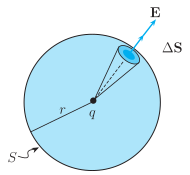
We start with the simplest case: a single point charge at the centre of a sphere of radius .
- Electric Field: By Coulomb's law, the field at any point on the sphere is:
The direction is radially outward (along $\hat{r}$).
2. Flux through a small area: Consider a tiny area element on the sphere. The flux through it is:
Since the normal to the sphere at every point is along the radius, $\theta = 0^\circ$ and $\cos \theta = 1$. Therefore:
- Total flux through the sphere: Summing over all area elements:
The sum of all area elements is the total surface area of the sphere, $S = 4\pi r^2$. Substituting:
This result — that the total flux is — is independent of the radius . It holds for any closed surface surrounding the charge.
Statement of Gauss's Law
The general law states:
The net electric flux () through any closed surface is equal to the total charge enclosed () divided by .
- is the total electric flux through the closed surface.
- is the net charge (sum of all charges) inside the surface.
- is the permittivity of free space.
Key implication: If no charge is enclosed (), the net flux through the surface is zero. This is true even if there are charges outside the surface.
Important Points about Gauss's Law
- Shape Independence: The law holds for any closed surface, regardless of its shape or size.
- Charge Location: The enclosed charge is the sum of all charges inside. Their exact positions inside do not matter.
- Field from All Charges: The electric field in the flux integral is due to all charges — both inside and outside the surface. However, only the charges inside contribute to the net flux. …
Drawn by us to help you understand the concept clearly, and verified to make sure it's accurate. For exams, practice from your textbook's own diagram.
What the Figure Shows
The figure depicts a spherical Gaussian surface of radius with a point charge placed exactly at its centre. The sphere is labelled S (with a leader line pointing to the surface). A small patch on the sphere is marked as — this is an infinitesimal area element. From the charge , a thin solid line (the radius ) and a dashed centre line run through a narrow cone to the patch , indicating that the area element is at a fixed distance from the charge. At the patch, the electric field E is drawn as an arrow pointing radially outward, perpendicular to the sphere’s surface. The field magnitude is the same at every point on the sphere because the charge is at the centre.
Physical Idea Taught
The figure illustrates Gauss’s law for the simplest symmetric case: a single point charge enclosed by a spherical surface. The key insight is that the electric flux through any closed surface depends only on the total charge inside the surface, not on its shape or size. Here, because the sphere is centred on the charge, the field is radial and constant in magnitude over the entire sphere, making the flux calculation straightforward.
Key Formula Developed
The textbook uses this figure to derive the flux through the sphere:
- Flux through one area element :
where:
- (Coulomb’s law for the field due to ),
- is the area vector (magnitude , direction along the outward normal ),
- is the permittivity of free space.
- Total flux through the entire sphere (summing over all ):
because the total surface area of the sphere is . …
Drawn by us to help you understand the concept clearly, and verified to make sure it's accurate. For exams, practice from your textbook's own diagram.
What the Figure Shows
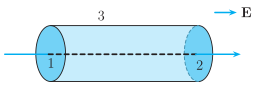
The diagram depicts a right circular cylinder placed in a uniform electric field . The cylinder is oriented horizontally, with its axis parallel to the field direction. The key visual elements are:
- Flat circular faces:
- Face 1 (left end): The outward normal points opposite to .
- Face 2 (right end): The outward normal points along .
- Curved surface (Face 3): The normal at every point is perpendicular to .
- Axis of the cylinder: Shown as a solid arrow entering Face 1, a dashed line inside, and a solid arrow exiting Face 2 — this reinforces the direction of through the cylinder.
- arrow: Placed top-right, indicating the uniform field direction (left to right).
No charges are drawn inside or outside the cylinder — the field is uniform and external.
Physical Idea Taught
The figure illustrates Gauss’s law for a closed surface that encloses no net charge. Even though the electric field is nonzero everywhere, the total electric flux through the entire closed cylindrical surface is zero. This happens because:
- Flux through the curved surface is zero ( is perpendicular to the area element ).
- Flux through the left face is negative (field enters the surface).
- Flux through the right face is positive (field exits the surface).
- The magnitudes of these two fluxes are equal, so they cancel.
Thus, the figure demonstrates that zero net flux implies zero enclosed charge, a direct consequence of Gauss’s law.
Key Formulas Developed
The textbook uses this figure to derive the total flux through the cylinder:
where:
- = flux through left face (Face 1)
- = flux through right face (Face 2)
- = flux through curved surface (Face 3)
For each flat face of area :
…