Q.A short bar magnet placed with its axis at 30∘ with a uniform external magnetic field of 0.25 T experiences a torque of magnitude equal to 4.5×10⁻² J. What is the magnitude of magnetic moment of the magnet?
Concept understanding — Magnetic Poles
Magnetic Poles: The Intuition First
Imagine you have a bar magnet — the kind you might have stuck on your refrigerator. If you bring two of them close, something interesting happens. Sometimes they snap together with a satisfying click. Other times, they push each other away, refusing to touch no matter how hard you try.
That's not random. Every magnet has two special regions, one at each end, where the magnetic force is strongest. These are its magnetic poles.
The word "pole" comes from the Greek polos, meaning "pivot" or "axis" — the Earth itself has a North Pole and a South Pole, and it behaves like a giant magnet.
The Two Types of Poles
Every magnet has exactly two poles: a north pole and a south pole. You cannot have a magnet with only one pole — cut a bar magnet in half, and each half immediately becomes a complete magnet with its own north and south poles.
The rule of interaction is simple and memorable:
- Unlike poles attract: north pulls south, south pulls north.
- Like poles repel: north pushes north away; south pushes south away.
This is the fundamental behaviour. No exceptions.
The Precise Statement
Magnetic poles are the regions of a magnet where the external magnetic field is strongest. Every magnet has exactly two poles — a north pole and a south pole — that cannot be isolated. Like poles repel; unlike poles attract.
The key points to remember for exams:
- Poles always come in pairs — there is no magnetic monopole (a single isolated pole) in nature, despite decades of searching.
- The north pole is defined as the pole that points toward Earth's geographic north when the magnet is freely suspended.
- The south pole points toward Earth's geographic south.
A Common Confusion (Watch Out)
Earth's geographic North Pole is actually a magnetic south pole. Why? Because the north pole of a compass needle (which is a magnetic north pole) is attracted to it. And unlike poles attract. So the Earth's north pole behaves like a magnetic south pole. This often trips students up in exams.
Why This Matters
Magnetic poles are the starting point for understanding everything from simple compasses to electric motors, generators, and MRI machines. The idea that "opposites attract" in magnetism is the same principle that makes electric charges behave the way they do — but with one crucial difference: you can have a single positive or negative electric charge, but you can never have a single magnetic pole.
That asymmetry is one of the deepest facts about magnetism.
The behaviour of magnetic poles — always in pairs, with like poles repelling and unlike poles attracting — is covered in the NCERT Class 12 Physics chapter on magnetism and matter, a frequent source of short-answer CBSE board questions. Searches for "magnetic poles and Earth's magnetism class 12 physics" will find this north-south pole explanation, including the Earth's-north-pole-is-a-magnetic-south-pole detail, matches the NCERT textbook's own framing.
Why this formula?
Magnetic Poles: Why the Key Formulas Hold
Let's build this from first principles — understanding why a magnetic pole behaves the way it does, not just memorizing the result.
1. What Is a Magnetic Pole?
A magnetic pole is a conceptual point where the magnetic field appears to originate or terminate. In reality, magnetic poles always come in north-south pairs (no isolated monopoles exist in nature), but we treat them as idealized sources for calculations.
- North pole: source of magnetic field lines (outward)
- South pole: sink of magnetic field lines (inward)
2. The Key Formula: Force Between Two Magnetic Poles
The force between two magnetic poles of strengths m1 and m2, separated by distance r, is:
F=4πμ0⋅r2m1m2
Why this form?
This is a Coulomb's law analog — and that's not a coincidence. Here's the reasoning:
-
Experimental observation: Magnetic poles attract/repel with a force that:
- Varies as 1/r2 (inverse square law)
- Is proportional to the product of pole strengths
- Depends on the medium (via μ0, the permeability of free space)
-
Mathematical analogy: The magnetic field B at distance r from a single pole m is:
B=4πμ0⋅r2m
This comes from Gauss's law for magnetism applied to a point source.
- Force derivation: The force on pole m2 in the field of pole m1 is:
F=m2⋅B1=m2⋅(4πμ0⋅r2m1)
Hence:
F=4πμ0⋅r2m1m2
Key insight: The 1/r2 dependence is not arbitrary — it follows from the geometry of 3D space (flux spreads over a sphere of area 4πr2).
3. The Magnetic Field of a Bar Magnet (Two Poles)
For a bar magnet of length 2l with poles +m and −m, the field at a point on the axis at distance x from the center is:
B=4πμ0⋅(x2−l2)22ml
Why this form?
-
Superposition principle: The total field is the vector sum of fields from the north pole (+m) and south pole (−m).
-
Field from north pole at distance (x−l):
BN=4πμ0⋅(x−l)2m(away from north)
- Field from south pole at distance (x+l):
BS=4πμ0⋅(x+l)2m(toward south)
- Net field (both along same direction on axis):
B=BN−BS=4πμ0m[(x−l)21−(x+l)21]
- Simplify using algebra:
(x−l)21−(x+l)21=(x2−l2)24xl
Therefore:
B=4πμ0⋅(x2−l2)24mxl
But for a bar magnet, the magnetic moment is M=m⋅(2l) (pole strength × separation). So 2ml=M, giving:
B=4πμ0⋅(x2−l2)22Mx
Key insight: The field is not simply 1/r2 because we have two poles — the net effect is a dipole field, which falls off as 1/r3 at large distances.
4. The Far-Field Approximation (Dipole Formula)
For x≫l (far from the magnet), x2−l2≈x2, so:
B≈4πμ0⋅x32M
Why 1/x3?
- A single pole gives 1/r2
- Two opposite poles separated by distance d give a dipole — the fields nearly cancel at large distances, leaving a weaker 1/r3 dependence
- This is a universal property of dipoles (electric or magnetic)
5. Torque on a Magnetic Dipole in a Uniform Field
τ=MBsinθ
Why this form?
-
Force on each pole: In uniform field B, north pole feels F=mB along field, south pole feels F=mB opposite field.
-
Torque calculation: These equal and opposite forces form a couple:
- Lever arm = 2lsinθ (perpendicular distance between forces)
- Torque = force × lever arm = (mB)×(2lsinθ)
-
Using magnetic moment M=m⋅2l:
τ=MBsinθ
Key insight: The torque tries to align the magnet with the field — this is why a compass needle points north.
Summary Table: Why Each Formula Has Its Form
| Formula | Key Reason |
|---|---|
| F∝1/r2 | Flux spreads over sphere area 4πr2 |
| F∝m1m2 | Force is proportional to source strength (linear response) |
| B∝1/x3 (dipole) | Two opposite poles nearly cancel; residual is dipole field |
| τ=MBsinθ | Lever arm depends on sinθ in a couple |
Remember: Every formula in magnetism is either a Coulomb analog (for poles) or a superposition of such analogs. The 1/r2 law is the foundation — everything else builds on it.
Concept: Magnetic Poles — torque on a magnetic dipole in a uniform field depends on the magnetic moment, field strength, and the sine of the angle between them.
Step 1: The torque on a magnetic dipole is
τ=MBsinθ
where M is the magnetic moment, B=0.25 T, and θ=30∘.
Step 2: Substitute the given values:
4.5×10−2=M×0.25×sin30∘
Since sin30∘=0.5, this becomes
4.5×10−2=M×0.25×0.5=M×0.125
Step 3: Solve for M:
M=0.1254.5×10−2=0.36 A⋅m2
The magnetic moment of the magnet is 0.36 A⋅m2.
The torque on a magnetic dipole in a uniform field is τ=MBsinθ. Using the given values, the magnetic moment works out to M=0.36 A⋅m2.
The key idea here is that a bar magnet behaves like a magnetic dipole — it has a north and south pole separated by a small distance, giving it a magnetic moment M. When placed in an external magnetic field B, the field exerts a torque that tries to align the moment with the field. The magnitude of this torque depends on three things: the strength of the moment, the strength of the field, and the angle between them.
The formula τ=MBsinθ is the magnetic analogue of τ=pEsinθ for an electric dipole in an electric field. The sinθ factor tells you that the torque is maximum when the dipole is perpendicular to the field (θ=90∘) and zero when it's aligned (θ=0∘ or 180∘). Here, the axis is at 30∘ to the field, so the angle between M (which points along the axis from south to north) and B is exactly 30∘.
Let's work through the numbers.
- Write down the torque equation. For a magnetic dipole in a uniform field,
τ=MBsinθ
where τ is the torque magnitude, M is the magnetic moment magnitude, B is the field magnitude, and θ is the angle between M and B.
-
Identify the given quantities.
- τ=4.5×10⁻² J (torque has units of N·m, which is the same as J)
- B=0.25 T
- θ=30∘
-
Solve for M.
Rearranging the formula:
M=Bsinθτ
- Plug in the values. sin30∘=21=0.5, so
M=0.25×0.54.5×10−2=0.1254.5×10−2
- Do the division.
M=1.25×10−14.5×10−2=1.254.5×10−1=3.6×10−1=0.36 A⋅m2
A common mistake is to use the angle between the axis and the field as 60∘ (the complement), thinking torque depends on the perpendicular component. But the formula uses the angle between M and B directly — here it's given as 30∘, so sin30∘ is correct. Don't overcomplicate it.
Notice that torque has units of energy (J), and B has units of T (which is N/(A·m)). So M=τ/(Bsinθ) gives units of J·m/N = (N·m)·m/N = m², but multiplied by A from the definition of T gives A·m² — exactly the unit of magnetic moment. A quick unit check can catch errors.
The magnitude of the magnetic moment is 0.36 A⋅m2.
Method: Torque on a Magnetic Dipole in a Uniform Field
This problem uses the torque formula for a magnetic dipole (bar magnet) placed in a uniform external magnetic field.
Steps
Step 1: Recall the torque formula
The torque τ experienced by a magnetic dipole of magnetic moment M placed in a uniform magnetic field B at an angle θ between the dipole axis and the field is:
τ=MBsinθ
Step 2: Identify the given values
- θ=30∘
- B=0.25 T
- τ=4.5×10⁻² J (Note: torque has units of N·m, which is same as J)
Step 3: Rearrange the formula for M
M=Bsinθτ
Step 4: Substitute and calculate
sin30∘=21
M=0.25×214.5×10−2=0.1254.5×10−2
M=0.36 A⋅m2
Step 5: Write the final answer
M=0.36 A⋅m2
Key Concept Check
- Torque is maximum when θ=90∘ (perpendicular)
- Torque is zero when θ=0∘ or 180∘ (parallel or antiparallel)
- The unit A⋅m2 is equivalent to J/T for magnetic moment
Here are the common mistakes students make on this exact problem, along with how to avoid each one.
1. Using the Wrong Formula for Torque
Mistake:
Students often confuse torque on a current loop (τ=NIABsinθ) with torque on a magnetic dipole (τ=MBsinθ). They may also mistakenly use cosθ instead of sinθ.
How to avoid:
- For a bar magnet (a magnetic dipole), the torque is always:
τ=MBsinθ
where θ is the angle between the magnetic moment vector M and the external field B.
- Memorise: Torque is maximum when θ=90∘ (perpendicular), and zero when aligned (θ=0∘). This helps you remember it’s sinθ, not cosθ.
2. Misidentifying the Angle θ
Mistake:
The problem says the axis is at 30∘ to the field. Many students take θ=30∘ directly, but sometimes the angle given is between the axis and the field — which is exactly θ for a bar magnet.
How to avoid:
- For a bar magnet, the magnetic moment M points along the axis from south to north.
- So the angle between M and B is the angle given between the axis and the field.
- Here, θ=30∘ is correct. Do not use 90∘−30∘=60∘ unless the problem says “angle with the perpendicular.”
3. Forgetting to Convert Units
Mistake:
Torque is given as 4.5×10⁻² J. Since torque has units of N·m, some students mistakenly treat it as energy and try to use work formulas.
How to avoid:
- Torque and energy both have the same SI unit (Joule = N·m), but they are different physical quantities.
- In this formula, τ is torque, not work. Just plug it in directly — no conversion needed.
- Always check: if the problem says “torque,” use τ=MBsinθ.
4. Solving for M Incorrectly
Mistake:
After substituting, students sometimes invert the sine or forget to divide by sinθ.
How to avoid:
- Write the formula clearly:
M=Bsinθτ
- Substitute step-by-step:
M=0.25×sin30∘4.5×10⁻²
Since sin30∘=0.5:
M=0.25×0.54.5×10−2=0.1254.5×10−2
- Then compute:
M=0.36 A⋅m2
- Double-check: The answer should be in A·m² (or J/T). If you get a very small or huge number, re-check the division.
5. Not Stating the Final Answer with Correct Units
Mistake:
Giving M=0.36 without units, or writing wrong units like N·m.
How to avoid:
- Magnetic moment has SI unit A·m² (ampere metre squared) or equivalently J/T (joule per tesla).
- Always write:
M=0.36 A⋅m2
- In exams, missing units can cost you marks even if the number is correct.
Quick Summary Checklist
| Mistake | Fix |
|---|---|
| Wrong formula | Use τ=MBsinθ for a bar magnet |
| Wrong angle | θ = angle between axis and field = 30∘ |
| Unit confusion | Torque is in N·m, just plug in as given |
| Calculation error | Solve stepwise: M=τ/(Bsinθ) |
| Missing units | Answer in A·m² or J/T |
By avoiding these, you’ll solve this problem correctly every time.
Showing the 12 most recent of 16 on this concept.
- COMEDK 2026Set 2026-A1 markMCQQ.On both sides of a magnetic needle, two short magnets A and B are placed on the same horizontal line which is perpendicular to the magnetic meridian. The south poles of A and B are facing each other, which are 10 cm and 20 cm respectively from the magnetic needle. If the needle remains undeflected, the ratio of the magnetic moment of A to that B is: (A) 2:1 (B) 8:1 (C) 1:8 (D) 1:2
›Reveal solutionSolution
The needle stays undeflected when the net magnetic field from the two magnets at the needle’s location is zero. Using the axial field formula for a short magnet, the ratio of magnetic moments is found to be 1:8, so the correct option is (C).
Concept & Intuition
A magnetic needle aligns with the local magnetic field. Here, two short magnets are placed on the same line perpendicular to the magnetic meridian, with their south poles facing each other. The needle is between them. For it to remain undeflected, the magnetic fields produced by A and B at the needle’s position must cancel exactly. Since both magnets are “short,” we can treat them as magnetic dipoles and use the axial field formula B=4πμ0⋅r32M for a point on the axis of a dipole. The distances from the needle are given, so we set the field magnitudes equal and solve for the ratio of magnetic moments.
Step-by-step reasoning
-
Identify the field direction
Both magnets have their south poles facing the needle. On the axis of a short magnet, the field points away from the north pole and toward the south pole. Since the south poles are closer to the needle, the field from each magnet at the needle points toward that magnet. Thus, the fields from A and B are in opposite directions (one left, one right), so they can cancel.
-
Write the axial field formula
For a short magnet of magnetic moment M, the magnetic field at a distance r along its axis (in vacuum) is
B=4πμ0⋅r32M.
This holds when r is much larger than the magnet’s length — given as “short magnets,” this is valid.
- Set up the cancellation condition Let MA and MB be the magnetic moments. Distances from the needle: rA=10 cm, rB=20 cm. For no deflection,
BA=BB⇒rA32MA=rB32MB.
The factor 4πμ0 cancels.
- Solve for the ratio Cancel the factor 2:
rA3MA=rB3MB⇒MBMA=rB3rA3.
Substitute rA=10, rB=20:
MBMA=203103=80001000=81.
So the ratio MA:MB=1:8.
TipNotice that the ratio depends on the cube of the distances — a small change in distance greatly affects the field. Here, doubling the distance reduces the field by a factor of 8, so the farther magnet must have 8 times the moment to balance.
Watch outA common mistake is to use the inverse-square law (like for electric charges) instead of the inverse-cube law for dipoles. Always check: a magnetic dipole’s field falls off as 1/r3, not 1/r2.
✓Final answerThe correct option is (C).
ANSWER: C
-
- COMEDK 2026Set 2026-M1 markMCQQ.A bar magnet of length 12 cm is placed such that its north pole points towards the geographic north. Two neutral points which are separated by 16 cm are obtained on the equatorial axis of the bar magnet. What is the pole strength of the bar magnet if the horizontal component of the earth's field is 1.25×10⁻⁵ T ? (A) 3.024 Am (B) 1.042 Am (C) 10.24 Am (D) 2.032 Am
›Reveal solutionSolution
With the north pole pointing geographic north, the neutral points lie on the equatorial line, where the magnet's field cancels the earth's horizontal component BH. With half-length l=6 cm and r=8 cm, equating Beq=BH gives pole strength m≈1.042 A m — option (B).
Concept. North pole toward geographic north ⇒ neutral points are broadside-on (equatorial). There the magnet's equatorial field is antiparallel to BH and equal in magnitude.
Step 1 — Geometry. Length =12 cm ⇒l=6 cm=0.06 m. The two neutral points are 16 cm apart and symmetric about the centre, so each is at
r=216=8 cm=0.08 m.
Step 2 — Equatorial field of the magnet.
Beq=4πμ0⋅(r2+l2)3/2M,M=m⋅(2l)=m×0.12.
Step 3 — Neutral-point condition Beq=BH.
r2+l2=(0.08)2+(0.06)2=0.0064+0.0036=0.01 m2,
(r2+l2)3/2=(0.01)3/2=0.001 m3.
10−7⋅0.0010.12m=1.25×10⁻⁵.
Step 4 — Solve.
10−7×120m=1.25×10⁻⁵ ⇒ 1.2×10⁻⁵m=1.25×10⁻⁵,
m=1.21.25≈1.042 A m.
✓Final answerPole strength m≈1.042 A m — option (B).
ANSWER: B
- KCET 2025Set D-41 markMCQQ.Two thin long parallel wires separated by a distance r from each other in vacuum carry a current of I ampere in opposite directions. Then, they will (A) Attract each other with a force per unit length of 2πrμ0I2 (B) Repel each other with a force per unit length of 2πrμ0I2 (C) Repel each other with a force per unit length of 2πr2μ0I2 (D) Attract each other with a force per unit length of 2πr2μ0I2
›Reveal solutionSolution
Antiparallel currents repel; the force per unit length comes from B=μ0I/2πr combined with F=BIL, giving F/L=μ0I2/2πr.
Step 1 — The field of the first wire.
A long straight wire carrying current I1 produces, at perpendicular distance r, a magnetic field of magnitude
B1=2πrμ0I1
circling the wire (right-hand rule). At the position of the second wire, this field is perpendicular to that wire.
Step 2 — The force on the second wire.
A length L of the second wire, carrying I2 perpendicular to B1, feels
F=B1I2Lsin90∘=B1I2L
Substituting B1:
F=2πrμ0I1I2L⟹LF=2πrμ0I1I2
With both currents equal to I as stated:
LF=2πrμ0I2
Step 3 — The direction: attract or repel?
Apply the right-hand rule twice.
Take wire 1 carrying current up the page and wire 2, a distance r to its right, carrying current down the page (opposite directions).
- Wire 1's field at wire 2's location points into the page (curl the right hand around wire 1).
- The force on wire 2 is F=I2L×B1, with L pointing down and B1 into the page. Then (down)×(into page) points to the right — i.e. away from wire 1.
By Newton's third law wire 1 is pushed equally to the left, away from wire 2. So the wires repel.
The general rule, worth memorising:
Currents in the SAME direction⇒ATTRACT
Currents in OPPOSITE directions⇒REPEL
Since the question states the currents are opposite, the wires repel. This eliminates (A) and (D).
Step 4 — Choose between (B) and (C): the power of r.
Both remaining options say "repel", so only the formula distinguishes them. From Step 2 the dependence is
LF∝r1
— a single power of r, because it inherits the 1/r falloff of a long straight wire's magnetic field. Option (C)'s 1/r2 would be dimensionally wrong for a force per unit length here and confuses this with an inverse-square law. So (B) is correct.
Aside: this very formula, with I=1 A and r=1 m giving F/L=2×10−7 N m−1, was historically the definition of the ampere.
✓Final answerThe correct option is (B) — Repel each other with a force per unit length of 2πrμ0I2.
ANSWER: B
- KCET 2025Set D-41 markMCQQ.Identify the correct statement (A) A current carrying conductor produces an electric field around it. (B) A straight current carrying conductor has circular magnetic field lines around it. (C) The direction of magnetic field due to a current element is given by Flemings Left Hand Rule (D) The magnetic field inside a solenoid is non-uniform
›Reveal solutionSolution
Test each statement against the Biot–Savart law and the right-hand rule; only the "circular field lines around a straight wire" statement survives.
Step 1 — Option (B): the correct statement.
For a long straight wire, the Biot–Savart law integrates to
B=2πrμ0I
This depends only on r, the perpendicular distance from the wire. So every point at the same distance r has the same field magnitude — the lines of constant B are circles centred on the wire.
The direction follows from the right-hand thumb rule: point the right thumb along the current, and the curled fingers give the sense of B. That curl is exactly a circle, in a plane perpendicular to the wire. The field lines are therefore closed concentric circles — consistent with ∇⋅B=0 (magnetic field lines never begin or end, since magnetic monopoles do not exist). ✓ True.
Step 2 — Option (A): "produces an electric field around it." ✗
A steady current-carrying conductor is electrically neutral — the drifting electrons' charge is exactly balanced by the fixed positive lattice ions. With zero net charge density, there is no external electrostatic field. What it does produce is a magnetic field. (There is an electric field inside the wire, driving the current, but that is not "around it".)
Step 3 — Option (C): "direction of magnetic field due to a current element is given by Fleming's Left Hand Rule." ✗
This confuses two different rules:
- Fleming's Left Hand Rule gives the direction of the force on a current-carrying conductor placed in an external magnetic field (F=IL×B). It is a rule about force, not about field.
- The direction of the field produced by a current element comes from the Biot–Savart law,
dB=4πμ0r2Idl×r^
whose cross product is evaluated with the right-hand rule.
So the statement names the wrong rule for the wrong quantity, with the wrong hand.
Step 4 — Option (D): "the magnetic field inside a solenoid is non-uniform." ✗
Ampère's law applied to a long solenoid gives
B=μ0nI
which contains no positional variable — the field is the same everywhere well inside the solenoid, both along the axis and off it. Uniformity is precisely why a solenoid is the standard laboratory source of a uniform magnetic field. (Only near the open ends does the field weaken and fringe — falling to about 21μ0nI right at the mouth — but the statement, made without that qualification, is false.)
Step 5 — Conclusion.
Three statements fail on definite physical grounds; only (B) is correct.
✓Final answerThe correct option is (B) — A straight current carrying conductor has circular magnetic field lines around it.
ANSWER: B
- KCET 2025Set D-41 markMCQQ.When a bar magnet is pushed towards the coil, along its axis, as shown in the figure, the galvanometer pointer deflects towards X. When this magnet is pulled away from the coil, the galvanometer pointer
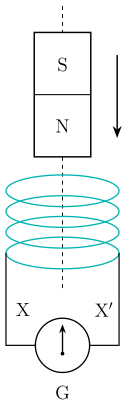 (A) Deflects towards X'
(B) Does not deflect
(C) Oscillates
(D) Deflects towards X
(A) Deflects towards X'
(B) Does not deflect
(C) Oscillates
(D) Deflects towards X›Reveal solutionSolution
Reversing the direction of the flux change reverses the sign of the induced emf (Lenz's law), so the pointer swings the other way — towards X'.
Step 1 — The governing law.
Faraday's law of electromagnetic induction with Lenz's sign convention:
ε=−dtdΦB
The minus sign is Lenz's law: the induced current flows in whatever sense opposes the change in flux that caused it. It is a direct statement of conservation of energy — if the current helped the change, the magnet would accelerate on its own and give energy for free.
Step 2 — What happens when the magnet is pushed towards the coil.
As the magnet approaches, the flux linked with the coil increases. The induced current therefore circulates so as to oppose the approach — the face of the coil towards the magnet acquires the same polarity as the approaching pole and repels it. Some definite current direction results, and we are told the galvanometer reads this as a deflection towards X.
Step 3 — What happens when the magnet is pulled away.
Now the flux linked with the coil decreases. Lenz's law again demands opposition, but the change to be opposed is the opposite one: the coil now tries to hold the magnet back, so the face towards the magnet takes the opposite polarity and attracts it.
Since the sign of dΦB/dt has flipped from positive to negative, the sign of ε flips too, and the induced current reverses direction in the coil and hence through the galvanometer.
Step 4 — Read the galvanometer.
A galvanometer is a centre-zero, direction-sensitive instrument: reversing the current through it reverses the side to which the pointer swings. Pushing in → X; therefore pulling out → the other side, X'.
Step 5 — Reject the rest.
- (B) "Does not deflect" — wrong: the flux is still changing, so an emf and a current definitely exist.
- (C) "Oscillates" — wrong: the flux changes steadily in one sense during withdrawal, giving a steady one-way current, not an alternating one.
- (D) "Deflects towards X" — wrong: that would mean the current direction is unchanged, which contradicts Lenz's law.
✓Final answerThe correct option is (A) — Deflects towards X' (the current reverses, because the flux is now decreasing instead of increasing).
ANSWER: A
- COMEDK 2025Set 2025-A1 markMCQQ.For a short magnet, the magnetic field on the axial line at a distance 10 cm from its centre is 1.6 m×10−7 T. What is the magnetic field on its equatorial line at the same distance 10 cm from its centre? (A) 4.8×10⁻⁷T (B) 3.2×10⁻⁸T (C) 1.6×10⁻⁷T (D) 0.8×10⁻⁷T
›Reveal solutionSolution
For a short bar magnet, the axial field is twice the equatorial field at the same distance. Given axial field = 1.6×10⁻⁷T, the equatorial field is 0.8×10⁻⁷T, so the correct option is (D).
Concept & Intuition
A short bar magnet produces a magnetic field that is not isotropic — it is stronger along the axis (the line through the north and south poles) than along the equatorial line (the perpendicular bisector). For a point at the same distance from the centre, the axial field is exactly twice the equatorial field. This comes from the geometry of the dipole field: on the axis, the contributions from both poles add constructively; on the equator, they partially cancel. So if you know one, you immediately know the other — no need to re-derive from scratch.
Step-by-step reasoning
- Recall the standard formulas for a short bar magnet
For a magnetic dipole of moment M, at a distance r from the centre (where r is much larger than the magnet’s length), the field magnitudes are:
- On the axial line:
Baxial=4πμ0⋅r32M
- On the equatorial line:
Bequatorial=4πμ0⋅r3M
- Compare the two expressions Dividing the axial by the equatorial:
BequatorialBaxial=M/r32M/r3=2
Hence,
Baxial=2⋅Bequatorial
or equivalently,
Bequatorial=21Baxial
- Apply the given data The axial field at 10 cm is 1.6×10⁻⁷T. Therefore:
Bequatorial=21×1.6×10−7=0.8×10⁻⁷T
- Match with the options The value 0.8×10⁻⁷T corresponds to option (D).
Watch outA common mistake is to think the equatorial field is zero or to confuse the factor — some students recall the electric dipole analogy incorrectly. For a magnetic dipole, the axial field is double the equatorial field, not equal or half.
TipYou don’t need to compute μ0 or M at all. The ratio is fixed for a short dipole, so the problem reduces to a simple halving.
✓Final answerThe correct option is (D).
ANSWER: D
- Recall the standard formulas for a short bar magnet
For a magnetic dipole of moment M, at a distance r from the centre (where r is much larger than the magnet’s length), the field magnitudes are:
- KCET 2023Set A-31 markMCQQ.The torque acting on a magnetic dipole placed in uniform magnetic field is zero, when the angle between the dipole axis and the magnetic field is (A) 45∘ (B) 60∘ (C) 90∘ (D) zero
›Reveal solutionSolution
τ=m×B, so τ=mBsinθ=0 when θ=0.
Step 1 — The torque law.
A magnetic dipole of moment m in a uniform field B feels no net force, but it does feel a couple:
τ=m×B,∣τ∣=mBsinθ,
where θ is the angle between the dipole axis m and B. The cross product is what makes the torque vanish when the two vectors are parallel.
Step 2 — Set the torque to zero.
mBsinθ=0⟹sinθ=0⟹θ=0∘ (or 180∘).
Step 3 — Check the given options.
θ=45∘: τ=21mB=0;θ=60∘: τ=23mB=0;
θ=90∘: τ=mB(maximum, not zero);θ=0∘: τ=0.✓
Physically: when the dipole is already aligned with the field it is in its stable equilibrium position — there is nothing left to rotate it. The 90∘ option is the classic trap, because that is where the torque is largest.
✓Final answerThe correct option is (D) — zero.
ANSWER: D
- COMEDK 2023Set 2023-E1 markMCQQ.Find the pole strength of a magnet of length 2 cm, if the magnetic field strength B at distance 10 cm from the centre of a magnet on the axial line of the magnet is 10−4 T. (A) 25 Am (B) 100 Am (C) 5×10⁻² Am (D) 1×10⁻⁴ Am
›Reveal solutionSolution
Using the axial field of a bar magnet, B=4πμ0d32M with M=m⋅2l, the pole strength comes out to m≈25 Am.
Magnetic moment M=m×(2l), where 2l=2 cm =0.02 m is the magnet length and m the pole strength. Distance d=10 cm =0.1 m.
For a short magnet, axial field:
B=4πμ0d32M=10−7⋅(0.1)32m(0.02).
Set B=10−4 T:
10−4=10−7⋅10−30.04m=10−7⋅40m=4×10⁻⁶m.
m=4×10−610−4=25 Am.
(Using the exact axial formula B=4πμ0(d2−l2)22Md gives essentially the same m≈25 Am.)
✓Final answerThe correct option is (A) — 25Am
- COMEDK 2023Set 2023-M1 markMCQQ.If θ1 and θ2 be the apparent angles of dip observed in two vertical planes at right angles to each other, then the true angle of dipθ is given by (A) cot2θ=cot2θ1+cot2θ2 (B) tan2θ=tan2θ1+tan2θ2 (C) cot2θ=cot2θ1−cot2θ2 (D) tan2θ=tan2θ1−tan2θ2
›Reveal solutionSolution
The true dip relates to the two perpendicular apparent dips by cot2θ=cot2θ1+cot2θ2.
Let the total field be B, its horizontal component BH and vertical component BV, so tanθ=BV/BH. In a vertical plane making angle α with the magnetic meridian, the effective horizontal component is BHcosα, while the vertical component is unchanged, giving apparent dip
tanθ1=BHcosαBV,tanθ2=BHcos(90∘−α)BV=BHsinαBV.
Hence
cot2θ1+cot2θ2=BV2BH2cos2α+BV2BH2sin2α=BV2BH2=cot2θ.
✓Final answerThe correct option is (A) — cot2θ=cot2θ1+cot2θ2
- COMEDK 2022Set 20221 markMCQQ.A bar magnet of length 6 cm, is placed in the magnetic meridian with N pole, pointing towards the geographical north. Two neutral points, separated by a distance of 8 cm are obtained on the equitorial axis of the magnet. If BH=1.2×10⁻⁵ T. Then the pole strength of the magnet is (A) 0.75 A-m2 (B) 0.25 A-m2 (C) 0.50 A-m2 (D) 1.50 A-m2
›Reveal solutionSolution
(The option's unit A-m^2 is a misprint; the numerical value is 0.25.)
Concept: neutral points occur where the magnet's field exactly cancels the horizontal component of the Earth's field. With the N pole pointing geographic north, the neutral points lie on the EQUATORIAL line of the magnet.
Geometry:
magnet length 2l = 6 cm -> l = 3 cm = 0.03 m
the two neutral points are 8 cm apart, symmetric about the centre -> d = 4 cm = 0.04 m
Equatorial field of a bar magnet:
B = (mu0/4pi) M / (d^2 + l^2)^(3/2) = B_H
d^2 + l^2 = (0.04)^2 + (0.03)^2 = 0.0016 + 0.0009 = 0.0025 m^2
(d^2 + l^2)^(3/2) = (0.05)^3 = 1.25 x 10^-4 m^3
10^-7 x M / (1.25 x 10^-4) = 1.2 x 10^-5
M = 1.2 x 10^-5 x 1.25 x 10^-4 / 10^-7 = 1.5 x 10^-2 A m^2
Pole strength:
m = M / (2l) = 1.5 x 10^-2 / 0.06 = 0.25 A m
(The option's unit A-m^2 is a misprint; the numerical value is 0.25.)
✓Final answerThe correct option is (B) — 0.25 A-m2
ANSWER: B
- KCET 2021Set B-21 markMCQQ.A toroid with thick windings of N turns has inner and outer radii R1 and R2 respectively. If it carries certain steady current I, the variation of the magnetic field due to the toroid with radial distance is correctly graphed in
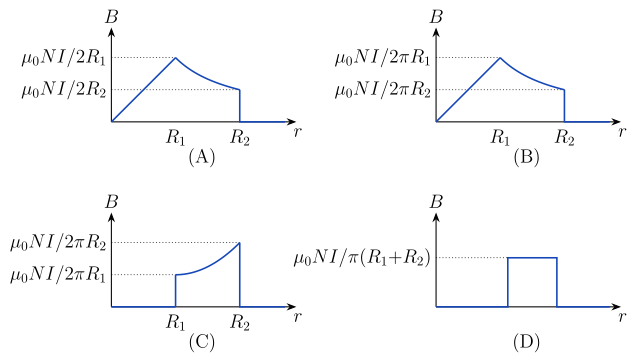 (A)
(B)
(C)
(D)
(A)
(B)
(C)
(D)›Reveal solutionSolution
Apply Ampère's law to the toroid: B is non-zero only inside the core, where B=μ0NI/2πr; at the mean radius this is the constant μ0NI/π(R1+R2) — the flat plateau of graph (D).
Step 1 — Where the field exists. Choose a circular Amperian loop of radius r concentric with the toroid. For r<R1 (the central hole) the loop encloses no current, so B=0. For r>R2 (outside) each winding's current is enclosed once going in and once coming out, so the net enclosed current is again zero and B=0. Only for R1<r<R2 (inside the core) does the loop enclose the full NI.
Step 2 — The field inside the core. Ampère's law on that loop gives B(2πr)=μ0NI, so B=2πrμ0NI.
Step 3 — The mean-radius value. For a toroid the field is customarily quoted at the mean radius rˉ=2R1+R2:
B=2πrˉμ0NI=π(R1+R2)μ0NI
Graph (D) plots exactly this: B constant at π(R1+R2)μ0NI across the core band and zero on either side.
Why the other graphs are wrong. (A) and (B) show B rising from r=0 — but the field in the central hole is exactly zero (no enclosed current), and (A)'s printed levels μ0NI/2R even omit the π. (C) shows B increasing from R1 to R2 — but B∝1/r can only decrease with r.
(Strictly, B falls as 1/r from μ0NI/2πR1 to μ0NI/2πR2 across the core; the official answer uses the standard mean-radius idealisation, which treats B as uniform at its mean value — the only option drawn to that model, at the exact printed value.)
✓Final answer(D)
- KCET 2021Set B-21 markMCQQ.Earth’s magnetic field always has a horizontal component except at (A) equator (B) magnetic poles (C) a latitude of 60∘ (D) an altitude of 60∘
›Reveal solutionSolution
H=Bcosδ is zero only when the dip δ=90∘, which occurs at the magnetic poles where the Earth's field is purely vertical.
1. Resolve the Earth's field into components
At any place on the Earth the total field B makes an angle δ (the angle of dip or inclination) with the horizontal. Resolving:
H=Bcosδ(horizontal component)
V=Bsinδ(vertical component)
with
tanδ=HV,B=H2+V2
2. When can H be zero?
Since B=0 anywhere on Earth,
H=0⟺cosδ=0⟺δ=90∘
A dip of 90∘ means the field is entirely vertical — the needle of a dip circle stands straight up. This is precisely the definition of the magnetic poles of the Earth. (There, a freely suspended compass needle has no horizontal direction to point in, which is why an ordinary compass is useless at the magnetic poles.)
3. Check the other options
- (A) Equator — at the magnetic equator δ=0∘, so H=Bcos0∘=B and V=0. The field is entirely horizontal: this is the place where H is maximum, the exact opposite of what is asked. ✗
- (C) A latitude of 60∘ — using the dipole relation tanδ=2tanλ, a magnetic latitude λ=60∘ gives tanδ=2tan60∘=3.46, so δ≈74∘ — large, but cos74∘=0, so H is small yet non-zero. ✗
- (D) An altitude of 60∘ — "altitude" is not even a meaningful parameter for the dip; changing height above the ground does not tilt the field to vertical. ✗
✓Final answerThe correct option is (B) — magnetic poles.
ANSWER: B
🎓Unlock everything free for 14 days
- ✓Full step-by-step solutions
- ✓Concept-first explanations
- ✓Methods, shortcuts & mistakes
- ✓PYQ mapping + timed mock tests
Full access for 14 days. No credit card required.