Physics · Ch 5 — Magnetism and Matter
The Bar Magnet
The Bar Magnet
The Bar Magnet: An Introduction
A bar magnet is the simplest example of a magnetic dipole. Its behavior can be understood by analogy with an electric dipole, but with magnetic poles instead of electric charges.
Key Observations from Iron Filings
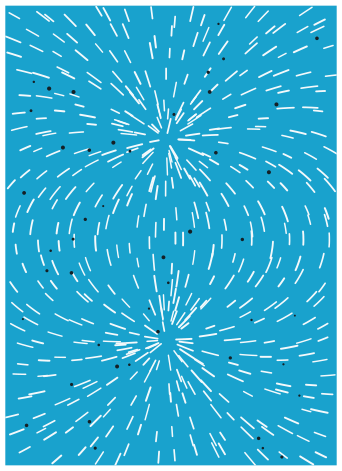
- When iron filings are sprinkled on a glass sheet placed over a short bar magnet, they arrange themselves in a characteristic pattern.
- This pattern reveals that the magnet has two poles — similar to the positive and negative charges of an electric dipole.
- The poles are designated as the North pole and the South pole.
- When suspended freely, the North pole points approximately towards the geographic north pole, and the South pole points towards the geographic south pole.
- A similar pattern of iron filings is observed around a current-carrying solenoid, indicating that a solenoid behaves like a bar magnet.
Physical Explanation
- The bar magnet produces a magnetic field in the space around it. …
Drawn by us to help you understand the concept clearly, and verified to make sure it's accurate. For exams, practice from your textbook's own diagram.
The figure shows a single, static illustration of iron filings sprinkled on a glass sheet placed over a short bar magnet. The magnet is oriented vertically beneath the sheet. The filings have self-organised into a pattern of curved arcs. Two dense, radiating clusters of filings appear — one near the top end of the magnet and one near the bottom end — fanning outward like a starburst. Between these two clusters, the filings form smooth, curved arcs that bulge outward to the left and right. No labels (N/S) are printed on the figure; the two-pole structure is implied by the symmetry of the pattern.
What the pattern teaches: The iron filings trace the magnetic field lines of the bar magnet. The two dense clusters correspond to the poles of the magnet — the regions where the field is strongest and lines converge or diverge. The smooth arcs between the poles show that the field lines emerge from one pole, curve through space, and re-enter the other pole. This pattern is identical in shape to the electric field lines of an electric dipole (two equal and opposite charges separated by a small distance). Thus, the bar magnet behaves as a magnetic dipole.
Key formula developed from this figure: The magnetic field at a point on the axial line (the line passing through both poles) of a bar magnet of magnetic dipole moment is given by:
where:
- is the magnetic field vector at a point on the axis,
- is the permeability of free space,
- is the magnetic dipole moment of the bar magnet (magnitude , where is the pole strength and is the separation between poles),
- is the distance from the centre of the magnet to the point (for ).
On the equatorial line (the perpendicular bisector of the magnet), the field is: …